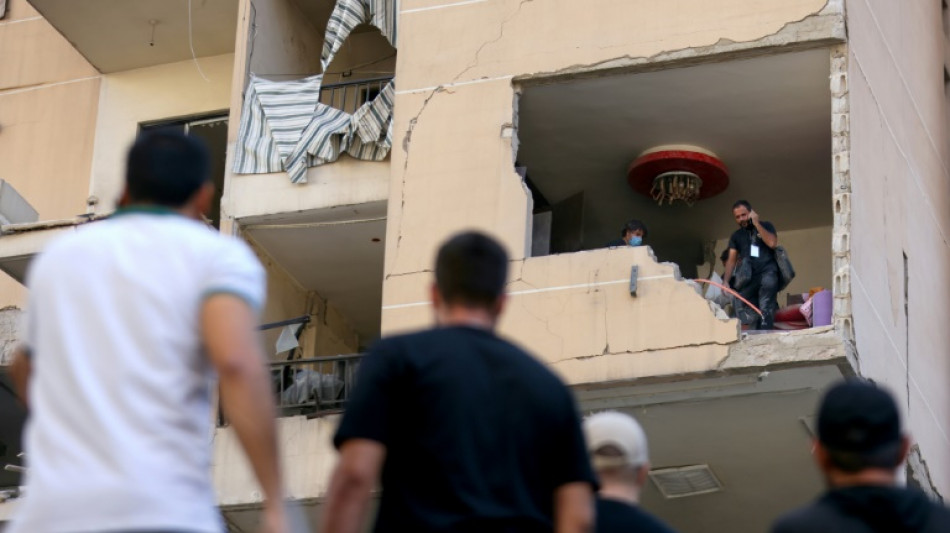
Tired, traumatised Lebanese fear new Israel-Hezbollah war / Photo: Ibrahim AMRO - AFP

 Iranian satire 'Head to Head' draws a veil over the men
 Archaeological 'breakthrough' could confirm origins of Paris
 Morocco elects new parliament with lowest turnout in nearly two decades

 North Korean IT contractor found remote work in New Zealand: agency
 Anthropic touts AI-led biology discovery
 Giants QB Dart to have season-ending surgery
 Venezuelan shot by ICE needs urgent surgery, mother tells AFP

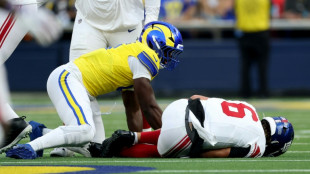 Giants QB Dart to have season-ending surgery: reports

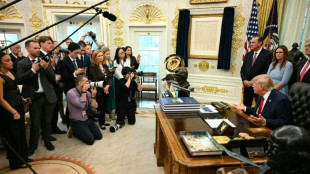 Judge urged to lift Trump's White House ban on media outlets
 Stocks fall on soaring bond yields, higher oil prices
 US judge weighing Trump's White House ban on media outlets
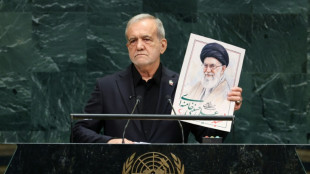
 At UN, OpenAI's Altman calls 'for extreme care' in AI
 Hamilton gives thumbs up to Gulf GPs despite Iran conflict
 Leclerc admits going 'too far' in Hamilton shunt in Italy

 Row engulfs Dolly Parton's estate as manager accuses nephew of making threats
 Mandela Digital Extends Early Access Programme to 11 February 2027 Following Strong Response

 US seeks 11th Presidents Cup win in a row over global foes

 McDonald's to boost franchisees as inflation weighs on consumers
 Trump invites Putin to G20 summit in Miami

 Archaelogical 'breakthrough' could confirm origins of Paris

 ILO financial crisis takes centre stage in leadership race

 Stocks dip, oil soars despite Trump hailing "productive" Iran talks

 China's Xi to get rare airport welcome from Trump
 Turkey reassures investors over investment fund crisis
 Saka says England still have 'scar' from World Cup semi-final loss
Lebanese businessman Anis Rubeiz has lived through conflict and crisis in his country but now sees no hope as all-out war between Israel and Hezbollah appears closer than ever.
"Everything is collapsing around us," said Rubeiz, 55, in Beirut's Christian-majority Ashrafieh district, criticising what he said were attempts to drag Lebanon into a war it could do without.
Lebanon is crushed by a five-year economic collapse and paralysed by a longstanding political deadlock.
Now it faces the prospect of all-out war between Israel and Hezbollah, which have been trading near-daily fire since war in Gaza broke out in October.
But the situation spiralled dramatically since last week, with hundreds dead in Israeli air strikes on Monday alone, the deadliest day since Lebanon's 1975-90 civil war.
Lebanon "can't handle" a war, said Rubeiz, who owns a real estate company.
"People are tired mentally... I don't see (hope) on the horizon... or even a ray of light."
In Beirut, the streets were relatively calm, after schools and universities closed, with some education facilities turned into makeshift shelters for the tens of thousands who have fled for their lives.
But people are apprehensive, and everyone is talking about the risk of disaster. Many have vivid memories of 2006 when Israel and Hezbollah last went to war, or the civil war before that.
"I'm basically ready in case war erupts -- I packed my bag with my children's identity papers and passports and clothes, and put them next to the door," said Abir Khater, 43, outside a shopping centre.
The store manager and mother of three said she moved her family from their home near Beirut's southern suburbs, which has seen several Israeli strikes since Friday, to Bhamdoun in the mountains outside the capital.
- 'Afraid' -
"I'm afraid just one missile will hit by mistake. Nobody knows what could happen to us," she said.
Her children are still traumatised after a catastrophic industrial explosion at Beirut's port in 2020, and the sectarian violence that has occasionally erupted in her area, she said.
During the 2006 war, "I wasn't married... but now I'm really afraid for my children", she said.
That month-long conflict killed around 1,200 people in Lebanon, mostly civilians, and 160 in Israel, mostly soldiers. It left enormous damage including to roads and other infrastructure.
Opinions on Hezbollah's actions have been divided since October when the Iran-backed group began its cross-border attacks on Israel in support of Palestinian Hamas militants fighting Israel in the Gaza Strip.
In Ashrafieh's Sassine Square, where an enormous Lebanese flag flies overhead, Mohammed Khalil was sitting on a bench, worrying about how to find a job and provide for his family.
"I need to rebuild my life," said the 33-year-old, who fled with his wife and three children from their village in the southern district of Nabatiyeh this week.
With so many other people also leaving, it took them two days to reach Beirut, a trip that would normally take a couple of hours at most.
"I have children. They need to go to school, I'm thinking of their future... but I hit a dead end," said Khalil, who has previously worked manual jobs.
- 'Rebuild' -
He said Hezbollah should respond after "what has happened to the people from the south", adding defiantly that "our side will win" in any case.
Everything is in "sacrifice for the resistance", he added, referring to Hezbollah.
A deep political crisis has left Lebanon without a president for almost two years, with Hezbollah allies and their opponents deadlocked, unable to reach a consensus.
The Shiite Muslim movement wields huge influence in Lebanon, while detractors accuse it of being a state within a state and of making unilateral decisions that mean the difference between war and peace.
Nina Rufayel, a teacher in her 50s, expressed solidarity with Lebanese from the south, but said she was worried about further escalation.
"I'm fearful for tomorrow. Who will rebuild... feed us, teach" our children, she asked.
"I'm not just afraid of whether war will break out or not, I'm afraid the whole country will be wiped off the map," she said.
Ghada Hatoum, who was walking in Beirut's Hamra shopping district, said "Hezbollah is not a state that can take the decision between war and peace -- it is a parallel entity to the state".
"It has shown its people (supporters)... that it took the wrong decision," she said, referring to its move to begin attacking Israel.
"Nobody is ready for war or has built a shelter. Are our lives that cheap? Are weapons worth more than lives?" she said, adding: "If I don't have a shelter to hide in, why drag me into war?"
N.AbuHussein--SF-PST