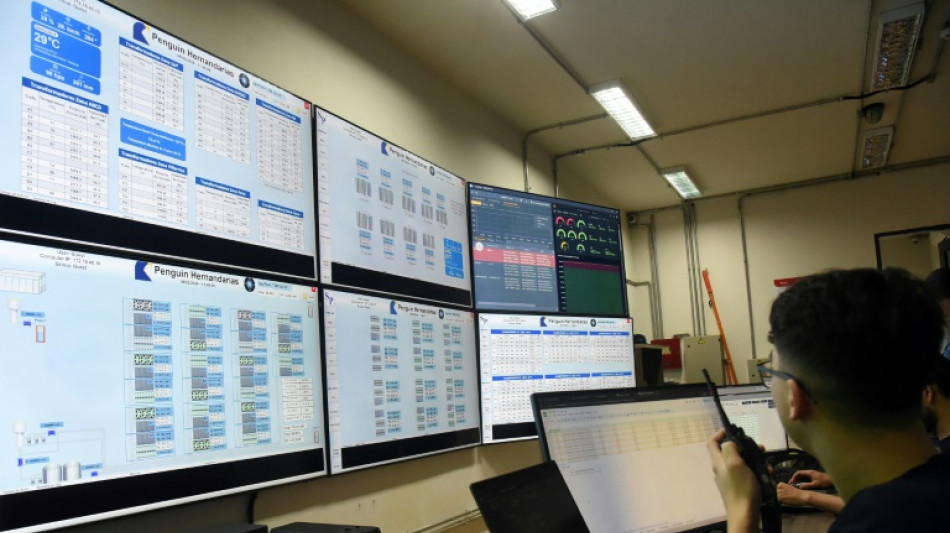
Cryptocurrency platform boss urges tighter regulation / Photo: DANIEL DUARTE - AFP

 Iranian satire 'Head to Head' draws a veil over the men

 Archaeological 'breakthrough' could confirm origins of Paris

 Morocco elects new parliament with lowest turnout in nearly two decades
 North Korean IT contractor found remote work in New Zealand: agency

 Anthropic touts AI-led biology discovery

 Giants QB Dart to have season-ending surgery

 Venezuelan shot by ICE needs urgent surgery, mother tells AFP

 Giants QB Dart to have season-ending surgery: reports

 Judge urged to lift Trump's White House ban on media outlets

 Stocks fall on soaring bond yields, higher oil prices

 US judge weighing Trump's White House ban on media outlets

 At UN, OpenAI's Altman calls 'for extreme care' in AI

 Hamilton gives thumbs up to Gulf GPs despite Iran conflict

 Leclerc admits going 'too far' in Hamilton shunt in Italy

 Row engulfs Dolly Parton's estate as manager accuses nephew of making threats

 Mandela Digital Extends Early Access Programme to 11 February 2027 Following Strong Response

 US seeks 11th Presidents Cup win in a row over global foes

 McDonald's to boost franchisees as inflation weighs on consumers
 Trump invites Putin to G20 summit in Miami

 Archaelogical 'breakthrough' could confirm origins of Paris

 ILO financial crisis takes centre stage in leadership race

 Stocks dip, oil soars despite Trump hailing "productive" Iran talks

 China's Xi to get rare airport welcome from Trump

 Turkey reassures investors over investment fund crisis
 Saka says England still have 'scar' from World Cup semi-final loss

The co-founder of one of the world's most popular cryptocurrencies called for tighter regulation of the sector to guard against the fraud and wild swings that have dogged it, in an interview with AFP.
Jeremy Allaire of Circle recounted the US firm's decision to offer a stabilised cryptocurrency -- and insisted crypto operators owed it to society to submit to safeguards just as other emerging sectors such as AI must.
"We have social objectives that we have to match against the technology," Allaire said during a visit this week to Circle's European headquarters in Paris.
Circle offers a USDC "stablecoin", pegged to the dollar, as well as a euro-pegged variant, EURC.
Currently, $35.5 billion worth of USDC are in circulation.
As with other cryptocurrencies, transactions are recorded on a decentralised ledger, the blockchain, and not by a bank as is the case with traditional currencies.
However, whereas the dollar value of cryptocurrencies such as bitcoin tends to fluctuate, often wildly, the creators of stablecoins actively target a stable value.
In a world propelled by technological development, Allaire said, safeguards are vital for such activities.
"If I'm writing software to control a ballistic missile system, that should be regulated activity," said Allaire.
"If I'm writing a large language model and deploying that, and it has the potential to do very problematic things in society, there need to be rules that need to be assessed. Crypto is the same thing."
- Crypto fraud, ransomware -
Cryptocurrencies have made headlines since their creation, from their extreme volatility to the collapse of several industry giants, foremost among them the FTX exchange platform.
The best-known cyptocurrency, bitcoin, remains the currency of choice for paying on the dark web without leaving any trace.
It is used for extorting funds via ransomware attacks, which block access to victims' computer systems and demand a ransom payment.
According to a recent report by Chainanalysis, the first half of 2024 was marked by a decrease in illicit activities. However, over that period, $460 million was paid out for ransomware, a rise of two percent on a year earlier.
Crypto exhanges operate through open-source software, Allaire noted.
"That helps with transparency, visibility, security, other things."
But some have been "using the technology to do things outside of any kind of supervision", he conceded.
"You've seen fraud, abuse. You've seen people running off with money."
When cryptocurrency emerged, "unregulated intermediaries" sprang up in the sector, he said.
"Of course, the risks they take... in many cases, have led to significant losses," Allaire said.
"But that's not an argument against the technology. That's an argument against humans. And it's an argument for better supervision."
- EU, US crypto regulations -
Regulators across the globe have taken note.
Last year the European Parliament adopted an EU-wide framework for crypto asset markets, "MiCA" -- Markets in Crypto-Assets -- requiring mandatory approval for digital-asset service providers.
In July, Circle announced it was the first "stablecoin" issuer to comply with this new regulation.
Stablecoins are used to facilitate intra-crypto exchanges by investors without having to go through a bank.
But they also give users access to a product pegged to the dollar without having a bank account in the United States, and allow cross-border payments or money transfers.
In the United States too, greater regulation is on the agenda.
US presidential candidate Kamala Harris was quoted as telling Bloomberg last week: "We will encourage innovative technologies like AI and digital assets, while protecting our consumers and investors."
In May the US House of Representatives passed a legal framework designed to regulate the crypto market -- the Financial Innovation and Technology for the 21st Century Act.
Circle is meanwhile preparing to move its headquarters from Boston to New York City - "at the very top of the World Trade Center... the very heart of the dollar international system," says Allaire.
"That's in part symbolic. It's also who we are, what we're doing. We're building, hopefully, the world's leading digital dollar and upgrading to this new internet financial system."
F.AbuShamala--SF-PST