Hamas weakened, not crushed a year into war with Israel / Photo: Omar AL-QATTAA - AFP/File

 North Korea to keep nuclear weapons 'forever': foreign minister

 Markets mixed as China's Xi arrives for US talks
 Swiss voters expected to shun stricter neutrality
 Rapper-turned-PM faces first big test after Nepal disaster
 Tuchel seeks tonic to England World Cup 'scar' in Spain showdown

 'Helps me cope': Catholic baptisms rise among French youth

 Colombians in Santa Marta stay inside after violence wracks the city

 Iran airlines cancel flights as US sanctions hit

 Meta launches camera-free AI glasses amid privacy pushback

 Australian PM says OpenAI hacked government health website

 Xi arrives in US to personal Trump welcome

 Morocco elects new parliament amid social frustration, youth discontent

 Scheffler and Burns to face Im and Lee in Presidents Cup opener

 Crushing wins for Lyon and Barca in women's Champions League

 Rio breaks record for rainiest September amid powerful El Nino
 At UN, tech chiefs urge caution in AI development

 Russian strikes kill seven in Ukraine, Zelensky vows winter campaign

 Venezuelan shot by ICE needs urgent medical care, mother tells AFP

 Zelensky says Putin using fighters from 47 countries in Ukraine war

 Klopp calls on Germany to 'rise above ourselves' as new era begins

 Russian strikes kill seven in Ukraine as Russia vows no 'pause' to war

 ArcPoint Expands Globally with Institutional Intelligence Platform for Modern Investors

 Ronaldo focussing on 'present' ahead of Wales test

 Outgoing UN chief makes final climate push at New York summit

 Grief and pain flow at hearing for Canadian suicide poison vendor

Israel's military campaign to eradicate Hamas in retaliation for the October 7 attack has weakened it by killing several of its leaders and thousands of fighters, and by reducing swaths of the territory it rules to rubble.
But the Palestinian militant group has not been crushed outright, and a year on from its unprecedented attack on Israel, an end to its hold over Gaza remains elusive.
Hamas sparked the Gaza war by sending hundreds of fighters across the border into Israel on October 7, 2023, to attack communities in the south.
The attack resulted in the deaths of 1,205 people, most of them civilians, according to an AFP tally based on official Israeli figures, which include hostages killed in captivity.
Vowing to crush Hamas and bring the hostages home, Israel launched a military campaign in the Gaza Strip from the land, sea and air.
According to data provided by the health ministry of Hamas-run Gaza, the war has killed more than 41,000 people, the majority civilians. The United Nations has acknowledged these figures to be reliable.
- Dead leader -
In one of the biggest blows to the militant movement since it was founded in 1987 during the Palestinian intifada uprising, Hamas's leader Ismail Haniyeh was assassinated in Iran on July 31.
Both Hamas and its backer Iran accused Israel of killing Haniyeh, though Israel has not commented.
After Haniyeh's death, Hamas named Yahya Sinwar, whom Israel accuses of masterminding the October 7 attack, as its new leader.
On the Gaza battlefield, Israeli forces have aggressively pursued both Sinwar and Hamas military chief Mohammed Deif, whom Israel says it killed in an air strike.
Hamas says Deif is still alive.
"Commander Mohammed Deif is still giving orders," a source in Hamas's armed wing, the Ezzedine Al-Qassam Brigades, told AFP on condition of anonymity as he was not authorised to speak to media on the matter.
- 'Number one target' -
A senior Hamas official who also asked not to be named described Sinwar, who has not been seen in public since the start of the war, as a "supreme commander" who leads "both the military and political wings" of Hamas.
"A team is dedicated to his security because he is the enemy's number one target," the official said.
In August, Israeli officials reported the dead in Gaza included more than 17,000 Palestinian militants.
A senior Hamas official acknowledged that "several thousand fighters from the movement and other resistance groups died in combat".
Despite its huge losses, the source in the group's armed wing still gloated over the intelligence and security failure that the October 7 attack was for Israel.
"It claims to know everything but on October 7 the enemy saw nothing," he said.
Israel has its own reading of where Hamas now stands.
In September, Defence Minister Yoav Gallant said that Hamas "as a military formation no longer exists".
Bruce Hoffman, a researcher at the Council on Foreign Relations, said that Israel's offensive has dealt a "grievous but not a crushing blow" to Hamas.
- 'Political suicide' -
Hamas has controlled Gaza and run its institutions single-handedly since 2007, after winning a legislative election a year earlier and crushing its Palestinian rivals Fatah in street battles.
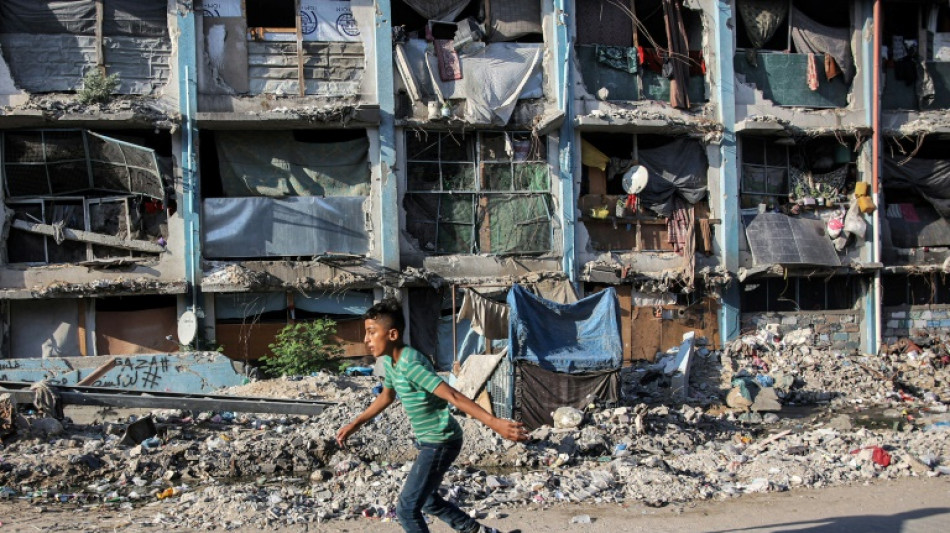
Now, most of Gaza's institutions have either been damaged or destroyed.
Israel accuses Hamas of using schools, health facilities and other civilian infrastructure to conduct operations, a claim Hamas denies.
The war has left no part of Gaza safe from bombardment: schools turned into shelters for the displaced have been hit, as have healthcare facilities.
Hundreds of thousands of children have not gone to school in nearly a year, while universities, power plants, water pumping stations and police stations are no longer operational.
By mid-2024, Gaza's economy had been reduced to a "less than one-sixth of its 2022 level," according to a UN report that said would take "decades to bring Gaza back" to its pre-October 7 state.
The collapse has fuelled widespread discontent among Gaza's 2.4 million people, two-thirds of whom were already poor before the war, according to Mukhaimer Abu Saada, a political researcher at Al-Azhar University in Cairo.
"The criticism is harsh," he told AFP.
His colleague Jamal al-Fadi branded the October 7 attack as "political suicide for Hamas", which has now "found itself isolated".
Hamas political bureau member Bassem Naim dismissed the assessment.
"While some may not agree with Hamas's political views, the resistance and its project continue to enjoy widespread support," said Naim, who like several other self-exiled Hamas leaders lives in Qatar.
A poll by the Palestinian Center for Policy and Survey Research in June showed that 67 percent of those surveyed in the Israeli-occupied West Bank believe that Hamas will eventually defeat Israel.
However, in Gaza itself that figure is lower: just 48 percent.
Y.Shaath--SF-PST