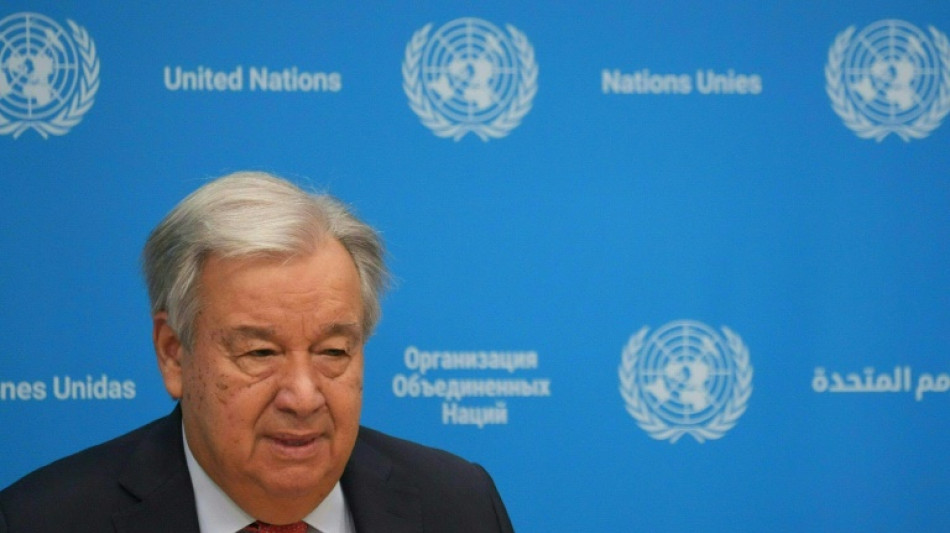
UN holds 'Summit of the Future' to tackle global crises / Photo: Bryan R. SMITH - AFP

 As Moscow steps up attacks, Kyiv residents brace for harsh winter
 Comic inspires unlikely kabaddi dreams for Japan's Asian Games amateurs

 Thailand slams chaotic Asian Games organisation as 'musical chairs'
 North Korea to keep nuclear weapons 'forever': foreign minister
 Markets mixed as China's Xi arrives for US talks
 Swiss voters expected to shun stricter neutrality
 Rapper-turned-PM faces first big test after Nepal disaster
 Tuchel seeks tonic to England World Cup 'scar' in Spain showdown

 'Helps me cope': Catholic baptisms rise among French youth
 Colombians in Santa Marta stay inside after violence wracks the city
 Iran airlines cancel flights as US sanctions hit
 Meta launches camera-free AI glasses amid privacy pushback
 Australian PM says OpenAI hacked government health website

 Xi arrives in US to personal Trump welcome

 Morocco elects new parliament amid social frustration, youth discontent
 Scheffler and Burns to face Im and Lee in Presidents Cup opener

 Crushing wins for Lyon and Barca in women's Champions League
 Rio breaks record for rainiest September amid powerful El Nino
 At UN, tech chiefs urge caution in AI development
 Russian strikes kill seven in Ukraine, Zelensky vows winter campaign
 Venezuelan shot by ICE needs urgent medical care, mother tells AFP
 Zelensky says Putin using fighters from 47 countries in Ukraine war
 Klopp calls on Germany to 'rise above ourselves' as new era begins

 Russian strikes kill seven in Ukraine as Russia vows no 'pause' to war
 ArcPoint Expands Globally with Institutional Intelligence Platform for Modern Investors

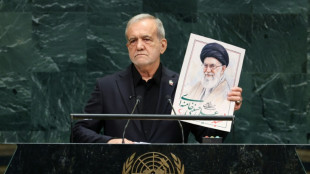
Global leaders are gathering in New York on Sunday for a "Summit of the Future" aimed at addressing 21st-century challenges ranging from conflict to climate, amid skepticism over whether the final pact will meet its lofty goals.
United Nations Secretary-General Antonio Guterres first proposed the meeting in 2021, billing it as a "once-in-a-generation opportunity" to reshape human history by rekindling international cooperation.
As an opening act for the annual high-level week of the UN General Assembly, which begins Tuesday, dozens of heads of state and government are expected to adopt a "Pact for the Future" on Sunday.
But after intense last-minute negotiations, Guterres expressed some frustration, urging nations to show "vision" and "courage," and calling for "maximum ambition" to strengthen international institutions that struggle to respond effectively to today's threats.
In the latest version of the text that will be submitted for adoption, leaders pledge to bolster the multilateral system to "keep pace with a changing world" and to "protect the needs and interests of current and future generations" facing "persistent crisis."
"We believe there is a path to a brighter future for all of humanity," the document says.
Spanning nearly 30 pages, the pact outlines 56 "actions," including commitments to multilateralism, upholding the UN Charter and peacekeeping.
It also calls for reforms to international financial institutions and the UN Security Council, along with renewed efforts to combat climate change, promote disarmament, and guide the development of artificial intelligence.
- Words to action -
Even though there are some "good ideas," the text "is not the sort of revolutionary document reforming the whole of multilateralism that Antonio Guterres had originally called for," Richard Gowan of the International Crisis Group told AFP.
The sentiment is widely shared among diplomats, many of whom express frustration when discussing the ambition and impact of the text, describing it as "lukewarm," "the lowest common denominator," and "disappointing."
"Ideally, you would hope for new ideas, fresh ideas. You know, 2.0 and then some. But when you have 200 countries that all have to agree, you end up with a Christmas tree of everything," said one diplomat.
After intense negotiations in recent days, Russia still has objections to the final version of the text published on Saturday, a diplomatic source told AFP. While the pact is expected to be adopted, its approval isn't guaranteed.
The fight against global warming was one of the sticking points in the negotiations, with references to the "transition" away from fossil fuels having disappeared from the draft text weeks ago, before being re-inserted.
Despite the criticism, it is still "an opportunity to affirm our collective commitment to multilateralism, even in the difficult current geopolitical context," one Western diplomat said, emphasizing the need to rebuild trust between the Global North and South.
Developing countries have been particularly vocal in demanding concrete commitments on the reform of international financial institutions, aiming to secure easier access to preferential financing, especially in light of the impacts of climate change.
The text does indeed include "important commitments on economic justice and reforming the international financial architecture," Human Rights Watch (HRW) commented, while also praising "the centrality of human rights."
However, world leaders "still need to demonstrate that they are willing to act to uphold human rights," said Louis Charbonneau, HRW's UN director.
Regardless of its content, the pact and its annexes -- a Global Digital Compact and a Declaration on Future Generations -- are non-binding, raising concerns about implementation, especially as some principles -- such as the protection of civilians in conflict -- are violated daily.
"Our next task is to breathe life into them, to turn words into action," Guterres urged on Saturday.
Y.Shaath--SF-PST