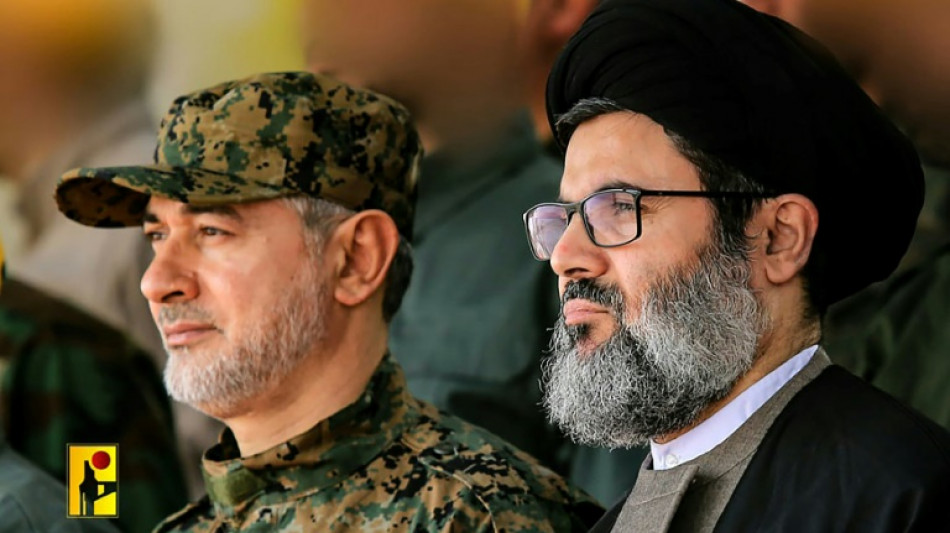
Hezbollah in disarray after Israeli strike kills top commanders / Photo: - - HEZBOLLAH MILITARY MEDIA OFFICE/AFP

 As Moscow steps up attacks, Kyiv residents brace for harsh winter
 Comic inspires unlikely kabaddi dreams for Japan's Asian Games amateurs

 Thailand slams chaotic Asian Games organisation as 'musical chairs'
 North Korea to keep nuclear weapons 'forever': foreign minister
 Markets mixed as China's Xi arrives for US talks
 Swiss voters expected to shun stricter neutrality
 Rapper-turned-PM faces first big test after Nepal disaster
 Tuchel seeks tonic to England World Cup 'scar' in Spain showdown
 'Helps me cope': Catholic baptisms rise among French youth

 Colombians in Santa Marta stay inside after violence wracks the city
 Iran airlines cancel flights as US sanctions hit
 Meta launches camera-free AI glasses amid privacy pushback
 Australian PM says OpenAI hacked government health website

 Xi arrives in US to personal Trump welcome
 Morocco elects new parliament amid social frustration, youth discontent
 Scheffler and Burns to face Im and Lee in Presidents Cup opener
 Crushing wins for Lyon and Barca in women's Champions League
 Rio breaks record for rainiest September amid powerful El Nino
 At UN, tech chiefs urge caution in AI development
 Russian strikes kill seven in Ukraine, Zelensky vows winter campaign
 Venezuelan shot by ICE needs urgent medical care, mother tells AFP
 Zelensky says Putin using fighters from 47 countries in Ukraine war

 Klopp calls on Germany to 'rise above ourselves' as new era begins

 Russian strikes kill seven in Ukraine as Russia vows no 'pause' to war

 ArcPoint Expands Globally with Institutional Intelligence Platform for Modern Investors
Hezbollah was in turmoil Saturday after Israel took out two leaders of its elite operations unit in a strike on a command meeting in a Beirut stronghold that Lebanese authorities said killed 31 people.
Lebanese Health Minister Firass Abiad said three children were among the dead in Friday's strike on an underground meeting room, which AFP journalists said left a huge crater in a densely populated neighbourhood of the capital's southern suburbs.
Israel said the strike killed the head of Hezbollah's elite Radwan Force, Ibrahim Aqil, and several other commanders.
Abiad said emergency services worked "through the night" to recover dead and wounded from the debris, adding that "a residential building collapsed on top of occupants" after the Israeli attack.
The Radwan Force has spearheaded Hezbollah's ground operations, and Israel has repeatedly demanded through international mediators that its fighters be pushed back from the border.
Coming hot on the heels of sabotage attacks on communications devices this week that killed 37 people in Hezbollah strongholds, the strike raised new questions about the Iran-backed group's security arrangements and dealt a heavy blow to its fighters' morale.
Hezbollah said a second senior commander was also killed, naming him as Ahmed Mahmud Wahbi, head of the group's operations against Israel from the onset of the Gaza war in October until the start of this year.
Confirming the death of Aqil, who was wanted by the United States for involvement in the 1983 bombing of the US embassy in Beirut, Hezbollah hailed him as "one of its great leaders".
It was the second Israeli strike on the Hezbollah military leadership since the start of the Gaza war. An Israeli strike on Beirut in July killed Fuad Shukr, a top operations chief for the movement.
It also followed sabotage attacks on pagers and two-way radios used by Hezbollah on Tuesday and Wednesday, which killed 37 people and raised fears of a wider war.
Stephane Dujarric, spokesman for UN Secretary-General Antonio Guterres, said the world body was "very concerned about the heightened escalation" and called for "maximum restraint" from all sides.
The Israeli military said it conducted a "targeted strike" against Aqil, which a source close to Hezbollah said killed a total of 16 Radwan Force members.
"The command of the Radwan Force was meeting in the basement of the building," the source said.
AFP journalists said the strike gutted the lower floors of the tower block.
The United States had offered a $7 million reward for information on Aqil, describing him as a "principal member" of an organisation that claimed the 1983 embassy bombing, which killed 63 people.
- Spearhead -
Israeli troops and Hezbollah fighters have battled each other along the Israel-Lebanon border since Hamas militants triggered the war in Gaza with their October 7 attack.
The focus of Israel's firepower for nearly a year has been on Gaza, but with Hamas much weakened, that focus has now moved to Israel's northern border.
Defence Minister Yoav Gallant said Israel's "enemies" would find no refuge, not even in Beirut's southern suburbs.
Military spokesman Daniel Hagari said Israel was "not aiming for a broad escalation in the region".
But Hamas called it a "brutal and terrorist aggression" and an "escalation".
Iran's foreign ministry accused Israel of seeking to "broaden the geography of the war".
Months of near-daily cross-border exchanges have killed hundreds in Lebanon, mostly fighters, and dozens in Israel, forcing tens of thousands on both sides to flee their homes.
The latest blow to Hezbollah came after thousands of Hezbollah operatives' pagers and walkie-talkies exploded over two days, killing 37 people and wounding thousands.
Hezbollah chief Hassan Nasrallah vowed Thursday that Israel would face retribution for those blasts.
Before Friday's Beirut strike, Israel said Hezbollah had fired dozens of rockets from Lebanon following air attacks that destroyed dozens of the militant group's launchers.
Gallant told troops on Wednesday that "Hezbollah will pay an increasing price" as Israel tries to "ensure the safe return" of its citizens to border areas.
"We are at the start of a new phase in the war," he said.
- 'Fear of wider war' -
Israeli Prime Minister Benjamin Netanyahu delayed by a day his scheduled departure to the United States, where he is due to address the UN General Assembly.
On Friday the UN's High Commissioner for Human Rights, Volker Turk, told the Security Council the attack on Hezbollah communications devices violated international law and could constitute a war crime.
The pagers and walkie-talkies exploded as their users were shopping in supermarkets, walking on streets and attending funerals, plunging Lebanon into panic.
"I am appalled by the breadth and impact of the attacks," said Turk, adding that it "is a war crime to commit violence intended to spread terror among civilians".
International mediators, including the United States, have been scrambling to stop the Gaza war from becoming an all-out regional conflict.
Hamas's October 7 attacks that sparked the war resulted in the deaths of 1,205 people, mostly civilians, on the Israeli side, according to an AFP tally based on Israeli official figures that include hostages killed in captivity.
Israel's retaliatory military offensive has killed at least 41,272 people in Gaza, most of them civilians, according to figures provided by the Hamas-run territory's health ministry. The United Nations has acknowledged the figures as reliable.
burs/kir/srm
D.Qudsi--SF-PST