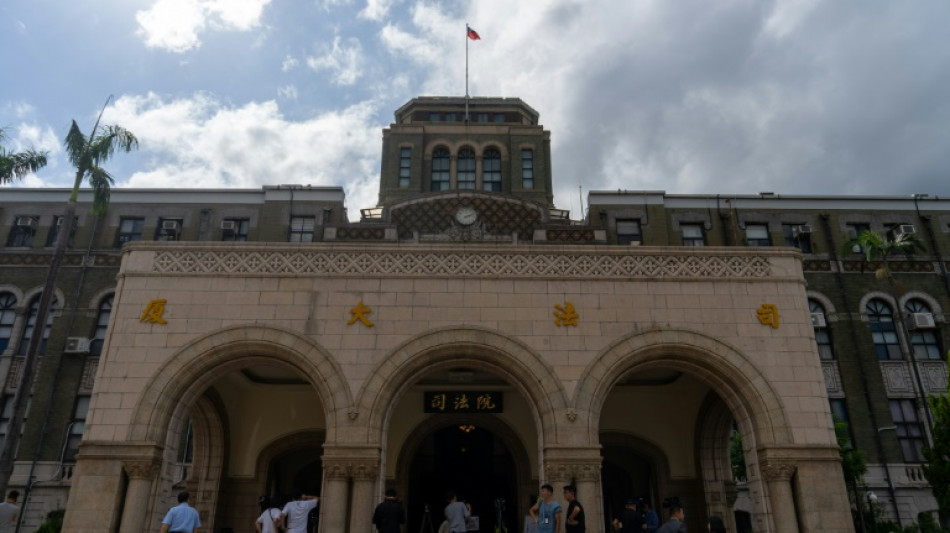
Taiwan retains death penalty but limits use to 'exceptional' cases / Photo: Yan ZHAO - AFP

 As Moscow steps up attacks, Kyiv residents brace for harsh winter

 Comic inspires unlikely kabaddi dreams for Japan's Asian Games amateurs

 Thailand slams chaotic Asian Games organisation as 'musical chairs'

 North Korea to keep nuclear weapons 'forever': foreign minister

 Markets mixed as China's Xi arrives for US talks

 Swiss voters expected to shun stricter neutrality
 Rapper-turned-PM faces first big test after Nepal disaster

 Tuchel seeks tonic to England World Cup 'scar' in Spain showdown

 'Helps me cope': Catholic baptisms rise among French youth

 Colombians in Santa Marta stay inside after violence wracks the city

 Iran airlines cancel flights as US sanctions hit

 Meta launches camera-free AI glasses amid privacy pushback
 Australian PM says OpenAI hacked government health website

 Xi arrives in US to personal Trump welcome

 Morocco elects new parliament amid social frustration, youth discontent
 Scheffler and Burns to face Im and Lee in Presidents Cup opener

 Crushing wins for Lyon and Barca in women's Champions League

 Rio breaks record for rainiest September amid powerful El Nino

 At UN, tech chiefs urge caution in AI development

 Russian strikes kill seven in Ukraine, Zelensky vows winter campaign

 Venezuelan shot by ICE needs urgent medical care, mother tells AFP

 Zelensky says Putin using fighters from 47 countries in Ukraine war

 Klopp calls on Germany to 'rise above ourselves' as new era begins

 Russian strikes kill seven in Ukraine as Russia vows no 'pause' to war

 ArcPoint Expands Globally with Institutional Intelligence Platform for Modern Investors

A Taiwan court decided on Friday to retain capital punishment, but ruled its application should be "limited to special and exceptional circumstances".
Democratic Taiwan has carried out 35 executions since a moratorium on capital punishment was lifted in 2010, with the latest -- that of a 53-year-old man convicted for setting a fire that killed his family -- occurring in April 2020.
Campaigners against the death penalty have long argued that the practice, carried out by shooting an inmate in the heart from behind as they lie face-down on the ground, is an inhumane method of punishment.
The case was brought by the 37 inmates currently on death row in Taiwan to the Constitutional Court, which ruled Friday that it would retain the death penalty.
"However, the death penalty is a capital punishment after all, and its scope of application should still be limited to special and exceptional circumstances," said chief justice Hsu Tzong-li during a lengthy readout of the court's decision.
In a statement, the court said while the right to life will be protected under Taiwan's constitution, "such protection is not absolute".
"The (Taiwan Constitutional Court) emphasized that because death penalty was the most severe punishment and irreversible in nature, its application and procedural safeguard (from investigation to execution) should be reviewed under strict scrutiny," it said in reference to the crime of murder.
However, "the judgement did not address the constitutionality of death penalty in general or imposed on other offences", like treason or drug-related offences.
The court also ruled that imposing the death sentence be "prohibited" for "defendants with mental conditions".
Additionally, death row inmates "should not be executed if they had mental conditions to the extent that have impeded their competency for execution".
Presidential spokeswoman Karen Kuo called the ruling "an important milestone for Taiwan's judiciary".
"The President (Lai Ching-te)... looks forward to the relevant agencies to amend the supporting regulations in accordance with the judgment to meet the values of procedural justice and human rights."
- Popular in Taiwan -
There are about 50 provisions in Taiwan's criminal laws that stipulate capital punishment to be the maximum sentence, and executions are carried out without notice once all appeals have been exhausted.
Capital punishment remains popular in Taiwan, with a recent survey by the Chinese Association for Human Rights showing that 80 percent were in favour of keeping it.
But a lawyer with Judicial Reform Foundation -- which campaigns for the abolition of the death penalty -- said they "regret the ruling".
"From our culture and education, we think there will be better law and order with the death penalty but crime rates didn't increase -- actually it decreased instead -- in recent years when we carried out relatively fewer executions," said Lin Yong-song Friday.
"We regret that the court didn't rule it to be unconstitutional... We will work hard to help people understand the importance of respecting life."
Taiwan is internationally regarded as a bastion of progressive values, as it was the first in Asia in 2019 to legalise marriage equality.
But it remains a "post-Confucian society," said death penalty scholar Jimmy Hsu.
"Revenge as a form of justice in ancient Chinese society -- like avenging the deaths of your father or close relatives -- has been in the centre and strongly supported by the Confucian elite in the old days," he told AFP.
"There are some remnants from the past that still play big roles in the society's self-understanding."
T.Samara--SF-PST