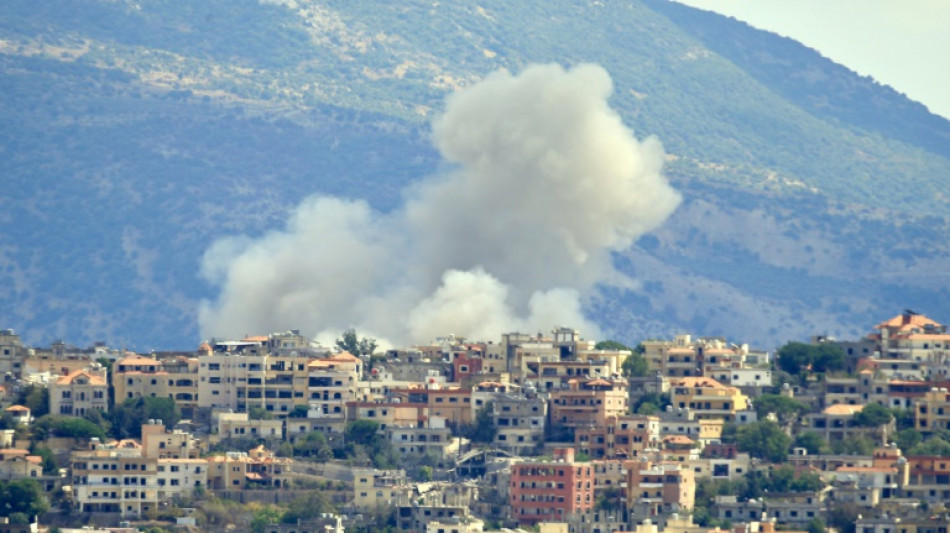
Why is Israel focusing on border with Lebanon? / Photo: - - AFP

 Trump to fete Xi with lavish White House welcome

 Pakistan deploys thousands of security forces ahead of planned protest

 Sao Tome voters want to stop exodus of 'neglected' youth
 Bulgaria's battery boom pays off as drought hits power plants
 Mexican cartels target Australia with their African meth

 Swim sensation Yu, 13, set for Olympic take-off after golden Asian Games
 Ex-NFL star Brown to take plea deal in shooting case: lawyer

 Malaysia's migrant return plan chills Myanmar Rohingya
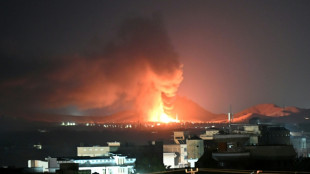 Pakistan confirms Afghan strikes after resident says Kandahar hit

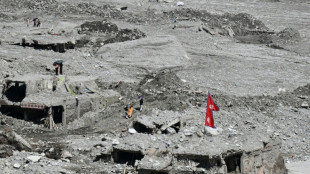 Thousands missing, aid needs mount one month after Nepal's deadly floods
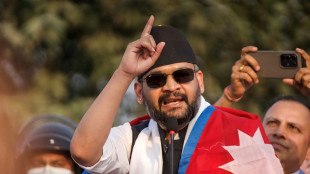
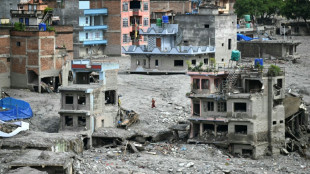 Nepal flood victims look to PM Shah to press climate case at UN

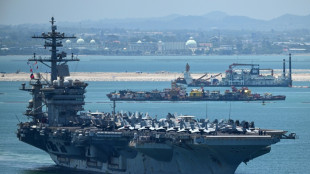 Trump admin says there were 8 suicide attempts on US aircraft carrier

 Iranian satire 'Head to Head' draws a veil over the men
 Archaeological 'breakthrough' could confirm origins of Paris
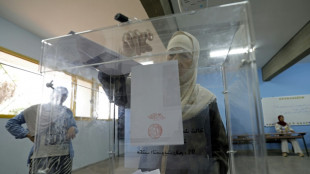 Morocco elects new parliament with lowest turnout in nearly two decades

 North Korean IT contractor found remote work in New Zealand: agency

 Anthropic touts AI-led biology discovery
 Giants QB Dart to have season-ending surgery
 Venezuelan shot by ICE needs urgent surgery, mother tells AFP

 Giants QB Dart to have season-ending surgery: reports

 Judge urged to lift Trump's White House ban on media outlets

 Stocks fall on soaring bond yields, higher oil prices

 US judge weighing Trump's White House ban on media outlets
 At UN, OpenAI's Altman calls 'for extreme care' in AI
 Hamilton gives thumbs up to Gulf GPs despite Iran conflict

A series of deadly explosions targeting Hezbollah members this week in Lebanon came only days after Israel announced plans to expand its war in Gaza to its northern border with Lebanon.
Hezbollah and its main backer Iran have blamed Israel for the blasts, but Israeli officials have neither confirmed nor denied responsibility.
The explosions have raised the likelihood of full-scale war with Hezbollah, and experts interviewed by AFP offered insights on how that might unfold.
- Why now? -
Since the Gaza war began almost a year ago, Israel and Hamas ally Hezbollah have engaged in near-daily cross-border clashes.
Hundreds have been killed in Lebanon, mostly Hezbollah militants, and dozens have died in Israel, with tens of thousands displaced on both sides.
Prime Minister Benjamin Netanyahu and other Israeli officials have stressed the need to secure the north so uprooted residents can return home.
"We will use all means necessary to restore security to our northern border and to safely return our citizens to their homes," Netanyahu said during a recent trip to the north.
But a return to peace in the north remains unlikely in the short term, said Calev Ben-Dor, a former Israeli foreign ministry analyst.
Ben-Dor said both Israel and the United States had hoped a Gaza ceasefire would lead to calm in the north, but the chances of such a ceasefire were fading.
"The chances for a ceasefire in Gaza are receding" just as "most of Israel's military goals in Gaza have been achieved", leaving Israel room to reassign units, he said.
Kobi Michael, an analyst for the Institute for National Security Studies and Misgav think-tanks, said the army had more flexibility to shift its forces to the northern front.
"(The army) can run the situation with less forces, and therefore we can move the focus and the concentration to the north," he told AFP.
"The idea that Israel cannot realise its sovereignty over the northern parts of the country is something that cannot be tolerated".
- What are Israel's goals? -
There have been calls from within the Israeli government to push Hezbollah out of southern Lebanon, beyond the Litani river, but Israel's current strategy remains unclear.
The United States, through its envoy Amos Hochstein, favours a diplomatic solution that keeps Hezbollah and its vast arsenal of rockets away from the border.
Ben-Dor said neither the United States, France nor Lebanon's government held enough sway over Hezbollah to push it back from the border, as called for in a UN resolution that urges its withdrawal from south of the Litani river.
For Michael, the Israeli military objectives would be to clear Hezbollah militants from the area between the Litani and the border, and to prevent their return.
He compared the situation to Israel's 18-year occupation of southern Lebanon until 2000, saying he expected a different form of "military control over south Lebanon" this time.
Without a diplomatic solution, he predicted a ground invasion.
- How much support for war? -
Hezbollah's removal from the border was widely supported by the Israeli public, said Ben-Dor.
But he acknowledged the Netanyahu government "suffers from a deficit of trust which may make it harder to undertake a major military operation".
Michael, for his part, said: "The Israeli constituency fully supports an all-out war against Hezbollah".
A survey by INSS, conducted in August, showed 44 percent of Israelis supported a wide-scale military operation in Lebanon, rising to 52 percent for Jewish Israelis.
Meanwhile, 23 percent preferred "limited military action", and 21 percent a "limited" response to avoid an escalation, the survey published on Tuesday found.
H.Jarrar--SF-PST