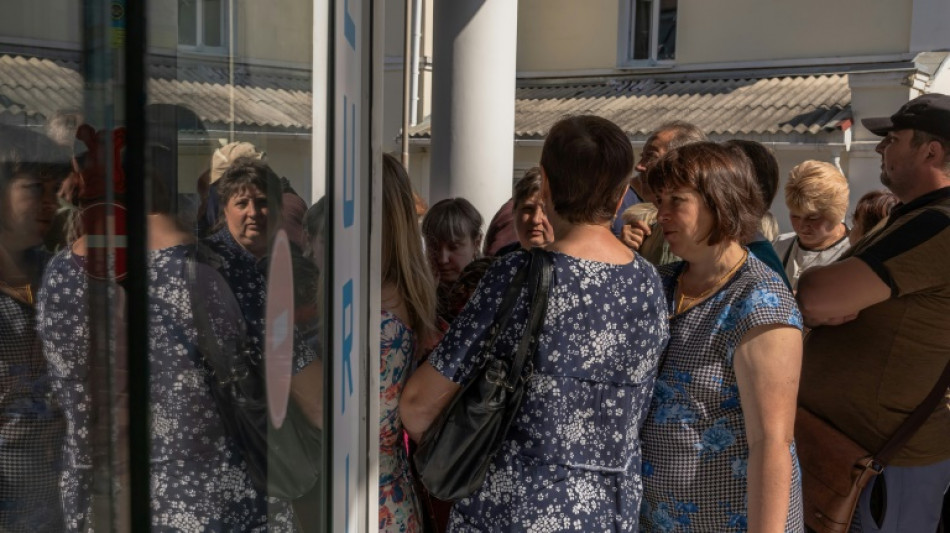
'God saved me': Kursk rout sparks panic, bombs along Ukraine border / Photo: Roman PILIPEY - AFP

 English, Spanish, Italian, German football leagues call for FIFA reform

 سهم ميتا يقفز 3.5% وقيمتها السوقية تقترب من تريليوني دولار
 عودة التوتر في تيغراي تضاعف الضغوط المعيشية في إثيوبيا
 موسكو تواصل عملياتها في أوكرانيا وتدرس حضور بوتين قمة العشرين

 دول اتفاقية مكة تبحث اجتماعاً عاجلاً لرؤساء الأركان

 هويدي: استمرار القتل في غزة يكشف غياب المساءلة رغم وقف النار

 اقتحامات واعتقالات إسرائيلية تطاول مناطق في الضفة والقدس
 قصف إسرائيلي يصيب فلسطينيين مع استمرار خروقات وقف النار بغزة

 صندوق مصر للاستثمار الصناعي يوسع دعم الإنتاج والتصدير

 صحة غزة: التحويلات الطبية مجانية وتحذير من محاولات الاحتيال

 «بي بي» ترصد 700 مليون دولار لحفر أربع آبار في مصر
 Ireland's Gaza stance spills from Eurovision into football
 Welcome aboard the Costa Serena, the Asian Games floating hotel

 Asian markets mixed after recent oil surge
 Cash for nature protection: hotelier's offer to Principe islanders
 US miner KoBold bets on AI to gain edge in DR Congo mineral hunt
 Internet disrupted in Ethiopia as conflict rages

 Asian markets mixed after oil gains

 'Genius' Ohashi bids for third Asian Games gold after world record

 India's 'Tree Father' plants for a greener future
 Hopping mad: New health warning stirs up Belgian brewers
 Canadian capital to rename 'Trump Ave'
 Pope heads to France on first state visit in 18 years
 Bacteria suspected in deaths of hundreds of baby whales off Argentina

 US 'must choose' whether to end war: Iran president to Fox News

The roar of artillery fire was deafening as Tetyana conferred with neighbours in her small village, which hugs the Russian border, over whether they should hold tight or flee.
The days were relatively calm in Myropillya, she said, but the nightly bombardments had become so unbearable that even sheltering in basements no longer felt safe.
"You know what they say, it's only when we start to feel the burning ourselves that we leave," the 59-year-old told AFP.
Finally prompted to flee after Ukraine's shock border incursion into Russia's Kursk region, she was at a gathering point for evacuees in the eastern city of Sumy.
The offensive has been one of Ukraine's speediest operations since Moscow invaded in February 2022. Analysts say it is the most significant ground operation by a foreign army inside Russia since World War II.
Moscow has been forced to redeploy troops and carry out mass civilian evacuations as it struggles to stem the advance.
For Ukraine, it has been a morale boost at an otherwise perilous moment in the war.
But Russia has also responded by pounding Ukrainian border areas -- where it says troops and equipment are stationed -- prompting Ukrainian officials to order the evacuation of some 20,000 people on its side of the new frontline.
- 'Leave everything behind' -
Sitting alone and disoriented at the Sumy evacuation centre, 80-year-old Anna was tearful as she described the intensifying artillery fire in her village of Yunakivka, near the border.
"I was about to hang myself. But God saved me," she told AFP.
"But I don't know what to do now," she added, perched on a temporary bed next to the few plastic bags of belongings she had been able to bring with her.
Overseeing efforts to help those who fled, aid worker Vitaliy Kaporukhin said the Ukrainian attack -- planned in secret and launched without warning -- had caught border residents off guard.
"People are upset," said Kaporukhin, who works with the aid organisation, Pluriton. "They're having to leave their homes. They're having to leave everything behind.
"Fortunately, it's an operation from our side, and Russian forces didn't come here. That would have been worse."
AFP journalists saw dozens of Ukrainian military vehicles daubed with white triangles, the insignia apparently used to identify forces involved in Kursk operation, kicking up dust on roads in the Sumy border territory.
Kyiv has been tight-lipped about the operation but a top Ukrainian official told AFP its aim was to destabilise Russia by showing up its weaknesses.
In one frontier village, servicemen who spoke to AFP on condition of anonymity said they had been deployed inside Russia. They described intensive Russian bombardments along the border and in the Kursk region.
Another group preparing to cross into Kursk voiced confidence they could hold ground there, citing weak Russian resistance -- for now.
- 'A taste of war' -
Ukrainian troops have carved rows of new defensive lines into the Sumy region's landscape.
Closer to the Russian border, smoke trails from Ukrainian projectiles could be seen marking the sky above sweeping fields of bright sunflowers.
The fresh scrutiny on Sumy represents a dramatic shift for a region that, compared with other eastern regions, has been spared the brunt of more than two years of devastating fighting with Russia.
But windows covered by plywood and gutted carcases of Soviet-era buildings point to frequent and deadly aerial attacks on Sumy and the surrounding area.
Air raid sirens and explosions rang out over the city, itself just 30 kilometres (18 miles) from the Russian border, at regular intervals.
Russian President Vladimir Putin's army stormed into the surrounding region when he ordered the invasion in February 2022, but within several weeks had been pushed by an unexpectedly resolute Ukrainian resistance.
This weekend the Ukrainian army said it was the region most heavily targeted by Russian aerial attacks, retaliatory strikes for the ongoing offensive.
"The border villages have already been wiped out," said Tetyana, whose first regret was having to leave behind the pickles she had spent the summer preparing. "There is nothing left there."
Despite the evacuations and the looming threat of Russian retaliation, life has seemed relatively normal in the region's main civilian hub in recent days.
Shouting children played in a water fountain in the centre of the Sumy, which had a population of around 250,000 before the war. Residents enjoyed evening meals on restaurant terraces dotting the historic centre.
At the evacuation centre, residents who had fled reported that Moscow had stepped up attacks, using devastating glide bombs on border areas.
Retired metal worker Mykola, who left his village of Khotyn some 10 kilometres (6 miles) from Russia, admitted it had pained him to have to leave his home.
But he found some consolation from Ukraine's offensive in Kursk.
"Let's let them find out what it's like," the 70-year-old said. "They don't understand what war is.
"Let them have a taste of it."
B.Mahmoud--SF-PST