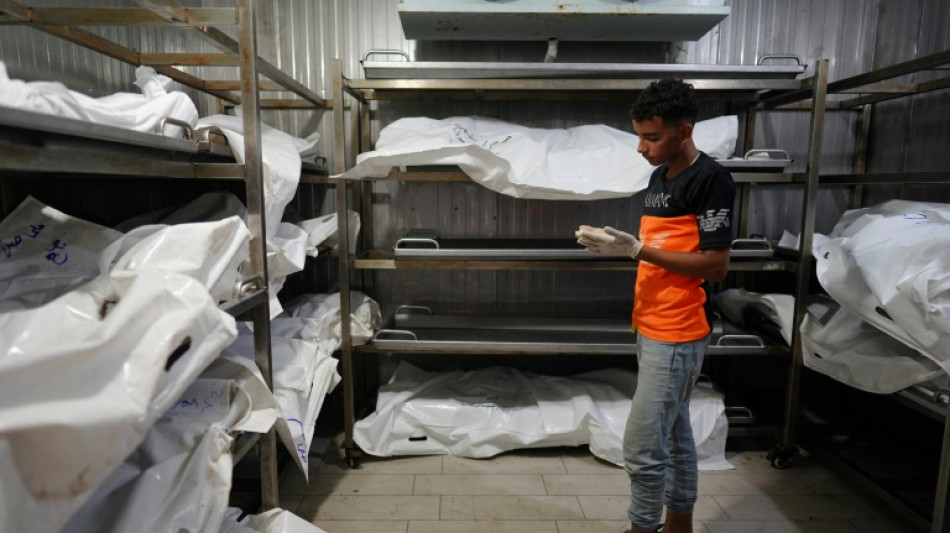
Nearly 40,000 and counting: the struggle to keep track of Gaza deaths / Photo: Bashar TALEB - AFP/File

 'Perfect lap' gives Russell pole for Azerbaijan GP as Antonelli crashes out

 UN Security Council condemns Houthi attacks on Saudi Arabia

 China swimmer makes Asian Games history as Thai wins 100m sprint

 Top French literary prize drops best-selling novel over AI claims

 US 'must choose' whether to end war: Iran president

 Pope warns against losing humanity in AI-driven 'paradise of machines'

 Pope warns against losing humanity in 'paradise of machines'

 From FBI warning to literary acclaim: the Russian journalist who took on Putin
 China swimmer in Asian Games first as North Korea lifters reign
 French literary prize removes novel from longlist after AI claims

 China's Zhang wins record seventh Asian Games swimming gold

 Verstappen edges Russell in final practice in Azerbaijan

 English, Spanish, Italian, German football leagues call for FIFA reform

 نقل أسيرين كوريين شماليين يثير خلافاً بين كييف وسيؤول

 عودة التوتر في تيغراي تضاعف الضغوط المعيشية في إثيوبيا

 موسكو تواصل عملياتها في أوكرانيا وتدرس حضور بوتين قمة العشرين

 دول اتفاقية مكة تبحث اجتماعاً عاجلاً لرؤساء الأركان

 زراعة القوقعة تمنح 50 طفلاً في غزة فرصة لاستعادة السمع

 «بي بي» ترصد 700 مليون دولار لحفر أربع آبار في مصر

 صندوق مصر للاستثمار الصناعي يوسع دعم الإنتاج والتصدير

 واشنطن تدرس قيوداً طوعية على صادرات الديزل لكبح الأسعار

 سهم ميتا يقفز 3.5% وقيمتها السوقية تقترب من تريليوني دولار

 الإمارات ولبنان تطلقان مبادرة لتأهيل مليون خبير في الذكاء الاصطناعي

 الدفراوي يواجه هابيرورا بطموح عربي في بطولة المحترفين بدبي

 رأس الخيمة وميامي الكبرى تبحثان فرص التعاون الاقتصادي

With much of Gaza reduced to rubble by 10 months of war, counting the dead has become a challenge for the Hamas-run territory's health ministry, as the death toll nears 40,000.
Israel has repeatedly questioned the credibility of the daily figures put out by the ministry and US President Joe Biden did so too in the early stages of the war.
But several United Nations agencies that operate in Gaza have said the figures are credible and they are frequently cited by international organisations.
- Data collection -
Two AFP correspondents witnessed health facilities enter deaths in the ministry's database.
Gaza health officials first identify the bodies of the dead, by the visual recognition of a relative or friend, or by the recovery of personal items.
The deceased's information is then entered in the health ministry's digital database, usually including name, gender, birth date and ID number.
When bodies cannot be identified because they are unrecognisable or when no one claims them, staff record the death under a number, alongside all the information they were able to gather.
Any distinguishing marks that may help with later identification, whether personal items or a birthmark, are collected and photographed.
- Central registry -
Gaza's health ministry has issued several statements setting out its procedures for compiling the death toll.
In public hospitals under the direct supervision of the territory's Hamas government, the "personal information and identity number" of every Palestinian killed during the war are entered in the hospital's database as soon as they are pronounced dead.
The data is then sent to the health ministry's central registry on a daily basis.
For those who die in private hospitals and clinics, their information is taken down on a form that must be sent to the ministry within 24 hours to be added to the central registry, a ministry statement said.
The ministry's "information centre" then verifies the data entries to "ensure they do not contain any duplicates or mistakes", before saving them in the database, the statement added.
Gaza residents are also encouraged by Palestinian authorities to report any deaths in their families on a designated government website. The data is used for the ministry's verifications.
The ministry is staffed with civil servants that answer to the West Bank-based Palestinian Authority as well as to the Hamas-led government in Gaza.
- 'High correlation' -
An investigation conducted by Airways, an NGO focused on the impact of war on civilians, analysed the data entries for 3,000 of the dead and found "a high correlation" between the ministry's data and what Palestinian civilians reported online, with 75 percent of publicly reported names also appearing on the ministry's list.
The study found that the ministry's figures had become "less accurate" as the war dragged on, a development it attributed to the heavy damage to health infrastructure resulting from the war.
For instance, at southern Gaza's Nasser Hospital, one of the few still at least partly functioning, only 50 out of 400 computers still work, its director Atef al-Hout told AFP.
Israeli authorities frequently criticise the ministry's figures for failing to distinguish between combatants and civilians. But neither the army nor Israeli Prime Minister Benjamin Netanyahu deny the scale of the overall toll.
The press office of Gaza's Hamas government estimates that nearly 70 percent of the roughly 40,000 dead are women (about 11,000) or children (at least 16,300).
Several UN agencies, including the agency in charge of Palestinian refugees (UNRWA), have said the ministry's figures are credible.
"In the past -- the five, six cycles of conflict in the Gaza Strip -- these figures were considered as credible and no one ever really challenged these figures,", the agency's chief Philippe Lazzarini said in October.
A study by British medical review The Lancet estimated that 186,000 deaths can be attributed to the war in Gaza, directly or indirectly as a result of the humanitarian crisis it has triggered.
The war in Gaza was triggered by the October 7 attack by Hamas, which resulted in the deaths of 1,198 people, mostly civilians, according to an AFP tally based on Israeli official figures.
P.Tamimi--SF-PST