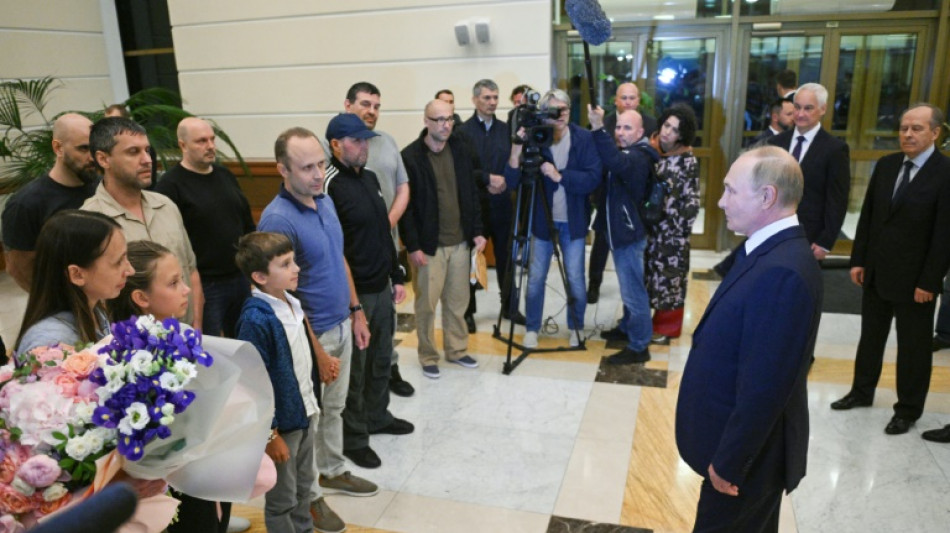
How Putin might gain or lose from the prisoner swap / Photo: Kirill ZYKOV - POOL/AFP

 Assefa seeks 'better than my best' at Berlin marathon
 US court refuses to overturn Pentagon ban on Anthropic
 Verstappen and Norris blame slow cars as Mercedes tops qualifying

 Crowds cheer pope in Paris after AI 'paradise of machines' warning
 Teen swimmer makes Games history as Thai, Chinese sprinters win gold
 Man City found guilty of 114 Premier League charges - reports
 Concerns over 'missing' UK explorer Ranulph Fiennes
 Suspected Paris killer of Argentine rugby star begs forgiveness

 Oil prices fall on cautious hopes for US-Iran progress

 Noskova, Muchova take Czech Republic into BJK Cup final
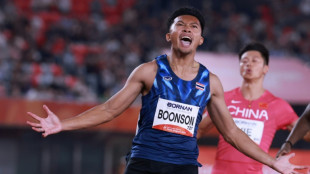 Thai sprinter Puripol breaks own Asian Games record to win 100m gold
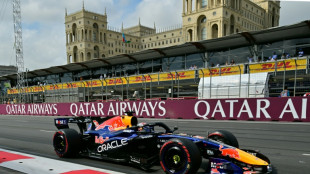
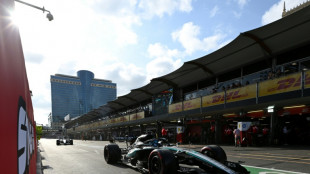 Russell takes pole for Azerbaijan GP, Antonelli crashes out
 Williams boss hails Chadwick as F1 inspiration for women
 World No.1 Sinner delays return with China Open withdrawal
 South Lebanon children return to school destroyed by Israel strike

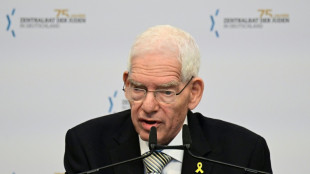 Jewish group urges Berlin far-left vote winners to tackle antisemitism
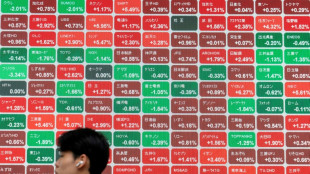 European stock markets climb as oil prices drop

 Trump accuser E. Jean Carroll finally has her damages
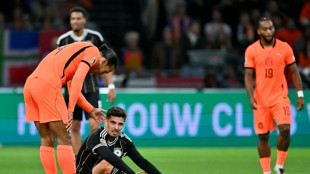 Germany's Havertz, Musiala ruled out of Greece match with injury
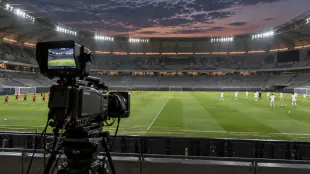 الإمارات تستهل «خليجي 27» بمواجهة اليمن في جدة

 الذهب يتراجع للجلسة الثانية تحت ضغوط الأسواق
 شي يحث واشنطن وطهران على إحياء اتفاق يونيو وإنهاء الحرب

 صحة غزة: التحويلات الطبية مجانية وتحذير من محاولات الاحتيال

 طقس فلسطين: تراجع طفيف في الحرارة وأجواء معتدلة

 قصف إسرائيلي يصيب فلسطينيين مع استمرار خروقات وقف النار بغزة

When eight Russian citizens including a convicted hitman touched down in Moscow on Thursday in a historic prisoner swap with the West, President Vladimir Putin greeted them like heroes.
"I want to congratulate you all on your return to your Motherland," Putin beamed, assuring the group that also included cybercriminals and spies that Russia had not forgotten them for "even a minute".
Putin's message -- both to those released on Thursday and his agents across the world -- was clear: Even if you get caught, the Kremlin has your back.
A total of 24 people were freed in Thursday's exchange -- 16 headed to the West and eight to Russia -- in the biggest prisoner swap deal since the Cold War.
Russia released US journalists Evan Gershkovich and Alsu Kurmasheva, ex-marine Paul Whelan as well as high-profile domestic dissidents.
In return, it secured the largest number of alleged Russian spies freed in a single exchange for over a decade, as well as FSB security service assassin Vadim Krasikov.
"For the target audience, Putin brought back his soldiers, the heroes of a hybrid Third World War," said Russian political analyst Konstantin Kalachev.
"And the audience is not just special services, but millions who feel like citizens of a country at war with a stronger enemy," he added.
Among those returning to Russia were two sleeper agents living on false documents in Slovenia, a prolific hacker and an alleged Russian colonel posing as a Brazilian researcher in Norway.
For Putin, the main prize was Krasikov -- an elite FSB officer arrested in Germany in 2019 for murdering a former Chechen separatist on what Berlin said was Moscow's orders.
A former FSB officer himself, Putin had long pushed for Krasikov to be included in a prisoner swap deal, an idea that Germany had resisted.
The deal will have "strengthened loyalty" among other spies and assassins, said Abbas Gallyamov, an independent political analyst and former Kremlin speechwriter.
"Putin can count on them to work with greater dedication," he added.
- 'Win-win' -
For the West, the exchange has raised fears Putin could become even more emboldened to take prisoners in what it blasts as "hostage diplomacy".
The Kremlin said Friday it was determined to see the release of more Russians it believes are wrongfully imprisoned in the West.
Over the last two years, Russia had been "blatantly" detaining Westerners for a possible swap "as negotiations with the West stalled" amid the Ukraine offensive, said Tatiana Stanovaya, a senior fellow at the Carnegie Russia Eurasia Center.
Russia and the West have a long history of swaps, including in 2022 when US basketball star Brittney Griner was exchanged with Russian arms dealer Viktor Bout.
But with Thursday's deal involving not just foreigners but Russian dissidents, Moscow reminded "the whole world of its repression, lawlessness and cruelty against critics of the authorities," Stanovaya said in an article.
Before the 2022 agreements to free first US Marine Trevor Reed and then Griner, deals had usually involved swapping spies for spies.
Moscow has tried to present this deal in similar terms.
Gershkovich and Whelan were both convicted of "espionage" -- charges rejected as baseless by the White House -- and the FSB said on Thursday that the Russians it released had "acted in the interests of foreign states to the detriment of Russia's security."
But to the West, the arrest of Gershkovich in particular -- the first "espionage" charges levelled at a US reporter in Russia since the cold War -- showed the Kremlin was willing to cross red lines.
Russia may see the exchange as a great success and "wonderful victory", political analyst Ekaterina Schulmann said in an interview with Russia's independent TV Rain.
But the reality was more nuanced.
"Russia is getting eight clumsy losers who couldn't do their job and got caught," she said.
"While it is giving away people who, if they want to and if they are able, will become significant political public figures."
W.Mansour--SF-PST