Indonesia's sea nomads turn to jobs on land / Photo: Jack MOORE - AFP

 Jay-Z rape accuser says she made 'false accusations'

 Senegal draw first match under Vieira and Nigeria survive scare

 Trump, Xi end summit long on pomp, but short on progress

 Russia not preparing for conflict with Europe, Putin says

 Trump's photo of Xi greeting carries signs of AI

 Six missing after building blast in historic Athens district

 Millions in US northeast brace for powerful storm

 Assefa seeks 'better than my best' at Berlin marathon

 US court refuses to overturn Pentagon ban on Anthropic

 Verstappen and Norris blame slow cars as Mercedes tops qualifying

 Crowds cheer pope in Paris after AI 'paradise of machines' warning

 Teen swimmer makes Games history as Thai, Chinese sprinters win gold
 Man City found guilty of 114 Premier League charges - reports

 Concerns over 'missing' UK explorer Ranulph Fiennes

 Suspected Paris killer of Argentine rugby star begs forgiveness

 Oil prices fall on cautious hopes for US-Iran progress

 Noskova, Muchova take Czech Republic into BJK Cup final

 Thai sprinter Puripol breaks own Asian Games record to win 100m gold

 Russell takes pole for Azerbaijan GP, Antonelli crashes out

 Williams boss hails Chadwick as F1 inspiration for women

 World No.1 Sinner delays return with China Open withdrawal

 South Lebanon children return to school destroyed by Israel strike

 Jewish group urges Berlin far-left vote winners to tackle antisemitism

 European stock markets climb as oil prices drop

 Trump accuser E. Jean Carroll finally has her damages

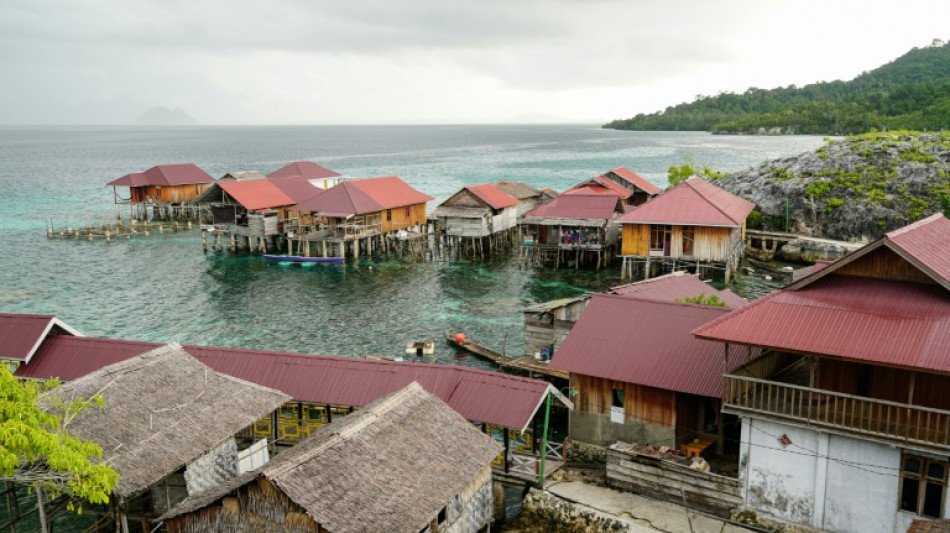
Sofyan Sabi's sea-dwelling community has fished beneath the waves off the Indonesian coast for centuries, but climate change and overfishing have forced him and many of his contemporaries on land to make a living.
The Bajau tribe of fishermen led a nomadic life at sea for generations, spending days and nights on boats with thatched roofs in the waters between Indonesia, Malaysia and the Philippines.
Members of the tribe learn to dive from a young age, and their bodies have adapted over time to allow them to fish underwater for longer periods, researchers say.
But for the hundreds of Bajau people living on the tiny boardwalk island village of Pulau Papan in Indonesia, their ancestors' unique way of life has all but died out.
"We changed professions. We are fishermen who work at a farm. Farming gives better income because there are many crops I can plant," Sofyan said, adding that he owns a nearby two-hectare plot to grow corn and bananas.
"Sometimes we earn nothing by going to sea. Sometimes there are fish, sometimes there aren't any," the 39-year-old told AFP.
Trained to hold his breath between 10 and 15 metres (33 and 50 feet) deep since he was a child, Sofyan still scans the waters for sea cucumbers or an octopus that could earn him as much as 500,000 rupiah ($31).
Researchers attribute the Bajau ability to dive deeper and longer to a possible genetic mutation that has given them larger spleens, allowing their blood to store more oxygen.
But commercial overfishing and rising temperatures have made sea catches increasingly unpredictable, said Wengki Ariando, a researcher at Thailand's Chulalongkorn University who has studied the Bajau.
"They are facing decreasing marine resources," he said.
As temperatures rise, fish migration and mating patterns change, corals are bleached, and the food chain changes.
More than half of Indonesia's 11 fishery management areas are now listed as fully exploited.
The country's fish stocks fell from 12.5 million metric tons in 2017 to 12 million in 2022, fishery ministry data shows.
"The fish are decreasing because too many people are catching them," said 52-year-old fisherman Arfin, who goes by one name.
- 'Changed their livelihood' -
A dilapidated mile-long jetty takes visitors along turquoise waters onto Pulau Papan.
Davlin Ambotang, who lives on the island, says the Bajau first started to settle there three generations ago.
"They saw this island as suitable for building houses, so they settled there. No longer nomads, moving around," he said.
But life on land has its own challenges.
Davlin's brother runs a homestay banking on tourist visits.
He complains that authorities direct visitors to sleep at government-built cottages instead of helping Bajau businesses flourish.
"There's no additional income for the people. The government controls everything," said Sofyan.
"There are many arguments between them and the locals."
The long stateless Bajau grew increasingly settled in villages like Pulau Papan in search of government recognition.
"The Bajau changed their livelihood because to get accepted as a people in Indonesia they have to be settled," said Wengki, adding that the drive to register them officially began in the 1990s under dictator Suharto.
- 'Difficulties on land' -
Wooden boats sit at the edge of the island, while a main walkway cuts through it, splintering off into side jetties.
The village hosts a silver-domed mosque.
On a makeshift court, women play a game of volleyball, while a group of men sit around smoking cigarettes.
"The young generation, they look like they are missing their identity," said Wengki.
"They are more like a land-based community."
With internet access available on land, the Bajau have set up groups on social media with thousands of followers, helping each other with their problems.
"There is no development, nothing. From the district government, there were donations, each family gets two to three bags of rice every month," said Tirsa Adodoa, a housewife in her 20s whose husband is a fisherman.
"It's not enough if we only rely on catching octopuses. If the octopus price drops like right now... it's not even enough for us to eat or buy things."
But others yearn for the nomads to keep their seafaring ways -- worrying future generations will be less like their boat-dwelling ancestors.
"Once they feel comfortable, it won't be easy for them to go back to the sea," said fisherman Muslimin, 49, who goes by one name.
"I wish they could work only as fishermen, because it's fun. There are too many difficulties on the land."
X.AbuJaber--SF-PST