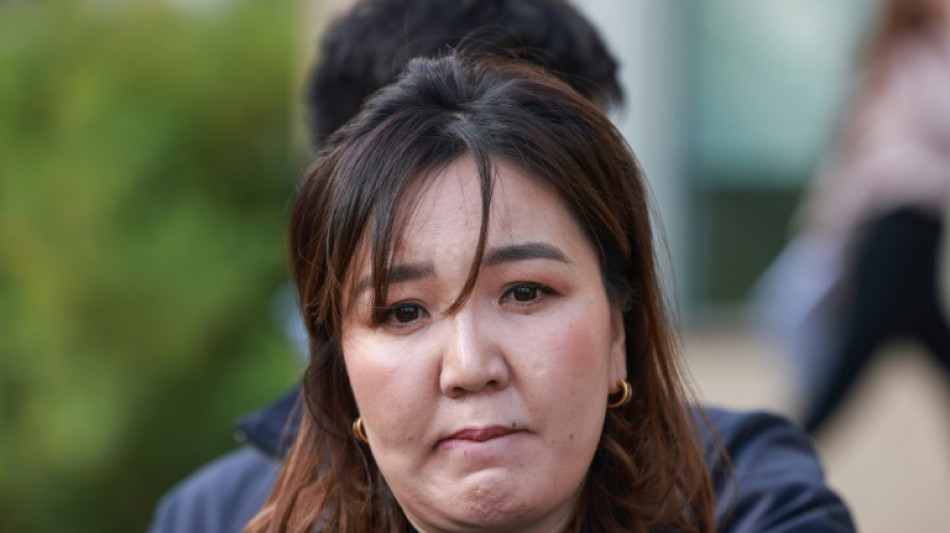
Hard-hitting journalist ensnared in Mongolia's press freedom crackdown / Photo: Byambasuren BYAMBA-OCHIR - AFP

 AI startup urges optimism from Europe despite safety fears
 'Godlike, invincible': Japan hails 11-year-old Games history-maker
 Nepal's hydropower ambitions face climate reality check

 Power cuts, rubble: millions come home to find Sudan's capital unlivable
 Internationals keep Presidents Cup lead with late fightbacks

 Tuchel to 'keep pushing' England to reach Spain's level
 Alcaraz saves match points to keep Europe ahead in Laver Cup
 Spain success driven by hunger to improve, says De La Fuente
 Lyon collapse at Stade Francais to suffer first Top 14 loss
 Oyarzabal and Spain sink England again as Modric shines for Croatia
 Housing protesters camp in central Madrid after mass demonstration
 Louise Trotter expands her palette at Bottega Veneta
 Pope prays at Lourdes after huge Paris mass
 USA trims International lead after Presidents Cup four-balls
 Russia accuses Europe of blocking Ukraine talks, as strikes drag on

 'He said hello': Families pray with pope on Paris avenue
 Pope celebrates giant Paris mass, flies to Lourdes
 Thousands march in Madrid over eviction of 87-year-old woman
 England women back to winning ways with last-gasp defeat of New Zealand
 Trump rejects Iran proposal for deal to reopen Hormuz
 England's Cox says injured Buttler leaves 'big shoes to fill'
 Ruthless Perpignan upset sloppy Bordeaux-Begles
 Deadly abbey attack feeds anti-Ukrainian sentiment in Poland
 Antonelli says he drove 'safety-first' on his worst weekend of season
 Fernandez fights back to reach Singapore Open final
Naran Unurtsetseg became one of Mongolia's most well-known journalists by exposing sexual abuse in a Buddhist boarding school, violence in the military and by taking on some of the country's most powerful people.
But she is now on trial after almost 200 days under house arrest and banned from working, the most high-profile victim of what critics say is a deepening crackdown on press freedom.
"I used to think innocent people should have nothing to fear," she told AFP from her home in the capital Ulaanbaatar.
"But I've been through a one-sided hearing since I was placed under investigation," she said.
"They don't want to see the facts that prove my innocence and intentions."
Democratic Mongolia long enjoyed relative freedom of expression, especially when compared to its autocratic neighbours China and Russia.
It boasts a vibrant media scene, with scores of outlets representing all shades of the political spectrum and confrontational debate commonplace.
But against a recent backdrop of what critics say is declining rule of law and a government seeking to curb criticism of its record on corruption, it has plummeted in press freedom rankings.
Reporters Without Borders in 2024 ranked the country 109th in the world, its lowest rating in decades and putting it just ahead of Ecuador, Indonesia and Nigeria.
Critics point to recent amendments to anti-defamation and "fake news" laws, making them criminal offences, as giving authorities much greater powers to punish journalists.
And recent reforms to the state secrets law mean that those who publish leaked government documents can face up to eight years in jail.
"An official or officials who are supposed to keep the secret should be responsible for revealing it," said Galbaatar Lkhagvasuren, a lawyer at Globe International Center, a non-profit that promotes press freedom in Mongolia.
"Ordinary people who obtained the file intentionally or unintentionally shouldn't be found guilty," he said.
A Mongolian government spokesperson did not respond to repeated requests for comment on the country's declining press freedom rankings.
- Confrontational -
Unurtsetseg's brand of confrontational broadcasts with her outlet, Zarig, made her powerful enemies but legions of fans in a country where corruption is deep-rooted and has sparked civil unrest.
She pioneered the use of live streaming -- now ubiquitous in Mongolia's online media -- on Facebook, where many get their news.
In one livestream, she chased down crooked politicians who had refused to pay back government-backed loans.
In another, she exposed brutal hazing in the country's army after two young men died during their mandatory military service.
And she said she was intimidated when she was quoted in the New York Times discussing a controversial religious succession.
"I had phone calls from (the Intelligence Agency)," she told AFP.
And then, in December, the police came for her at the Zarig offices after she criticised judicial authorities on Facebook.
Other journalists gathered to livestream the arrest on social media in solidarity.
Unurtsetseg was slapped with a total of nine charges from three different agencies.
They included spreading false information and defamation by the judiciary, tax evasion by the country's revenue collector and, most seriously, obtaining state secrets by the intelligence agency.
- 'I didn't do anything wrong' -
"The tax authority, the intelligence agency, and the police are against me," she told AFP.
"People told me to apologise so I don't have to go to jail but I don't want to," she said.
"I didn't do anything wrong."
An additional charge of aiding foreign powers was eventually dismissed for lack of evidence.
Shortly after Unurtsetseg was arrested, dozens of journalists who had paid for her work were questioned by police.
One was Uyanga Surnee, a journalist at daily newspaper Zuunii Medee, who had wired Unurtsetseg some 200,000 tugrik ($50), five years ago.
"When I went to the police office... they didn't ask much about the transaction, instead, the police asked what I knew about Unurtsetseg's private life," she told AFP.
Her trial is ongoing, and a verdict is expected in early July.
Yesun-Erdene Tumurbaatar, a journalism teacher at Press Institute of Mongolia, said her arrest has little to do with the content of her work.
"Her journalism was political -- that is why they are clamping down on her," he said.
Experts and local journalists say the severity of her treatment throughout the investigation -- and the treatment of other journalists linked to her -- has already sent a clear message.
The arrest has sent ripples through Ulaanbaatar's relatively small community of journalists, which numbers only a few hundred covering a country of 3.4 million.
In May, another journalist, Bayarmaa Ayurzana, was arrested after exposing alleged embezzlement by Mongolia's deputy prime minister -- a candidate in this month's legislative elections.
"Since the arrest, we journalists started to hesitate to report because of fear," Oyunchimeg Shashiimaa, chief editor at News.mn, told AFP.
"The message of her arrest was that if we publish critical reports about state affairs, we will be questioned and punished," she said.
"We are struggling to keep people informed but we fear we will be gagged for trying."
T.Samara--SF-PST