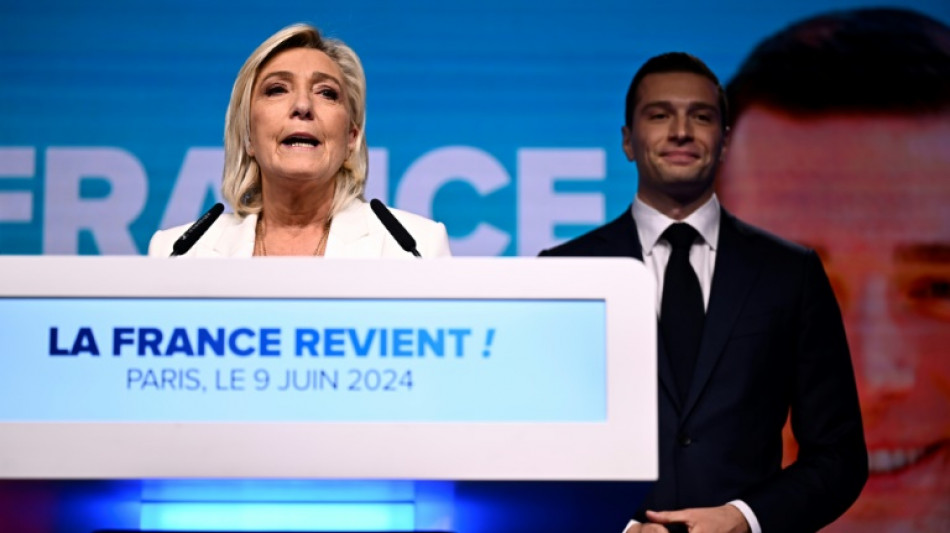
Far-right gains rock France -- but EU vote sees centre hold / Photo: JULIEN DE ROSA - AFP

 Make-A-Wish Announces 2026 Starblazer Award Honorees; Allied World Becomes First Corporate Founder

 فنان من غزة يفوز بجائزة "كاتب الشجاعة" البريطانية

 عصام غالب عواد: الفلسطيني في قفص الاتهام.. حين يُجبر صاحب المأساة على الاعتذار قبل أن يرويها

 Chelsea Transfer News: Real Betis Star Jose Antonio Morante Rejects Move to Stamford Bridge

 إيطاليا تؤكد دعمها الكامل لانضمام ألمانيا لبرنامج المقاتلات العالمية

 الرئيس عباس في ذكرى الاستقلال: حق فلسطين لا يسقط بالتقادم والشباب ركيزة البناء

 Grave of the Fireflies: Takahata Isao’s Lifelong Quest for Realism

 مطالبات برلمانية أمريكية لماسك بالاحتفاظ بسجلات استخدام أوكرانيا لشبكة ستارلينك

 DJ Chaia Brings 'Yiddishland' Sound to Capital Region with Kleztronica Rave
Far-right gains in EU elections triggered a political earthquake in France on Sunday, but mainstream parties looked set to keep a majority in the bloc's parliament.
French President Emmanuel Macron dissolved France's national parliament and called a snap election after exit polls showed far-right leader Marine le Pen's National Rally (RN) trouncing his liberal party on the European stage.
Projected results put the RN on around 33 percent, with 31 seats in the incoming EU parliament -- more than double the score of Macron's Renaissance back on 15 percent.
Meanwhile, the news was dismal too for German Chancellor Olaf Scholz, who saw the far-right Alternative for Germany claiming second place on 16 percent ahead of his Social Democrats on 14 percent.
The stinging blows for Europe's most powerful centrist leaders meant that the far-right was on course to boost its presence in the EU's transnational parliament.
In announcing his decision, Macron said he refused to "resign" himself to "far right parties... progressing everywhere in the continent."
But it was far from a clean-sweep for the far-right which fell short of expectations in the Netherlands and Belgium, with the picture still emerging elsewhere.
And crucially, parties on the extreme right remain divided -- making them likely to remain on the sidelines in Brussels.
A preliminary projection from the parliament showed the three main centrist parties set to maintain a clear majority, albeit slightly reduced, with 401 out of 720 seats up for grabs.
The centre-right European People's Party (EPP) came first with 186, followed by its two main partners -- the centre-left Socialists and Democrats on 133 and the centrist Renew Europe on 82.
"Today is a good day my friends. We are the strongest party. We are the anchor of stability," European Commission chief Ursula von der Leyen, who is seeking another term in charge, told her EPP grouping.
"Together with others we will build a bastion against the extremes from the left and from the right. We will stop them. This is for sure."
- Green losses -
The crushing victory for Le Pen in France had been widely predicted -- and her party had already come first in the European polls in the country in 2019.
"A deep humiliation as expected for Macron's centrist camp in today's European elections," wrote Eurasia Group analyst Mujtaba Rahman.
Elsewhere around Europe, Green parties appeared among the biggest losers of the night -- as right-wing opponents channelled discontent into anger at EU's environmental push.
More than 360 million people across the EU's 27 nations were eligible to vote to help shape the European Union's direction over the next five years.
The election came as the continent is confronted with Russia's war in Ukraine, global trade tensions marked by US-China rivalry, a climate emergency and the prospect of a disruptive new Donald Trump presidency.
"I can understand that people feel fear and vote with a hard mindset," Jaime Bajo, a sports centre operator, said as he cast his ballot in Madrid.
- Horsetrading begins -
Now the voting is over, the horsetrading will begin as EU leaders and lawmakers look to select who runs the powerful European Commission over the next five years.
Von der Leyen remains favourite -- but it is still to be seen if she will get the nod from the bloc's 27 leaders and then be able to ensure the centrist groups back her in parliament.
The picture was set to become clearer with the results from Italy -- where Prime Minister Giorgia Meloni's post-fascist Brothers of Italy is expected to triumph.
Meloni is being courted both by von der Leyen -- who needs her backing for a second mandate -- as well as Le Pen and Hungarian Prime Minister Viktor Orban, who would like to form a far-right parliament supergroup.
One thing was evident -- many Europeans, hammered by the high cost of living, turned to the anti-immigration message of the far right.
In Germany, turnout was the highest since 1979 at 66 percent. But that did not spare Chancellor Scholz from a dismal night -- with all three parties in his troubled coalition behind the conservatives and far right, exit polls showed.
In Austria, the far-right Freedom Party led the count according to exit polls, the first time the group has topped a nationwide ballot in the Alpine country.
In the Netherlands the far-right Freedom Party of Geert Wilders took second place behind a Green-Labour coalition.
- War worries -
In Hungary nationalist Orban stoked fears of the Ukraine war expanding to one between the West and Russia, blaming Brussels and NATO. As he cast his vote he framed it as a "pro-peace or pro-war election".
But in eastern EU countries, the spectre of Russia's threat loomed large.
That message resonated in Poland too, where estimates said the pro-European coalition of Donald Tusk looked set to stave off an attempted comeback from nationalist former ruling party Law and Justice.
Projections from the EU parliament put Tusk's alliance on 38 percent, ahead of PiS on 33 percent.
burs-del/ec/db
T.Samara--SF-PST