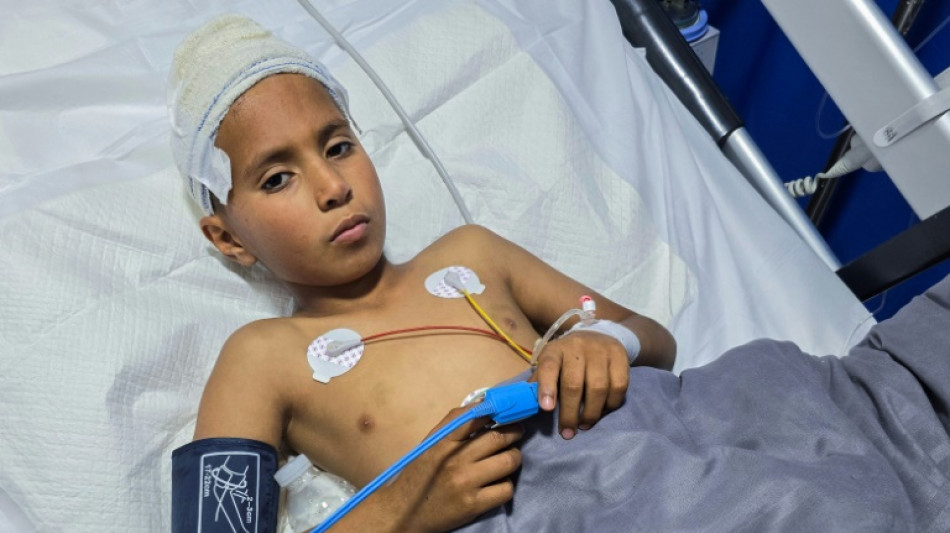
Deadly landmines pose hidden threat in Libyan capital / Photo: Mahmud TURKIA - AFP

 How young is too young as child prodigies win big at Asian Games

 UK Labour party meets buoyed by Burnham but eager for concrete plans

 Thousands protest ahead of Mexican president's report on missing students

 Bangkok floods force thousands into shelters

 AI startup urges optimism from Europe despite safety fears

 'Godlike, invincible': Japan hails 11-year-old Games history-maker

 Nepal's hydropower ambitions face climate reality check

 Power cuts, rubble: millions come home to find Sudan's capital unlivable

 Internationals keep Presidents Cup lead with late fightbacks

 Tuchel to 'keep pushing' England to reach Spain's level

 Alcaraz saves match points to keep Europe ahead in Laver Cup
 Spain success driven by hunger to improve, says De La Fuente

 Lyon collapse at Stade Francais to suffer first Top 14 loss
 Oyarzabal and Spain sink England again as Modric shines for Croatia

 Housing protesters camp in central Madrid after mass demonstration

 Louise Trotter expands her palette at Bottega Veneta

 Pope prays at Lourdes after huge Paris mass

 USA trims International lead after Presidents Cup four-balls

 Russia accuses Europe of blocking Ukraine talks, as strikes drag on

 'He said hello': Families pray with pope on Paris avenue

 Pope celebrates giant Paris mass, flies to Lourdes

 Thousands march in Madrid over eviction of 87-year-old woman
 England women back to winning ways with last-gasp defeat of New Zealand

 Trump rejects Iran proposal for deal to reopen Hormuz

 England's Cox says injured Buttler leaves 'big shoes to fill'
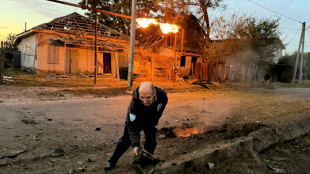
Hundreds of deadly landmines and unexploded ordnance still litter parts of Libya after years of fighting, posing a constant danger to civilians, especially children, long after the conflict.
"It's a disaster zone," said Saleh Farhat, describing his neighbourhood on the southern outskirts of the capital Tripoli, where his son Mohamed was being treated in a hospital intensive care unit after being severely injured in an explosion.
Although relative calm has returned to the oil-rich country since the battle for Tripoli four years ago, the United Nations says more than 400 people, including 26 children, have been injured or killed since 2019 in accidents linked to left-over explosive devices.
Mohamed Farhat, 10, was playing with friends in a garden when the children picked up what they thought was a piece of scrap metal.
"A few seconds later, a strong explosion threw us to the ground," his friend Hamam Saqer, 12, told AFP from a nearby hospital bed. His feet were badly wounded in the blast and he was covered in bandages.
"We didn't know it was a weapon," he added, vowing never to return to that garden again.
His 11-year-old brother Laith Saqer was lying in the next bed, having had a lucky escape suffering just some light scratches.
"We didn't know," he said of the explosive. "We went to play, that's all."
Libya is still struggling to recover from years of war and chaos after the 2011 overthrow of longtime dictator Moamer Kadhafi -- with clashes periodically between its myriad of rival armed groups.
- 'Explosives in toys' -
The country is divided between a UN-recognised government based in Tripoli led by Abdulhamid Dbeibah and a rival administration in the country's east backed by military strongman Khalifa Haftar.
The rivals fought a bloody battle for control of Tripoli between April 2019 to June 2020, with Haftar's forces halted on the capital's outskirts.
Before retreating though, they laid anti-personnel mines in homes, according to residents and deminers, who say they found the devices in everything from toys to saucepans and toilets.
According to a 2023 report by the US State Department, the Russia-backed Wagner Group, which deployed in Libya in support of Haftar's forces, also placed "landmines and boobytraps" in the area "while retreating from the outskirts of Tripoli".
But it acknowledged that the "full extent of landmine contamination ... and explosive remnants of war in Libya remains unknown due to the limited control" of the government in Tripoli.
The southern suburbs, where the three children were injured, have been the "scene of all wars since 2011 until today", said Farhat.
"The authorities are not doing enough to eliminate mines and unexploded ordinances," he added, saying he had frequently heard about neighbours having their limbs amputated after a landmine accident.
About 36 percent of Libya's areas which had been littered with mines and ordnance have been cleared, according to the UN mission in Libya, but another 436 million square metres (about 108,000 acres) remain unswept.
If stability and a united government return to the northern African country it would take "five to 10 years to get rid of" the remaining unexploded ordnance, an official from the defence ministry told AFP, asking not to be named.
In early May, authorities and the Libyan Mine Action Center said they were developing a "national anti-mine strategy" to deal with the issue, with the help of the Geneva International Centre for Humanitarian Demining.
"People are afraid because their lives are in danger," said local Tripoli official Seddik al-Abassi, calling for specialised equipment to help sweep the city's residential areas.
But it will come too late for Farhat's son Mohamed, who was wounded in the head by shrapnel from the blast. Doctors say he is in stable condition, but he faces a long road to recovery.
S.Barghouti--SF-PST