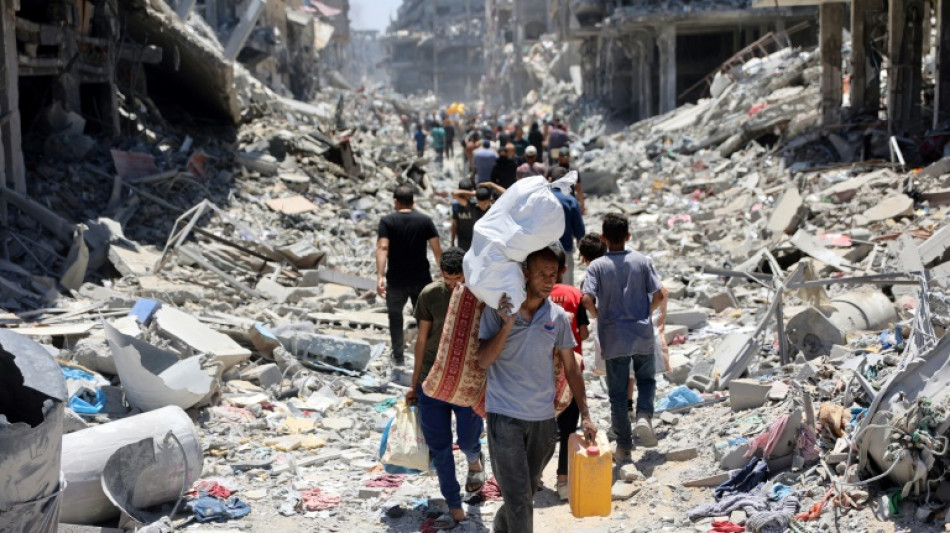
Gazans back in war-ravaged Jabalia 'shocked' by destruction / Photo: Omar AL-QATTAA - AFP

 Suede and Manic Street Preachers Deliver Electrifying Co-Headline Performance at Motorpoint Arena

 Trump Reduces Public Appearances Amid CIA-Mossad Warnings of Iranian Drone Plot

 Make-A-Wish Announces 2026 Starblazer Award Honorees; Allied World Becomes First Corporate Founder

 فنان من غزة يفوز بجائزة "كاتب الشجاعة" البريطانية

 عصام غالب عواد: الفلسطيني في قفص الاتهام.. حين يُجبر صاحب المأساة على الاعتذار قبل أن يرويها

 Chelsea Transfer News: Real Betis Star Jose Antonio Morante Rejects Move to Stamford Bridge

 إيطاليا تؤكد دعمها الكامل لانضمام ألمانيا لبرنامج المقاتلات العالمية
 الرئيس عباس في ذكرى الاستقلال: حق فلسطين لا يسقط بالتقادم والشباب ركيزة البناء

 Grave of the Fireflies: Takahata Isao’s Lifelong Quest for Realism
Mohammed Al-Najjar, a 33-year-old Gazan, said Saturday he was "shocked" and feeling "lost" as he returned home, only to find much of Jabalia refugee camp in ruins after an Israeli offensive
"All the houses have been reduced to rubble," Najjar told AFP in Jabalia, in the northern Gaza Strip.
"You are lost, you do not know where exactly your house is in the middle of this massive destruction."
Israeli forces carried out a massive bombardment campaign in Jabalia in recent weeks, part of a fierce ground offensive in northern Gaza -- an area the military had previously said was out of the control of Hamas militants.
"I was shocked by the extent of the destruction in the latest aggression on Jabalia camp," said Najjar.
In recent days, AFP correspondents have seen scores of Palestinians streaming into the area, trying to find their homes and salvage whatever belongings are left.
Men, women and children were walking through streets where their houses once stood, now full of grey concrete slabs.
Charred furniture, beds and mangled iron doors littered almost every street in the camp, an area once bustling with activity and home to more than 100,000 people, according to UN figures from before the war.
Many families carried their belongings on donkey carts, while others walked with beds and mattresses on their heads.
"We have no other place other than our homes," said Suad Abu Salah, 47, who has also returned after having fled the area earlier on in the Israel-Hamas war, now nearing its eighth month.
But "Jabalia has been wiped off the map," she said.
The war was sparked by Hamas's unprecedented October 7 attack on southern Israel, which resulted in the deaths of 1,189 people, mostly civilians, according to an AFP tally based on Israeli official figures.
Militants also took 252 hostages, 121 of whom remain in Gaza, including 37 the army says are dead.
Israel's retaliatory offensive has killed at least 36,379 people in Gaza, mostly civilians, according to the Hamas-run territory's health ministry.
- 'Stay on our land' -
Despite the destruction, Najjar said people were "determined" to return to the neighbourhoods they had left to avoid the fighting.
Residents were willing to "set up tents and temporary shelters in the middle of the rubble", he said, even though "there's fear, fear that the (Israeli) occupation might come back."
"But we will stay on our land. We have nowhere else."
On Friday the Israeli military announced it had completed its mission in eastern Jabalia, where it had previously said Hamas militants had regrouped.
On Saturday Jabalia residents said they could still hear constant gunfire and artillery shelling from the east.
Fresh fighting erupted in the north in early May, around the same time Israeli troops took control of the Palestinian side of the Rafah crossing, on Gaza's southern border with Egypt.
During the latest operation, Israeli forces in Jabalia had retrieved the bodies of seven hostages, and last month the military reported "perhaps the fiercest" fighting there since the start of the war.
Mahmud Assaliyah, 50, said "houses have been torn apart and entire apartment blocks have been completely destroyed in Jabalia."
"There's not a single house that has not been targeted by the Israeli occupation army."
He has returned to find his house, too, had been flattened.
"Cement pillars have fallen, walls have been destroyed, furniture has been scattered, burnt down and torn apart," Assaliyah said.
"We want to live like other people in the world," she said.
"We need a solution and an end to this war, so that we can live in peace."
D.Khalil--SF-PST