
'I got used to it': Another year of war for Ukraine pupils / Photo: Anatolii STEPANOV - AFP

 Tamil Film 'Arivu' Selected for 57th International Film Festival of India

 أسعار الديزل في الولايات المتحدة تنخفض دون 6 دولارات لأول مرة منذ شهرين
 Why Wind Farms Paint One Turbine Blade Black to Protect Birds
 Dianna Russini Seeks Super Bowl Radio Row Credential Amid Media Return
 Clare Luvanga Leads Washington Spirit to Third Straight NWSL Championship with 2-1 Win
 Malta Stuns Sweden with Late Penalty Comeback in Rugby Europe Trophy

 BingX: Major Announcement of Far-Reaching Significance
 أونروا تحذر من أزمة إنسانية في غزة بسبب القيود على الإغاثة

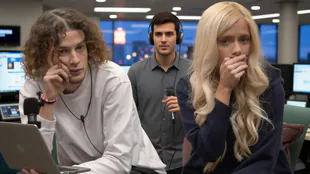 Big Brother’s Omar El Mayer Addresses Backlash, Confirms Relationship with Rhianna Collins
Like millions of Ukrainian children, Kyiv teenager Sofia Klochko is finishing up a third school year marked by war and the constant stress of air raid sirens and strikes.
"It was really difficult but I got used to it," said the blue-eyed 13-year-old, who attends school number 61 in central Kyiv, ahead of the end of the school year on Friday.
"This year, living with all these air raid alerts at night has been difficult," she said.
When the sirens go off, Klochko wakes up and goes down into the basement of her home "since there is no other option, you are afraid".
But she said things are easier now than the previous years of war.
"At least we have a kind of routine," she said.
According to a Ukrainian government study carried out in December and January, teachers have noticed that over the past two years "the emotional state of pupils has deteriorated and their motivation for learning has diminished".
Two-thirds of teachers said children have become more tired -- compared to 52 percent in the 2022-2023 school year.
Fifty percent said that children were more tense -- compared to 41 percent last school year -- and 38 percent said their pupils were more anxious against 27 percent in the previous year.
Ukraine's education system has shown extraordinary resilience, with classes resuming nationwide -- even if only remotely -- just three weeks after the start of the invasion.
But the upheaval of war is having a major negative effect on children's learning.
According to the Pisa 2022 global education ranking published in December, Ukraine has fallen 12 points in maths, 19 in science and 38 in reading, compared to the previous 2018 edition.
The decline is dramatic -- even taking into account the global "unprecedented drop" of an average of 15 points for maths and 10 points for reading as a result of the Covid pandemic.
- Remote learning -
Some children have lost their loved ones, "many have lost their homes or have had to move, the economic situation has deteriorated... This has impacted results," the deputy education minister Andriy Stashkiv told AFP.
Stashkiv also pointed out that Ukrainian children were having their Pisa tests for the study during a period of intensified Russian strikes.
Many children are taught online as 20 percent of Ukraine is occupied while 1,600 schools are damaged and over 200 are completely destroyed.
Out of more than four million Ukrainian schoolchildren before the war, 900,000 study entirely online because they live near the front line or near the Russian border and around 600,000 others are refugees abroad, Stashkiv said.
Of the refugee children, two-thirds are still being taught by Ukrainian schools online.
In Ukraine itself, the government has built bunkers for schools in an effort to bring children back to offline schooling.
Thanks to donations, it has also given out some 150,000 tablets and smartphones to families that are struggling.
"The challenges are very serious," Stashkiv said, adding that education was still a top priority for the government just behind defence.
Klochko said she was doing her best to "study with good grades" since "the future of our Ukraine rests on the shoulders of people like me".
Her school has two underground bunkers.
It is there that children and their teachers go when the air raid alerts sound, warning people about the danger of potential strikes.
- 'Want more cuddles' -
The war is also a major challenge for teachers.
"The children are tired, we are tired," said Lyudmyla Kinzerska, 49, a Ukrainian language and literature teacher for Klochko's class.
"I can't allow myself to be weak or show my emotions when we go to the bunker. I have to smile and say everything is going to be fine."
Kinzerska starts the school day speaking to the children about their nighttime experiences, about who had to go to a bunker or a metro station for shelter and who did not get any sleep.
"The war has affected everyone but each child shows it differently," she said.
But she tries to offer hope to children too.
"We try to talk more about the future. I want them to have dreams, so that the war does not take away the dreams of children," Kinzerska said.
During a lunch break, the children spill out into a large corridor and several come over to hug their headmistress, 45-year-old Nelli Ustych.
It used to happen before the war as well, but hugs have become more popular because the children just "want more cuddles", Ustych said.
O.Salim--SF-PST