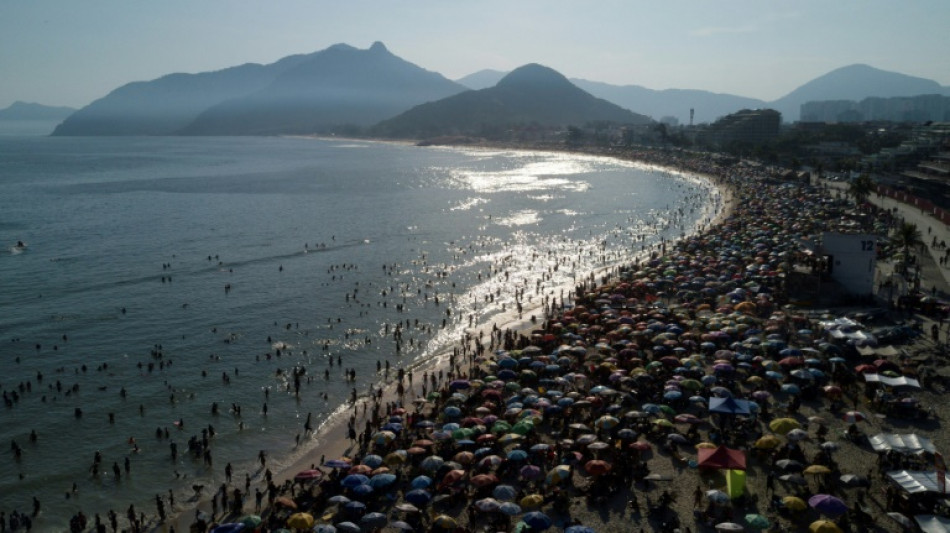
Bid to 'privatize' Brazil beaches sparks outcry / Photo: TERCIO TEIXEIRA - AFP/File

 Tamil Film 'Arivu' Selected for 57th International Film Festival of India

 أسعار الديزل في الولايات المتحدة تنخفض دون 6 دولارات لأول مرة منذ شهرين

 Why Wind Farms Paint One Turbine Blade Black to Protect Birds

 Dianna Russini Seeks Super Bowl Radio Row Credential Amid Media Return

 Clare Luvanga Leads Washington Spirit to Third Straight NWSL Championship with 2-1 Win

 Malta Stuns Sweden with Late Penalty Comeback in Rugby Europe Trophy

 BingX: Major Announcement of Far-Reaching Significance

 أونروا تحذر من أزمة إنسانية في غزة بسبب القيود على الإغاثة

 Big Brother’s Omar El Mayer Addresses Backlash, Confirms Relationship with Rhianna Collins
A proposed constitutional amendment that could see Brazil's famed beaches fall into private hands has outraged environmentalists and citizens in a country that prides itself on open access to its vast shores.
Brazil has one of the world's longest coastlines, at around 7,500 kilometers (4,600 miles) and by law beaches are public assets and thus government property. They are largely pristine, without the eyesore high-rise condos and hotels common at seaside resorts in other countries.
However, a proposal to change the government ownership rule has been making its way through Congress, promoted by senator Flavio Bolsonaro, son of ex-president Jair Bolsonaro who often said while in office that he dreamed of creating the "Brazilian Cancun" -- a nod to Mexico's hub of mega resorts.
The idea is to transfer ownership of coastal land to states, municipalities and private occupants, which critics say could damage environmental protection efforts and block beach access.
A senate public hearing on Monday sparked outrage on social media.
"Let's pressure the senators to vote against this proposal," said Brazilian actress and environmental activist Laila Zaid in an Instagram video viewed almost one million times.
The furore comes as Brazil is tackling historic flooding in its south, which experts attribute to climate change.
Leticia Camargo, who coordinates a working group on marine conservation in Congress, told AFP the proposal could "lead to greater occupation of marine land right at a time when climate change will make storm surges and coastal erosion increasingly frequent."
She said the move could also open up "pressure for very large real estate interests."
The proposal has already been approved by the lower house, and Camargo said it would likely be approved by the Senate Constitution and Justice Committee, where the right-wing opposition has a majority.
It then heads to the full Senate for a vote.
Camargo says she is positive the pressure from the public could stall the amendment.
Local media reported senate president Rodrigo Pacheco will not immediately put the matter on the agenda for a vote.
Flavio Bolsonaro said on X it was "fake news" that the aim was to privatize beaches.
Daniel Capecchi, a constitutional law professor at the Federal University of Rio de Janeiro, said that if it went to a vote, there was a "considerable probability" the measure would be approved.
However, he said if studies prove the change will have a severe environmental impact it could be challenged in court as a violation of the unalterable constitutional right to an ecologically balanced environment.
Camargo said the fierce public reaction shows "that if you mess with Brazilian culture in such a serious way, which is our access and our use of the beach, you touch a serious issue."
A.Suleiman--SF-PST