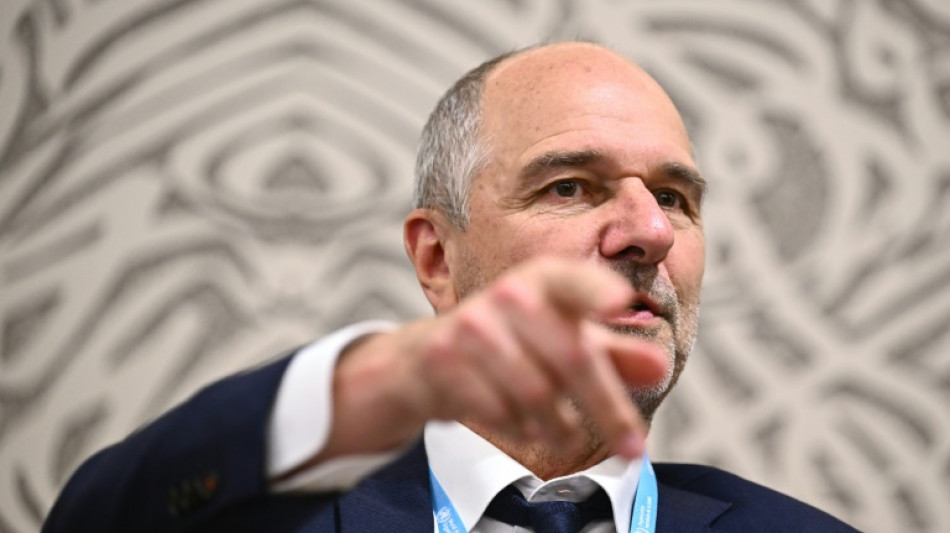
Israel's Rafah incursion taking dire health toll: WHO / Photo: Fabrice COFFRINI - AFP

 Swiss reject plan to toughen neutrality

 Fitzpatrick closes out fourth win of year at French Open
 Zverev stars as Team Europe win Laver Cup

 UK PM urges 'calm' as thousands block flashpoint N.Ireland parade

 China's Yan one and done after golden Asian Games throw

 Kiss praises Wallabies' composure after wild Test finish

 एलेक्स बोडी और प्रो. डॉ. डायटर लाज़िक ने ALPHA WHEY और BODI एनर्जी ड्रिंक के लिए एक अनुबंध पर हस्ताक्षर किए

 Alex Bodi a prof. dr. Dieter Lazik podepsali smlouvu týkající se produktů ALPHA WHEY a BODI Energetický nápoj

 Banton takes England to 355-7 in Sri Lanka ODI decider

 أليكس بودي والبروفيسور الدكتور ديتر لازيك يوقعان عقدًا بشأن منتجي «ألفا ويل» و«بودي إنيرجي درينك»

 알렉스 보디와 디터 라지크 교수가 ALPHA WHEY 및 BODI 에너지드링크에 관한 계약을 체결했습니다.

 亞歷克斯·博迪(Alex Bodi)與迪特爾·拉齊克(Dieter Lazik)教授簽署關於 ALPHA WHEY 及 BODI 能量飲料的合約

 Алекс Боді та проф. д-р Дітер Лазік уклали договір щодо ALPHA WHEY та Боді Енергетичний напій

 Алекс Боди и проф. д-р Дитер Лазик заключили договор о выпуске продуктов ALPHA WHEY и BODI Энергетический напиток

 West Indies reach 295-7 after Greaves ton in India ODI

 England closing the gap on Spain says Kane
 Inspired Wallabies notch statement Test win over Springboks

 Assefa's world record bid at Berlin Marathon foiled by injury

 Alex Bodi and Prof. Dr Dieter Lazik sign a contract for ALPHA WHEY and BODI Energy Drink

 Swiss reject plan to toughen neutrality: projection

 UK police call in bomb disposal team near air force base

 Bangkok floods send thousands into shelters after days of rain

 Assefa just misses women's world record at Berlin Marathon

 Dramatic winners Zimbabwe to end five-year exile by tackling DR Congo

 Pope to meet victims of clerical sex abuse on France trip

Israel's military offensive in Rafah is already taking a dire health toll in southern Gaza, and if it continues, "substantial" increases in deaths can be expected, a top WHO official warned Tuesday.
Since Israel launched its long-threatened Rafah incursion in early May, access to healthcare in Gaza's southernmost city has been devastated, said Rik Peeperkorn, the World Health Organization's representative in the Palestinian territories.
Speaking to AFP and Reuters in a joint interview in Geneva, he pointed to the around one million people on the move since the incursion, which has left two of Rafah's three hospitals completely disfunctional.
Al-Najar, Rafah's most important hospital, which had been servicing 700 dialysis patients from all over the Palestinian territory, has shut down, as has the Kuwaiti hospital.
And the Emirati maternity and paediatric hospital was now "barely functional", Peeperkorn said, pointing out that it could no longer accept new patients.
"If the incursion would continue, we would lose that last hospital in Rafah," he warned.
That would mean that around 1.9 million people in southern Gaza will basically be fully dependent on a string of field hospitals along the coast.
It would still be possible to be referred to the Al Aqsa hospital in the middle part of Gaza, and Peeperkorn pointed out that WHO had helped revive two recently defunct hospitals in Khan Yunis, also in central Gaza.
- 'A band-aid' -
But while that might sound like "a contingency plan", he stressed that "if there will be a full incursion (in Rafah)... this contingency plan is like a band-aid".
"It will not prevent what we expect: substantial additional mortality and morbidity."
Already, WHO and other aid organisations are struggling to keep humanitarian operations running, as bringing fuel and other aid into the Palestinian territory has been significantly hampered by the closure and disruption of two key crossings.
"There are currently 60 WHO trucks (in Egypt) waiting to get into Gaza," Peeperkorn said, adding that only three trucks with medical supplies had crossed in since May 7.
And even when medical and other aid makes it into Gaza, it remains "very challenging" to transport and deliver the goods both in the south and to the north, he said.
The Gaza war began after Hamas fighters attacked southern Israel on October 7, resulting in the deaths of more than 1,170 people, mostly civilians, according to an AFP tally based on Israeli official figures.
Palestinian militants also took 252 hostages, 121 of whom remain in Gaza, including 37 the Israeli army says are dead.
Israel's relentless military retaliation has killed at least 36,096 people in Gaza, mostly civilians, according to the Hamas-run territory's health ministry.
- 'Very concerned' -
The United Nations has long warned of looming famine, especially in the north of besieged Gaza.
And since the Rafah incursion, Peeperkorn said he was becoming increasingly worried about malnutrition in the south.
He said that during a mission to the north in April he had been somewhat relieved to see signs that access to food might be improving slightly.
"There was more food on the market, it was a bit more diverse," he said.
And while the hospitals he visited then were still full of severely malnourished children -- "two-year-olds weighing only four kilos" -- he said he had been hopeful that the situation might be on "a better trajectory".
But now, with the impact of the Rafah incursion already taking a heavy toll on access to aid and healthcare, he said that "we fear that instead of (being) on the right trajectory with regard to malnutrition, we will see very quickly a reverse again".
"We are very concerned."
Asked if he feared more people could eventually die from otherwise non-life-threatening injuries and disease or malnutrition-linked causes, than from the fighting itself, he said: "I would really hope... that this is not going to happen".
Y.AlMasri--SF-PST