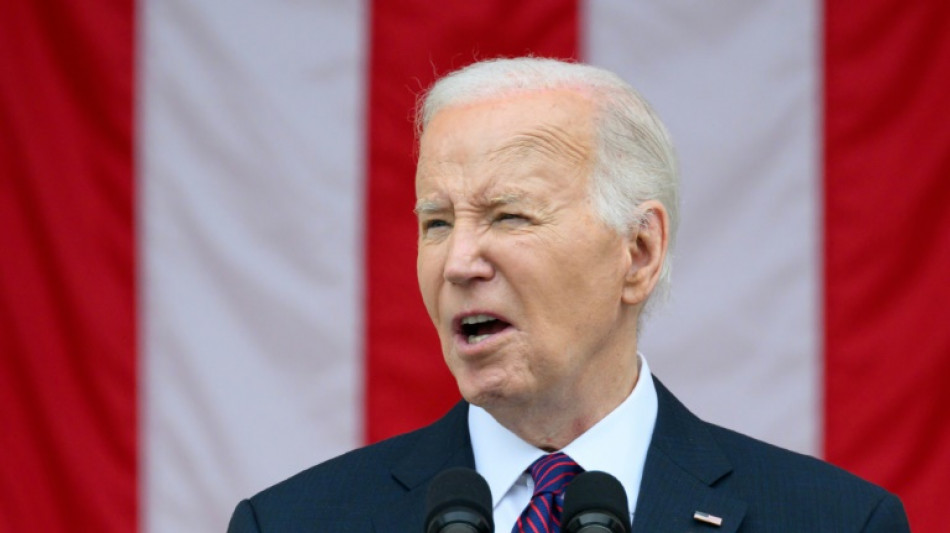
Biden's blurred red lines on Rafah under pressure / Photo: Mandel NGAN - AFP

 Tamil Film 'Arivu' Selected for 57th International Film Festival of India

 أسعار الديزل في الولايات المتحدة تنخفض دون 6 دولارات لأول مرة منذ شهرين

 Why Wind Farms Paint One Turbine Blade Black to Protect Birds

 Dianna Russini Seeks Super Bowl Radio Row Credential Amid Media Return

 Clare Luvanga Leads Washington Spirit to Third Straight NWSL Championship with 2-1 Win

 Malta Stuns Sweden with Late Penalty Comeback in Rugby Europe Trophy

 BingX: Major Announcement of Far-Reaching Significance

 أونروا تحذر من أزمة إنسانية في غزة بسبب القيود على الإغاثة
 Big Brother’s Omar El Mayer Addresses Backlash, Confirms Relationship with Rhianna Collins
Joe Biden's red lines have repeatedly shifted when it comes to Israel's assault on Rafah, but the US president faces growing pressure to firm up his stance after a deadly strike in the Gazan city.
Global outrage erupted after the Israeli attack that killed 45 people in a camp for displaced people on Sunday, despite repeated calls by Washington for its key ally Israel to do more to protect civilians as it pursues its war against Hamas.
Facing US campus protests and a tough reelection battle, Biden said earlier this month that he would not supply Israel with weapons for a major invasion of Rafah, and he halted a shipment of bombs.
But the White House has kept its red line on what constitutes such an offensive deliberately vague, even as Israel steps up attacks and, as of Tuesday, pushed tanks into central Rafah.
"There's no mathematical formula," US National Security Advisor Jake Sullivan said last week.
"What we're going to be looking at is whether there is a lot of death and destruction from this operation or if it is more precise and proportional."
Biden would likely try to continue that balancing act as long as possible amid a generally "inchoate" policy on the conflict, said Colin Clarke, Director of Research at the Soufan Group.
"Biden wants to appear tough on Rafah, and has really tried to be stern with (Israeli Prime Minister Benjamin) Netanyahu, but in an election year, his red lines are increasingly blurred," Clarke told AFP.
"I think he'll continue shifting those lines, ducking and weaving, largely in response to events on the ground."
For now, Washington gave no sign it had changed its mind despite horrifying scenes of what witnesses said were charred and mutilated bodies, including those of children, at the scene of the Rafah camp strike.
Vice President Kamala Harris told reporters on Tuesday that "the word tragic doesn’t even begin to describe it" but didn't respond when asked if it crossed the US line.
- 'Genuinely empathizes' -
US officials were still assessing what had happened in what Netanyahu called a "tragic accident." Israel's military says it targeted two senior Hamas militants and insisted Tuesday its munitions alone could not have caused the blaze that killed the civilians.
The White House gave a muted reaction on Monday saying that while Israel "must take every precaution possible to protect civilians" it was still "actively engaging" with the Israeli military to figure out what went on.
But internationally the pressure is growing on Biden, a self-described Zionist who has stuck by Netanyahu despite deep disagreements since the war began with the October 7 Hamas attack.
Questions are mounting over how long the United States can tolerate an Israeli assault on Rafah when the International Court of Justice -- the UN's top court, of which both the US and Israel are members -- ordered it to stop.
Political pressure is also mounting on Biden at home in a year when the 81-year-old faces a bitter election rematch with former president Donald Trump.
Protests against his support for Israel have roiled university campuses across the United States, while many on the left wing of his Democratic Party also oppose his stance.
Republicans however have assailed Biden over what they say is his faltering support for Israel, with US House Speaker Mike Johnson inviting Netanyahu to address Congress.
"I think in his heart of hearts, Biden wants to end the Israeli siege of Rafah because he genuinely empathizes with the suffering of the Palestinian people," added Clarke.
But with US cabinet members pushing for a wider deal for Saudi Arabia to normalize relations with Israel "he's got to keep an open line with Netanyahu and his inner circle, even if it pains him."
V.AbuAwwad--SF-PST