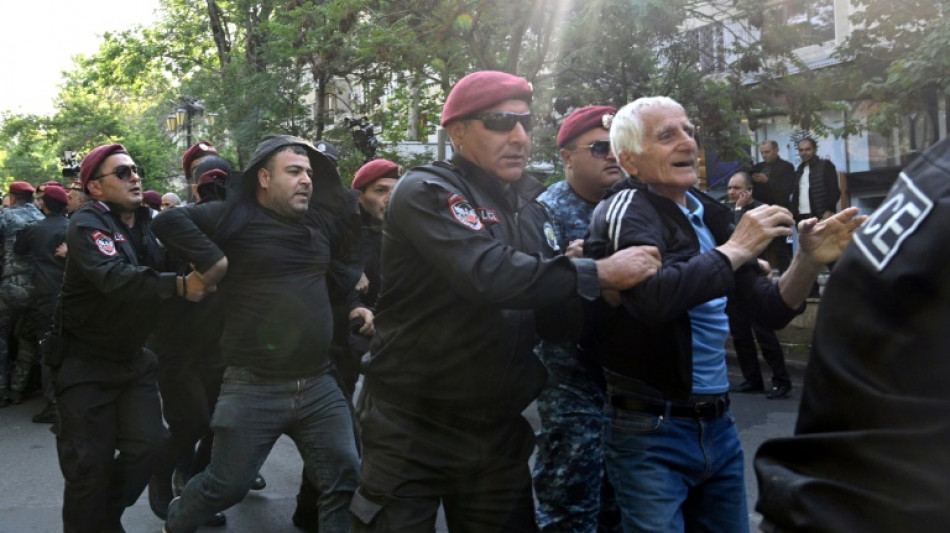
Armenia says detained 273 anti-government protesters / Photo: KAREN MINASYAN - AFP

 Tamil Film 'Arivu' Selected for 57th International Film Festival of India

 أسعار الديزل في الولايات المتحدة تنخفض دون 6 دولارات لأول مرة منذ شهرين

 Why Wind Farms Paint One Turbine Blade Black to Protect Birds

 Dianna Russini Seeks Super Bowl Radio Row Credential Amid Media Return

 Clare Luvanga Leads Washington Spirit to Third Straight NWSL Championship with 2-1 Win

 Malta Stuns Sweden with Late Penalty Comeback in Rugby Europe Trophy

 BingX: Major Announcement of Far-Reaching Significance

 أونروا تحذر من أزمة إنسانية في غزة بسبب القيود على الإغاثة
 Big Brother’s Omar El Mayer Addresses Backlash, Confirms Relationship with Rhianna Collins
Armenia said on Monday police had detained hundreds of demonstrators demanding the resignation of Prime Minister Nikol Pashinyan over territorial concessions made to arch foe Azerbaijan.
Protests erupted in the Caucasus nation last month after the government agreed to hand territory it had controlled since the 1990s back to neighbouring Azerbaijan.
Pashinyan's position remains unshaken despite the challenge mounted by charismatic archbishop Bagrat Galstanyan, who is trying to launch an impeachment process against him.
Pashinyan, a former journalist and opposition lawmaker, came to power in a peaceful revolution after leading street protests in 2018.
On Monday, hundreds of protestors took to the streets across Armenia, trying to block roads in what Galstanyan has called a "nationwide campaign of disobedience."
The interior ministry said that by 0900 GMT "a total of 273 citizens were detained for disobeying the lawful demands of police."
- Firm grip on power -
Last week, Yerevan returned control over four border villages it had seized decades ago to Azerbaijan, a key step toward normalising ties between the two countries -- who fought two wars for control of the Nagorno-Karabakh region.
The area Armenia has handed back is strategically important for the landlocked country because it controls sections of a vital highway to Georgia.
Armenian residents of nearby settlements say the move cuts them off from the rest of the country and they have accused Pashinyan of giving away territory without getting anything in return.
Pashinyan defended the territorial concessions, saying they were aimed at securing peace with Baku.
On Sunday, several thousand people flooded Yerevan's central Republic Square in a fresh protest spearheaded by Galstanyan.
The archbishop hails from the Tavush region, where the four villages handed over to Azerbaijan are located.
Galstanyan said he would renounce his clerical office to run for prime minister and called for snap parliamentary elections.
Under Armenian law, he is not eligible to hold that office because he has dual citizenship -- Armenian and Canadian.
Despite Yerevan's disastrous military defeat to Azerbaijan in 2020 and the loss of Karabakh last year, Pashinyan's grip on power remains firm.
His governing coalition holds a comfortable majority in parliament, and opposition parties are largely unpopular within society at large.
They would require the support of at least one independent or ruling party MP to launch the impeachment process, and its success would then require at least 18 lawmakers from Pashinyan's own party voting to unseat him.
Azerbaijan recaptured Karabakh in a lightning offensive last year against Armenian separatists who had held sway over the mountainous enclave for three decades.
The region's entire Armenian population -- more than 100,000 people -- fled to Armenia in the aftermath.
I.Yassin--SF-PST