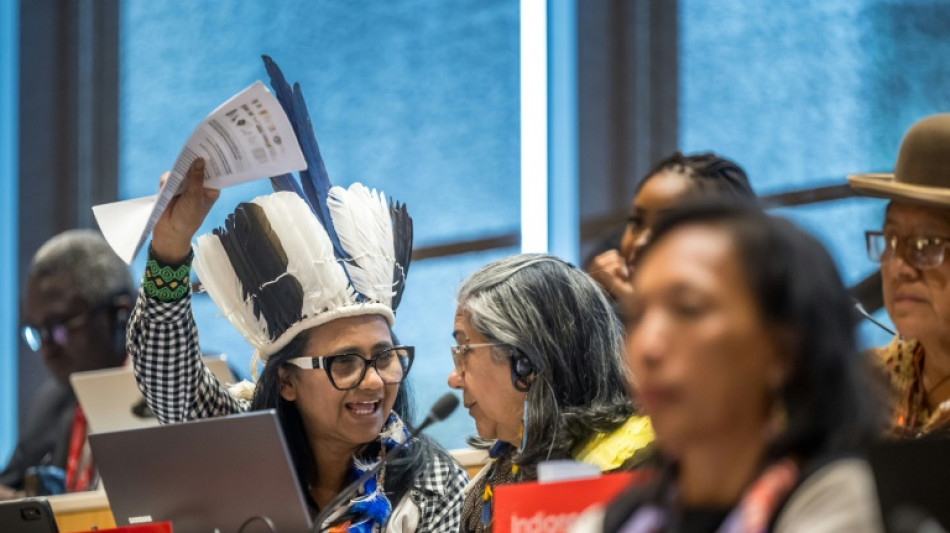
Celebrations as new biopiracy treaty agreed at UN / Photo: Fabrice COFFRINI - AFP

 UK village on edge over threats to air base in terror alert

 Two giant pandas, emblems of China soft diplomacy, arrive in US

 Aleksandar Vucic: from Milosevic minister to long-serving Serbian statesman

 Trump expects new Iran talks despite rejecting deal offer

 Xavi gets first win as Netherlands boss, Denmark beat Wales

 Madrid housing protest camp enters second night as PM vows action

 Tigray TV station hit by drone, rebels advance in north Ethiopia

 Banton hundred paves way for England ODI series win over Sri Lanka

 Milestone man Kohli powers India to big ODI win over West Indies

 Swiss reject plan to toughen neutrality

 Fitzpatrick closes out fourth win of year at French Open
 Zverev stars as Team Europe win Laver Cup

 UK PM urges 'calm' as thousands block flashpoint N.Ireland parade

 China's Yan one and done after golden Asian Games throw

 Kiss praises Wallabies' composure after wild Test finish
 एलेक्स बोडी और प्रो. डॉ. डायटर लाज़िक ने ALPHA WHEY और BODI एनर्जी ड्रिंक के लिए एक अनुबंध पर हस्ताक्षर किए

 Alex Bodi a prof. dr. Dieter Lazik podepsali smlouvu týkající se produktů ALPHA WHEY a BODI Energetický nápoj

 Banton takes England to 355-7 in Sri Lanka ODI decider

 أليكس بودي والبروفيسور الدكتور ديتر لازيك يوقعان عقدًا بشأن منتجي «ألفا ويل» و«بودي إنيرجي درينك»

 알렉스 보디와 디터 라지크 교수가 ALPHA WHEY 및 BODI 에너지드링크에 관한 계약을 체결했습니다.

 亞歷克斯·博迪(Alex Bodi)與迪特爾·拉齊克(Dieter Lazik)教授簽署關於 ALPHA WHEY 及 BODI 能量飲料的合約

 Алекс Боді та проф. д-р Дітер Лазік уклали договір щодо ALPHA WHEY та Боді Енергетичний напій

 Алекс Боди и проф. д-р Дитер Лазик заключили договор о выпуске продуктов ALPHA WHEY и BODI Энергетический напиток

 West Indies reach 295-7 after Greaves ton in India ODI

 England closing the gap on Spain says Kane

Representatives of Indigenous peoples celebrated Friday at the United Nations following the agreement of a treaty against the pillaging of their traditional knowledge and genetic resources, like those from medicinal plants.
The new treaty, agreed by more than 190 nations, aims to combat so-called biopiracy by making applicants for patents disclose the origins of such materials used in a new invention.
Genetic resources -- such as those found in medicinal plants, agricultural crops and animal breeds -- are increasingly used by companies in everything from cosmetics to seeds, medicines, biotechnology and food supplements.
The idea is to increase intellectual property transparency on Indigenous people's traditional knowledge about resources, but the treaty does not address potential compensation for those communities.
The treaty is the culmination of more than 20 years of work at the UN's innovation and patenting agency -- the World Intellectual Property Organization (WIPO).
"Here we are not simply making history but the foundation for a sustainable future for all," the Indigenous Caucus group said after the deal was struck.
The treaty "finally recognises the crucial role that Indigenous peoples play in protecting these resources, ensuring their survival by transmitting our traditional knowledge from generation to generation.
WIPO said it was the first treaty to address "the interface between intellectual property, genetic resources and traditional knowledge".
- Sanctions debate -
Genetic resources have enabled considerable progress in health, climate and food security, according to the UN.
While natural genetic resources -- such as those found in medicinal plants -- cannot be directly protected as intellectual property, inventions developed using them can be patented.
But many developing countries were concerned that patents were being granted that circumvented the rights of Indigenous peoples.
The treaty text says patent applicants will be required to disclose where the genetic resources used in an invention came from, and the Indigenous people who provided the associated traditional knowledge.
The goal is to combat biopiracy by ensuring that an invention is genuinely new, and that the countries and local communities concerned agree with the use of their genetic resources, such as plant species cultivated over time, and the traditional knowledge surrounding them.
The treaty establishes sanctions, which would be imposed in accordance with the laws of countries that adopt the agreement
Some developing countries wanted to be able to revoke patents easily, while wealthy countries argued that stiff penalties would hamper innovation.
"We commend the outcome achieved, which strikes a fine balance between fostering innovation and enhancing transparency in the patent system," the Netherlands said on behalf of a group of mostly Western countries.
The treaty will enter into force once 15 countries have ratified it.
- 'Balanced outcome' -
Negotiations to finalise the treaty began at WIPO's Geneva headquarters on May 13.
Brazilian ambassador Guilherme de Aguiar Patriota, who has chaired the talks, hailed the new treaty early Friday as a "very carefully balanced outcome".
More than 30 countries already have disclosure requirements in their national laws.
Most of these are emerging and developing economies, including China, Brazil, India and South Africa, but others are European states, such as France, Germany and Switzerland.
However, those procedures vary and are not always mandatory.
The new treaty text says countries "shall provide an opportunity to rectify a failure to disclose the information required... before implementing sanctions".
However, that opportunity does not need to be extended in "cases where there has been fraudulent conduct or intent as prescribed by national law".
The treaty also says no country "shall revoke, invalidate, or render unenforceable" a patent solely because the applicant failed to disclose the necessary information.
Developing countries have long been calling for greater transparency on the origin of genetic resources.
I.Matar--SF-PST