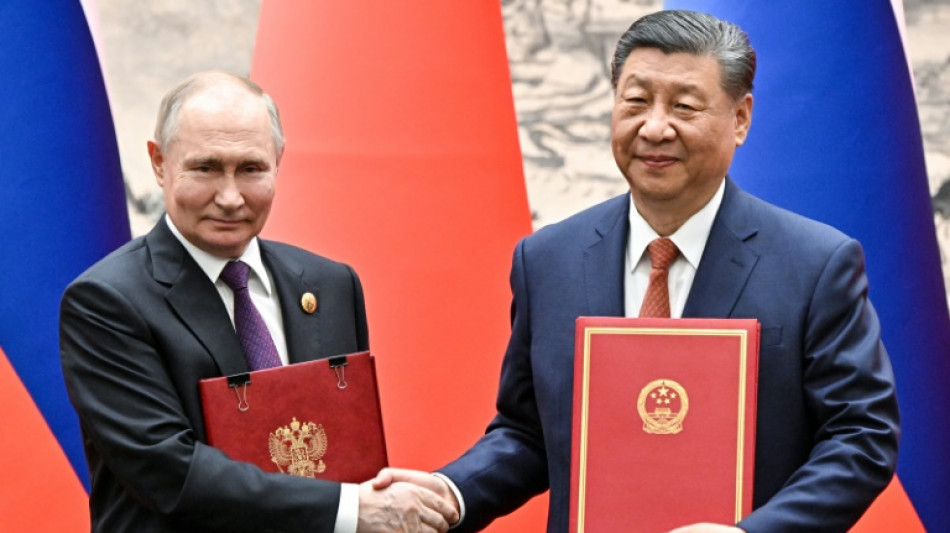
Despite Western pressure, China in no hurry to reduce Russia support / Photo: Sergei BOBYLYOV - POOL/AFP

 Indiana River Otters Make Comeback After Decades of Conservation Efforts

 Tamil Film 'Arivu' Selected for 57th International Film Festival of India

 أسعار الديزل في الولايات المتحدة تنخفض دون 6 دولارات لأول مرة منذ شهرين
 Why Wind Farms Paint One Turbine Blade Black to Protect Birds

 Dianna Russini Seeks Super Bowl Radio Row Credential Amid Media Return
 Clare Luvanga Leads Washington Spirit to Third Straight NWSL Championship with 2-1 Win

 Malta Stuns Sweden with Late Penalty Comeback in Rugby Europe Trophy

 BingX: Major Announcement of Far-Reaching Significance
 أونروا تحذر من أزمة إنسانية في غزة بسبب القيود على الإغاثة
 Big Brother’s Omar El Mayer Addresses Backlash, Confirms Relationship with Rhianna Collins
Despite Western calls on China to cut its support for Moscow's war against Ukraine by limiting supplies of dual-use materials and weapons components to Russia, Beijing has no interest in dropping its backing for President Vladimir Putin, analysts say.
While China does not want to upend its ties with the West, and insists it is not sending lethal weapons to Moscow, Washington has stressed that Russia would struggle to sustain its assault on Ukraine without Beijing.
On Thursday, Putin arrived in China on a two-day visit as Moscow is seeking more support from President Xi Jinping for the war effort in Ukraine following multiple rounds of Western sanctions.
The high-profile talks follow Xi's summit last week in Paris with French President Emmanuel Macron, who welcomed "commitments" of China to "control strictly" the exports of dual-use goods while also evoking concern about "information that we may have" about violations by certain Chinese companies.
European Commission President Ursula von der Leyen, who also joined those talks, said that "more effort is needed to curtail delivery of dual-use goods to Russia that find their way to the battlefield."
"Providing Russia with dual-use components rather than finished weapons has allowed China to provide support for Russia while claiming plausible deniability," wrote Nathaniel Sher, a senior research analyst at Carnegie China.
"Even if Beijing curtails dual-use exports in order to avoid further sanctions, its strategic interest in Russia remaining a stable partner will persist."
Citing customs data, Sher said that every month, China is exporting over $300 million worth of dual-use products identified by the United States, the European Union, Japan and the United Kingdom as "high priority" items necessary for Russia's weapons production.
Such items refer to 50 dual-use products such as microelectronics, machine tools, radars and sensors, that are essential for manufacturing weaponry like missiles, drones and tanks, according to the think tank.
- Jet-parts to Russia -
The Center for Strategic and International Studies (CSIS) said that according to some estimates, Beijing's overall share in Russian imports of machine tool parts jumped to 80–90 percent in 2023.
"Throughout the war, China has sold millions of dollars' worth of semiconductors, chips, ball bearings, navigation equipment, parts for fighter jets, and other components to Russia," the Washington-based think tank said in a recent report.
"This has ultimately enabled the Kremlin to speed up its weapons production, including armor, artillery, missiles, and drones, and put up an effective defense against Ukraine's 2023 counteroffensive."
Western officials have repeatedly expressed concern about transfers of dual-use materials from Chinese businesses to Russia.
On a visit to China in April, US Treasury Secretary Janet Yellen warned Chinese officials of the consequences of supporting Russia's military procurement efforts.
"However, Beijing has done little to prevent such transactions, given the rise in dual-use trade with Russia," said Sher.
"Increasingly deep links between the Chinese party-state and private firms make it difficult to imagine a scenario in which Beijing would not have foreknowledge of dual-use transactions with Russia, especially in highly sensitive domains," he said.
- 'Overreliance' on China -
The scale of Chinese aid puts Russia in a delicate position.
"Such overreliance makes Russia critically dependent on maintaining good relations with China," the CSIS said in the report.
Putin, who has become a virtual pariah in the West, has little choice.
Marc Julienne, director of the Centre for Asian Studies at the French Institute of International Relations (IFRI), said Beijing needed to perform a careful balancing act.
Its relationship with Moscow serves its geostrategic interests, but it is not in China's interests to allow Russia to become "too weakened" and rely solely on China, he said.
"Beijing now benefits much more from staying out of the conflict than from getting directly involved," Julienne told AFP.
While China has emerged as Russia's most important partner, Moscow has been relying on other countries in its war effort as well.
A Ukrainian government website called War & Sanctions has a database of components found in Russian weaponry originating from over 30 countries.
In Kyiv, AFP journalists have been shown a Russian drone carburettor inscribed with "Made in Ireland" and Japanese camera lenses from a Russian Kartograf reconnaissance drone.
Nearly all of the top suppliers of microelectronics into Russia are based in China and Hong Kong, with one outfit based in Turkey, according to the CSIS.
M.Qasim--SF-PST