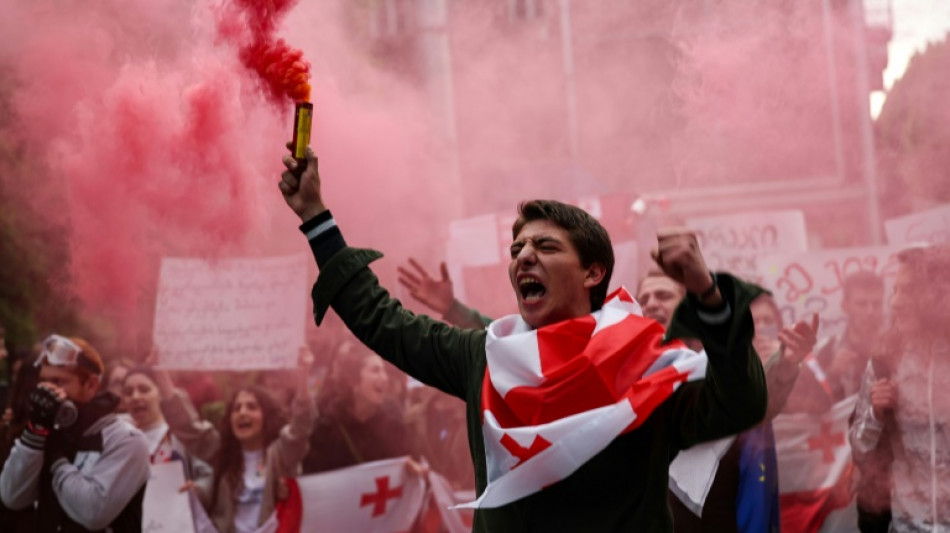
Western allies denounce Georgia 'foreign influence' law / Photo: Giorgi ARJEVANIDZE - AFP

 Indiana River Otters Make Comeback After Decades of Conservation Efforts

 Tamil Film 'Arivu' Selected for 57th International Film Festival of India

 أسعار الديزل في الولايات المتحدة تنخفض دون 6 دولارات لأول مرة منذ شهرين
 Why Wind Farms Paint One Turbine Blade Black to Protect Birds

 Dianna Russini Seeks Super Bowl Radio Row Credential Amid Media Return
 Clare Luvanga Leads Washington Spirit to Third Straight NWSL Championship with 2-1 Win

 Malta Stuns Sweden with Late Penalty Comeback in Rugby Europe Trophy

 BingX: Major Announcement of Far-Reaching Significance
 أونروا تحذر من أزمة إنسانية في غزة بسبب القيود على الإغاثة
 Big Brother’s Omar El Mayer Addresses Backlash, Confirms Relationship with Rhianna Collins
Georgia faced a blizzard of international condemnation Wednesday as the EU, NATO and UN slammed the adoption of a controversial "foreign influence" law targeting overseas-funded NGOs.
Ruling party lawmakers voted through the legislation Tuesday in defiance of protesters worried the Caucasus country is shifting away from its pro-Western course towards Russia.
The move was divisive in the ex-Soviet republic, where according to opinion polls most of the population wants to join the European Union and NATO, and is staunchly anti-Kremlin.
"The adoption of this law negatively impacts Georgia's progress on the EU path," EU foreign policy chief Josep Borrell said in a joint statement with the European Commission.
"We urge the Georgian authorities to withdraw the law."
The EU statement reiterated condemnation for "intimidation, threats and physical assaults on civil society representatives, political leaders and journalists" during demonstrations against the law.
A spokeswoman for the NATO military alliance said the law was a "step in the wrong direction... away from European and Euro-Atlantic integration".
"We urge Georgia to change course and respect the right to peaceful protest," said NATO spokeswoman Farah Dakhlallah.
UN human rights chief Volker Turk said in a statement he "deeply regrets" Georgia's adoption of the law.
"Authorities and lawmakers have chosen to disregard the many warnings by human rights defenders and civil society organisations," Turk said.
"The impacts on the rights to freedom of expression and association in Georgia unfortunately now risk being significant."
- 'Kremlin-style law' -
The flurry of criticism came after the United States Tuesday warned the "Kremlin-style" law would hit Washington's ties with Georgia if it was not withdrawn.
Georgian President Salome Zurabishvili, who is at loggerheads with the government, has vowed to veto the law, though the ruling Georgian Dream party has enough lawmakers in parliament to override her veto.
The bill requires NGOs and media outlets that receive more than 20 percent of their funding from abroad to register as bodies "pursuing the interests of a foreign power".
Critics say it mirrors repressive Russian legislation used to silence dissent, in a symbol of the ex-Soviet republic's drift closer to Russia's orbit in recent years.
Protests have sprung up against it, and scuffles have even broken out inside parliament between opposition lawmakers and members of the Georgian Dream party.
Georgian Dream has sought to depict the protesters as violent mobs. It insists it is committed to joining the EU, and portrays the bill as aimed at increasing transparency of NGO funding.
burs-del/raz/jj
Z.Ramadan--SF-PST