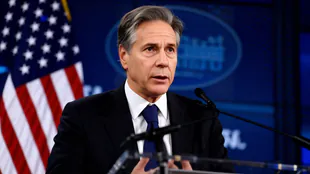
Russia's Kharkiv push aims to stretch Ukraine forces: analysts / Photo: SERGEY BOBOK - AFP

 Indiana River Otters Make Comeback After Decades of Conservation Efforts

 Tamil Film 'Arivu' Selected for 57th International Film Festival of India

 أسعار الديزل في الولايات المتحدة تنخفض دون 6 دولارات لأول مرة منذ شهرين

 Why Wind Farms Paint One Turbine Blade Black to Protect Birds

 Dianna Russini Seeks Super Bowl Radio Row Credential Amid Media Return
 Clare Luvanga Leads Washington Spirit to Third Straight NWSL Championship with 2-1 Win

 Malta Stuns Sweden with Late Penalty Comeback in Rugby Europe Trophy

Russia's offensive around Ukraine's Kharkiv likely aims more at presenting Kyiv with a strategic quandary over where to deploy its already stretched forces than taking the major city, experts say.
Moscow's troops were by Monday firing on around 30 villages in the northeast region and had occupied tens of square kilometres (miles) in the space of a few days.
But analysts don't see Russia's immediate aim as taking Ukraine's second-largest city, with a pre-war population of 1.4 million, after Moscow already failed to capture the industrial hub in its initial invasion from February 2022.
"This Russian force is of insufficient size to seize a city the size of Kharkiv," Australian former general Mick Ryan wrote on blogging platform Substack.
"It could however hold it at risk with increased artillery strikes," he added, saying the coming weeks "may be one of the toughest moments for Ukraine in the war so far".
Over the two years of its invasion, Russia has been running complementary campaigns of attrition of men and materiel on the battlefield and public opinion among Kyiv's allies.
It still holds a numerical advantage, bolstered by the months of dallying in Washington over the $61-billion aid package finally passed in April.
The Ukrainians "were forced to ration their shells and war materiel for months, leading to higher attrition rates," said Ivan Klyszcz of the Estonia-based International Center for Defense and Security (ICDS).
- Shorter supply lines -
"The promise of new US military support meant that the rationing does not need to be as rigorous anymore," Klyszcz added, although Kyiv "must continue to hold as much territory and preserve as many forces as possible".
Following the failure of Ukraine's offensive last summer and the "rasputitsa" period of melting snow and thick mud across the country, the initiative is now back with Russia.
Moscow is also able to absorb punishing losses given its "human reserves and industrial capacity much greater than Ukraine's," said Pierre Razoux of the Mediterranean Foundation for Strategic Studies (FMES).
Russia's government says it wants to create a "buffer zone" to protect its border region of Belgorod that has regularly come under bombardment.
The Kharkiv region's location on the border means "the Russians can mobilise air support, drones and artillery, firing from within their territory, giving them shorter supply lines and the cover of air superiority," Razoux said. "They're in an optimal position".
Ukraine for its part faces a basic strategic dilemma.
"They have to defend the front line, but also strategic sites that they must not lose," Razoux added, highlighting especially major cities and the roads linking them back to Ukraine's western boundaries with Romania and Poland.
The question for the defenders is "what's more important, defending a key objective or holding the front line?" he asked.
- 'Military and political' -
For now, pulling off both missions seems out of Kyiv's reach.
"This is both a military and a political issue," Ryan wrote. "If the Ukrainians decide to hold ground at all costs, they will lose more of their increasingly smaller army; if they chose to preserve their army, they will have to give up ground."
It may not be immediately clear whether the Russians can pull off a major push in the northeast, and it will take still longer for any strategic impact to show up elsewhere along the front line.
"There does not seem to be a fundamental change in (Russian) strategy," Klyszcz said, as "capturing the entire Donbas region... appears a higher priority for Russia at this stage".
Retired French general Olivier Kempf wrote on his blog that Russia's push into the Kharkiv region "is evidence of weak initial resistance".
Ukrainian forces would have avoided "expending too many forces in salients that are tricky to defend," he added.
"Now we will see the intentions and capabilities of both sides," Kempf predicted, judging the ground taken so far "not necessarily significant".
Russian leader Vladimir Putin is likely aiming to change minds further from the fighting, including among Kyiv's Western allies.
His attention will be on the upcoming American presidential election and the possible return to power of Donald Trump, who has little interest in keeping up Ukraine aid.
"If Ukraine flags before the election, Trump would take it as proof Joe Biden is a loser who bet on the wrong horse," Razoux said.
R.AbuNasser--SF-PST