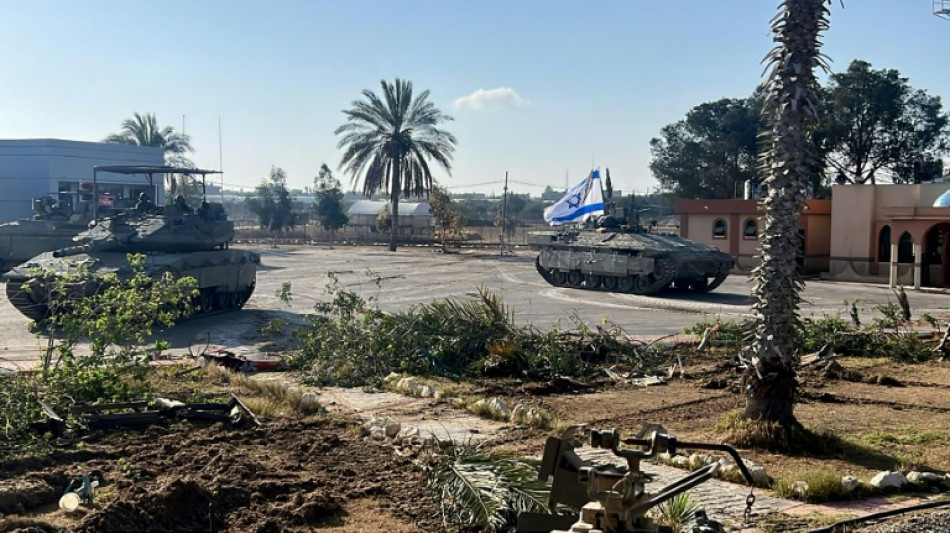
UN official says Israel closure of Gaza crossings 'completely crippling' aid / Photo: - - Israeli Army/AFP

 حملة طبية مجانية في حزما تخفف الأعباء عن سكان القدس

 بلينكن يحذر من 'مغامرة طائشة' في الحرب على إيران ويؤكد خروجها أقوى

 وكالة الفضاء الأوروبية تطلق بيانات «إقليدس» لرسم خريطة كونية تضم 900 مليون مجرة

 Suede and Manic Street Preachers Deliver Electrifying Co-Headline Performance at Motorpoint Arena
 Trump Reduces Public Appearances Amid CIA-Mossad Warnings of Iranian Drone Plot

 Make-A-Wish Announces 2026 Starblazer Award Honorees; Allied World Becomes First Corporate Founder

 فنان من غزة يفوز بجائزة "كاتب الشجاعة" البريطانية

 عصام غالب عواد: الفلسطيني في قفص الاتهام.. حين يُجبر صاحب المأساة على الاعتذار قبل أن يرويها

Israel's closure of key crossings into Gaza has cut off the main entry point for aid, and particularly fuel, rendering humanitarian operations all but impossible, a senior UN official warned Thursday.
"We lost the main entry point for all humanitarian aid," said Andrea De Domenico, who heads the United Nations humanitarian office, OCHA, in the occupied Palestinian territories.
Israel on Sunday closed the key Kerem Shalom crossing between Israel and southern Gaza, through which most humanitarian aid enters the Palestinian territory, after a barrage of Hamas missiles killed four Israeli soldiers in the area.
On Tuesday, the Israeli army seized and closed down the Palestinian side of the nearby Rafah crossing between Egypt and Gaza after ordering residents of eastern Rafah to evacuate.
In an interview with AFP, De Domenico said that although Israel says it reopened Kerem Shalom on Wednesday, getting aid through remains extremely tricky.
And the Rafah crossing, through which all fuel into Gaza passes, remains closed, meaning no fuel is getting in.
"In Gaza there are no stocks" of fuel, he said.
That "means no movement," De Domenico said.
"It is completely crippling the humanitarian operations."
The warning comes amid increasing international calls to ramp up aid into Gaza, where famine has already begun in the north, according to World Food Programme executive director Cindy McCain.
- 'Lost lives' -
The Gaza war began with Hamas's unprecedented October 7 attack on Israel, which resulted in the deaths of more than 1,170 people, mostly civilians, according to an AFP tally of Israeli official figures.
Israel's retaliatory offensive has killed at least 34,904 people in Gaza, mostly women and children, according to the Hamas-run territory's health ministry.
Even before the Rafah crossing closed, De Domenico said the UN had for weeks been pushing for alternative ways to bring fuel into the territory amid alarm over Israeli threats to launch a ground assault on the southern city, where the UN says 1.4 million people are sheltering.
Israel had assured the UN it was trying to find a solution, he said, adding though that aid groups would likely access far less than the 200,000 litres (52,835 gallons) a day they had been striving to bring in before operations intensified.
World Health Organization chief Tedros Adhanom Ghebreyesus said Wednesday that hospitals in southern Gaza had only "three days of fuel left".
The head of the UN children's agency (UNICEF), Catherine Russell, warned that if fuel is not allowed in, "the consequences will be felt almost immediately".
"Life support services for premature babies will lose power; children and families will become dehydrated or consume dangerous water... Lost time will soon become lost lives."
Other aid was also barely trickling in, De Domenico said.
While Israel announced on Wednesday that was reopening the Kerem Shalom crossing, he lamented that there was no way to actually get safely through with aid trucks.
"It’s crazy... they have tanks all over the place, they have troops on the ground, they are bombarding the area east of Rafah and they want us to go out and pick up the fuel or commodities?
"They know that we simply cannot go."
- 'Disaster' -
Without new supplies, De Domenico said food stocks were running out, and medical treatment for malnourished children risked being suspended for want of supplies.
The exhaustion of aid agency stocks comes just as Israel's incursion into eastern Rafah has forced an estimated 80,000 civilians onto the roads again in search of safety, most of them with little more than what they can carry.
"That means that you have 80,000 people that most probably need a lot of support," he said.
The lack of fuel was a particular threat to those on the move with communications likely to be an early casualty.
"Families that will be split... won’t be able to find each other," he said, pointing to the risks of children being separated from their families.
If "there is no fuel, no tower, no communications or phone calls, no child."
Israel's military operations in Rafah also threaten to knock out some of the last functioning hospitals in Gaza, making it even harder for people to access medical assistance and meaning there "won't be any safe space for women to deliver".
"For me, it is unimaginable that we are forcing human beings to such a horrific and inhuman experience," he said.
"It's a disaster."
H.Nasr--SF-PST