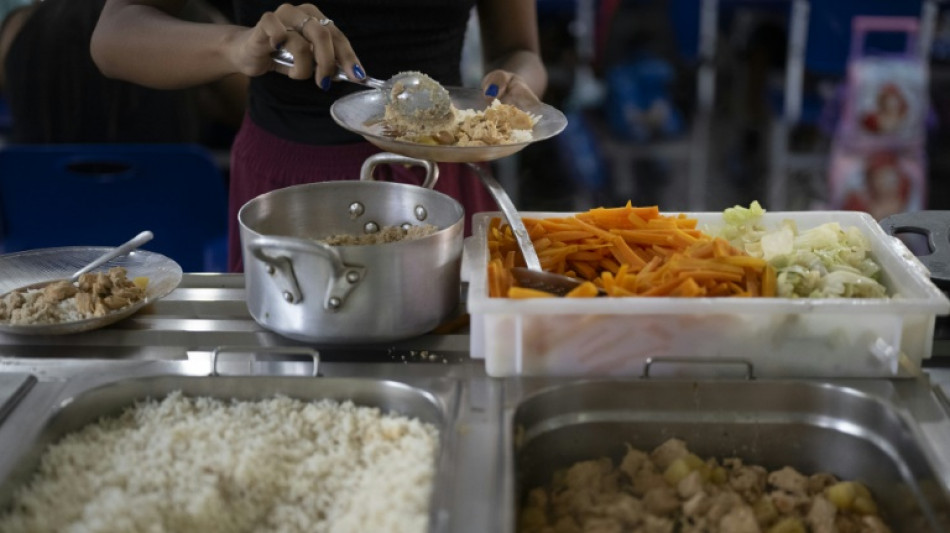
Rio de Janeiro tests new recipe against childhood obesity / Photo: Pablo PORCIUNCULA - AFP

 Oil up, Wall Street dips after Trump rejects Iran truce offer

 Gakpo withdraws from Netherlands squad

 SpaceX puts Starship megarocket in orbit for first time

 Iran denies link to suspected bomb plot at UK airbase used by US

 Ex-boss Mancini says City charges 'not my concern'

 Berlin Marathon winner Assefa finished race with torn Achilles

 Comedian convicted for Erdogan 'insult' but freed pending appeal

 French prosecutors seek two-year sentence for ex-minister Dati in graft case

 Eala makes fast start as weather and transport woes hit Asian Games

 Hurricane Polo approaches Mexico, threatens severe damage

 Energy markets rally after Trump rejects Iran truce offer
 Japanese convenience store enlists Lady Gaga to bolster recruitment

 Seoul summons Ukraine envoy in row over North Korean POWs

 Ireland 'raised awareness worldwide' in Israel game: Hallgrimsson

 Colombian police capture wife, daughter of Ecuador drug lord

 More Asian Games woes as bus takes Pakistan team to wrong venue

 Radio frequencies vital to Earth observation must be protected: UN

 Comedian on trial for insulting Erdogan in standup show

 Women's Fashion Week kicks off in Paris

 Pope arrives in French border city to speak on united Europe

 The wildfires choking Indonesia, sparking regional haze

 PU Prime Deepens Argentina Presence Through FX Expo Buenos Aires 2026

 Nothing to seal here: NZ police help stranded pup home

 White House releases list of products US, China could tax less

 'Pseudo-journalism': Partisan 'news' sites target US midterms

Chicken with potatoes, carrot-and-cabbage salad: it looks like a detox meal, but it's the menu at a school cafeteria in Rio de Janeiro, Brazil, which is seeking new ways to fight childhood obesity.
Nearly one-third of children in Brazil are obese, an epidemic city health officials and community leaders are seeking to address in innovative ways, enlisting school cafeterias and taking their message of healthful eating to the street.
"Cake? There's no cake here," laughs cook Neide Oliveira as she chops onions for the 650 students of Burle Marx public school in the Curicica neighborhood on Rio's west side.
Additive-packed snacks and cookies are also out, after city officials banned ultraprocessed foods from schools this year.
Instead, students are discovering classic Brazilian fruits and vegetables that are often overlooked these days, like yams, okra and persimmons -- which many kids initially mistook for tomatoes.
Judging from how students devour their lunch, the program is having an impact.
"I like everything they make here, and it's good for my health. At home I eat a lot of junk food, like pizza and hamburgers," says 15-year-old Guilherme.
- 'Epidemic' -
"Childhood obesity is an epidemic, not just in Brazil, but worldwide," says Marluce Fortunato, nutritionist for the Rio city government.
The city is responding with a program at public and private schools, asking teachers to educate students on healthful eating habits.
Thirty-one percent of Brazilian children and teens are overweight or obese. A recent study by the Desiderata institute found more than 80 percent of five- to 19-year-olds reported eating at least one ultraprocessed food the previous day, such as sausages, soda and pastries.
"Science has shown these products are very detrimental to our health and are responsible for 70 percent of chronic diseases worldwide," pediatrician Daniel Becker told AFP.
And in children, they can lead to a double-barreled problem: obesity combined with malnutrition, which can damage learning ability and attention span, he says.
- Temptation just outside -
But changing eating habits is a challenge.
Ultraprocessed foods are made with ingredients designed to "addict the tastebuds," and have a market advantage over natural products given their mass distribution and cheaper prices, says Becker.
Sitting next to Guilherme, his friend Lucas, 14, is feasting on his chicken, rice and beans. But he admits that after school he regularly buys chips outside.
Fortunato says schools need parents' help.
"It's easier to educate young children. Once a person's way of thinking is set, it's a challenge to introduce new concepts," she says.
She mentions the example of a father who complained to the school because his son started asking for natural juices at home, which are more expensive than their sugary, additive-heavy counterparts.
- 'Barbie eggs' -
Still, some adults manage to change.
At age 60, grandmother Vera Lucia Perreira discovered organic vegetables -- and fell in love.
"They're not just healthful, they're tasty," she says.
"My seven-year-old granddaughter already eats better" than previous generations, she beams.
Perreira is one of 160 women involved in a project called Organic Favela, launched 13 years ago to transform eating habits in the poor Babilonia neighborhood.
The project runs workshops for residents, and also uses creative approaches, like healthful recipes painted in graffiti on neighborhood streets.
Founder Regina Tchelly also works with schools. Her mission: get children to have five colors of natural foods on their plates.
"We teach people to make avocado butter" and "'Barbie eggs'" -- dyed red with beets, she says.
The 42-year-old entrepreneur is the author of a cookbook that won Brazil's top literary prize last year, the Jabuti, in the creative economy category.
- 'Sweet poison' -
At the national level, a high-visibility ad campaign launched in March seeks to raise awareness of the health risks of ultraprocessed foods, enlisting celebrities and experts to spread the word.
The campaign, called "sweet poison" ("doce veneno," in Portuguese), wants the government to tax ultraprocessed foods and use the proceeds to subsidize healthful ones.
"It's hard to change, but that doesn't mean people have to be prisoners of their ideas," says Perreira.
"We have to open their minds to look differently at food, for the sake of our future."
K.AbuTaha--SF-PST