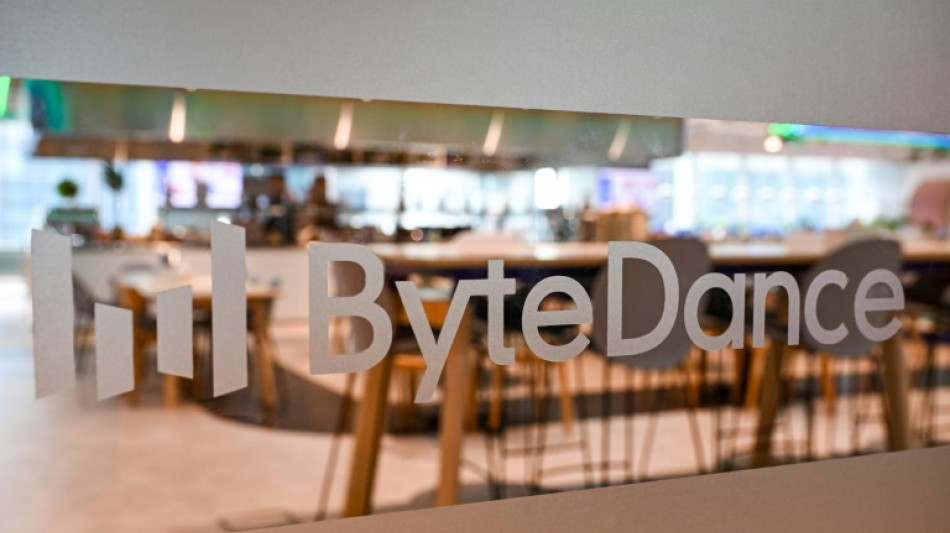
What is ByteDance, the TikTok parent in US crosshairs? / Photo: Roslan RAHMAN - AFP/File

 UN to hold fourth informal poll of secretary-general candidates

 Who are the Emiratis behind crisis-hit Manchester City?
 Singer Angelique Kidjo urges Africans to 'create together'
 Alleged Rihanna mansion shooter mentally fit for trial, says judge

 Mystery over UK airbase scare as police find petrol not explosives

 OpenAI unveils low-cost AI model, a day after shelving Astra upgrade
 Premier League confirms Man City guilty of serious financial breaches

 Brazil's Lula turns to Bad Bunny tune to criticise Trump ahead of polls
 Nigerian dancer eyes world record after seven-day marathon
 Swiss regulator concludes Julius Baer bank probe

 Brazil's patron saint pulled into latest election scrap

 Football overload leaves players near 'breaking point', warns Tebas

 Paris Eiffel Tower says chief to step down after uproar over removing women staff
 Amaze Holdings (NYSE: AMZE) Executes Binding LOI to Acquire BullionFX | Alchemy, a Decentralized Gold-Backed Financial Ecosystem for Valued at US$155 Million
 Clashes between French teens, police as school blockades intensify

 Stocks move sideways despite oil moving lower

 African leaders to gather in Egypt for business summit

 UK decides against charging foreign visitors for museums

 Dallaglio to sell England World Cup winners' medal
 Brazil come from behind to beat Australia 4-2 in friendly

 Ruthless An retains Asian Games badminton crown as Kunlavut triumphs

 Alonso to stay with F1 team Aston Martin in 2027

 China badminton 'still strong' despite Asian Games slump
 'Exceptional' Turner painting shown in Rome before sale
 European stocks climb as oil dips
From its birth in a Beijing apartment 12 years ago, ByteDance grew into one of the world's biggest tech firms -- best known in most countries as the creator of TikTok.
But TikTok now faces a furious campaign in Washington: the House of Representatives is set to vote Wednesday on a bill that could see the wildly popular video-sharing app banned in the United States if it does not sever itself from ByteDance.
How big is ByteDance?
ByteDance has rocketed in recent years to become one of the most valuable companies in the world, worth around $225 billion, according to market intelligence firm CP Insights.
That puts it well above Elon Musk's SpaceX and ChatGPT maker OpenAI.
ByteDance launched TikTok in 2017, and the app took the world by storm, crossing a billion users in four years.
The app was an international version of Douyin, which was released in China in 2016 and now has hundreds of millions of users.
Thanks to the explosive growth of these apps, ByteDance has branched out into e-commerce and travel bookings, and also released a video editing app.
The company says it has more than 150,000 employees in almost 120 cities around the world.
A privately held company, ByteDance does not release revenue and profit figures, but media estimates of its earnings put it on par with some of the biggest firms in the world.
In 2023, ByteDance's sales crossed $110 billion, Bloomberg reported in December, a figure greater than Chinese tech giant Tencent's estimated revenues that year.
ByteDance did not respond to AFP queries about its revenues, including how much it earns from TikTok.
AFP, along with more than 100 fact-checking organisations, is paid by TikTok and Facebook parent Meta to verify videos that potentially contain false information.
Who owns ByteDance?
TikTok has said around 60 percent of ByteDance is owned by institutional investors including US giant BlackRock.
ByteDance's founders have a 20 percent stake, and the remainder is held by employees, according to TikTok.
Incorporated in the Cayman Islands, ByteDance also lists General Atlantic among its investors. Three of the five members of ByteDance's board are Americans, according to TikTok.
A Chinese state-owned entity owns 1 percent of Douyin, according to the ByteDance website. TikTok has said this is a requirement under Chinese law and does not impact ByteDance's international operations.
That 1 percent stake also came with a board seat in ByteDance's Chinese entity, tech news website The Information reported in 2021.
When asked during a US congressional hearing in March last year if a Chinese official was on the Beijing ByteDance Technology board, TikTok CEO Shou Zi Chew said "I believe so".
He said in that hearing, however, that TikTok will not be "manipulated by any government".
Why does ByteDance worry the United States?
A large number of US lawmakers -- Republicans and Democrats -- are not convinced that TikTok is independent of Beijing despite being headquartered outside China.
The app has been a diplomatic hot potato between the United States and China since the administration of former president Donald Trump, who once wanted to ban the app.
Now, a bill in Congress aims to force the company to cut ties with ByteDance or be barred from the United States.
The bill's supporters say ByteDance as a Chinese firm simply cannot go against the wishes of Beijing, and can provide access to the data on more than 170 million American users for everything from spying to election influence campaigns.
These concerns have been echoed by US intelligence and law enforcement agencies -- including by the FBI director this week -- as well as regulators elsewhere.
TikTok is banned from government employees' work phones in the United States and several other nations including Australia and Canada over security concerns.
How have ByteDance and TikTok responded?
Both insist that there is no risk to US user data. TikTok's CEO has told Congress that the firm has never been asked by the Chinese government for US user data nor has it provided it.
The company says it now routes all of its US traffic through infrastructure in the United States, and that it is deleting previously collected data. It has also said that Douyin employees do not have access to TikTok's US user data.
TikTok will take the fight against a forced break from ByteDance to the courts in the United States if the legislation is passed, according to Bloomberg.
US President Joe Biden will sign the bill if it passes Congress, the White House has said, though the chances of its success are uncertain given opposition in the Senate.
What about China?
China has repeatedly said it opposes a forced sale of TikTok. It warned against targeting TikTok on Wednesday.
"Although the United States has never found evidence that TikTok threatens US national security, it has not stopped suppressing TikTok," foreign ministry spokesperson Wang Wenbin said, describing the bill as "bullying".
"In the end, this will inevitably come back to bite the United States itself."
Any sale of TikTok would likely require Beijing's approval.
The Chinese commerce ministry published rules in 2020 that added "civilian use" to a list of technologies that are restricted for export.
H.Nasr--SF-PST