Global operation smashes 'most harmful cyber crime group' / Photo: - - NATIONAL CRIME AGENCY/AFP

 In Manchester, people say City scandal is 'shame for football'

 Stocks lacklustre as inflation data weighs on sentiment

 Israel-bound plane rerouted, pilots wounded in reported fight

 Truth commission on Sweden's Sami people seeks redress

 Energy costs spark inflation surges in France, Italy

 South Korea break China hearts to reach Asian Games football final

 Eala storms into Asian Games semi-finals to thrill adoring fans

 Turkey freezes ex-minister's assets as fund crisis grows

 What we know about the North Korean POW dispute

 Most equities rise after oil price plunge, US data in focus

 Polar oceans transformed as warming melts ice habitats: research

 Lost shark becomes viral star in South Korea

 Dangote to launch $16bn refinery in Kenya

 North Korean leader 'extremely obese': Seoul spy agency

 Yankees and pope-backed White Sox start MLB playoffs with wins

 Malaysia's ex-PM Mahathir in hospital for observation

 'No limits': Marathon world record holder Sawe chasing history

 Countdown begins to biggest-ever Rugby World Cup

 Bangladesh women lose ground after quota reform
 Vietnam admits 'differing opinions' on Hanoi development

 Stocks temper gains as oil pares heavy losses, US data in focus

 New Zealand denies breaching climate commitments to EU

 Albert becomes youngest US scorer in 4-2 win over Chile

 Pirate island's plunging population shows Greece's demographic decline

 With elections ahead, Latvia's Russian-speakers reject Moscow's help
An international operation led by UK and US law enforcement has severely disrupted "the world's most harmful cybercrime group", the Russian-linked ransomware specialist LockBit, officials announced Tuesday.
LockBit and its affiliates have targeted governments, major companies, schools and hospitals, causing billions of dollars of damage and extracting tens of millions in ransoms from victims.
Britain's National Crime Agency (NCA), working with the Federal Bureau of Investigation, Europol and agencies from nine other countries in Operation Cronos, said it had infiltrated LockBit's network and taken control of its services.
"We have hacked the hackers, we have taken control of their infrastructure, seized their source code, and obtained keys that will help victims decrypt their systems," NCA director general Graeme Biggar told reporters in London.
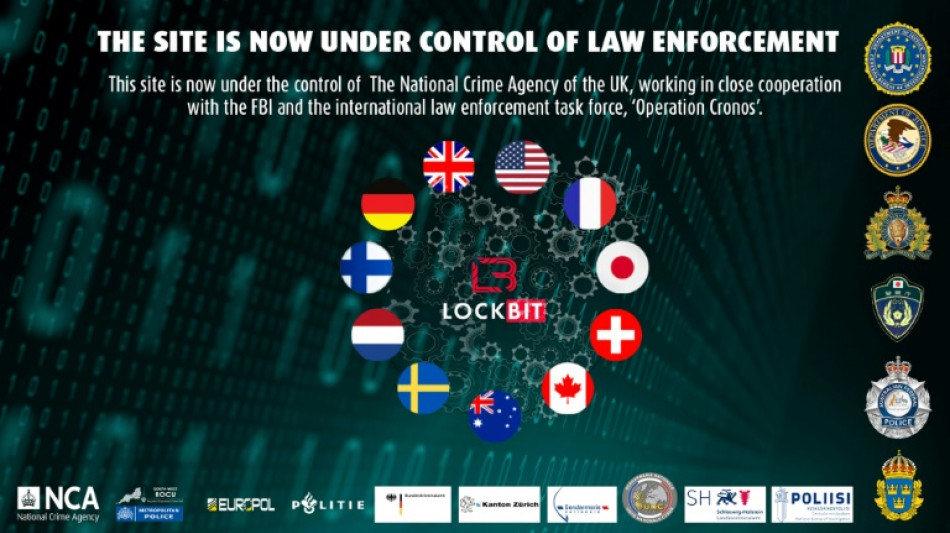
LockBit's website -- selling services that allow people to organise cyber attacks and hold data until a ransom is paid appears -- was taken over on Monday evening.
A message appeared on the site stating that it was "now under control of law enforcement".
"As of today LockBit is effectively redundant, LockBit has been locked out," Biggar said.
The US Justice Department (DOJ) said the agencies had seized control of "numerous public-facing websites used by LockBit to connect to the organization's infrastructure" and taken control of servers used by LockBit administrators.
The NCA added that it had obtained more than 1,000 decryption keys and will be contacting UK-based victims in the coming days and weeks to offer support and help them recover encrypted data.
Biggar said the network had been behind 25 percent of all cyber attacks in the past year.
LockBit has targeted over 2,000 victims and received more than $120 million in ransom payments since it formed four years ago, according to the DOJ.
Those targeted have included Britain's Royal Mail, US aircraft manufacturer Boeing, and a Canadian children's hospital.
In January 2023, US law enforcers shut down the Hive ransomware operation which extorted some $100 million from more than 1,500 victims worldwide.
Since then, LockBit has been seen as the biggest current threat.
- Dark Web -
Hive and LockBit are part of what cybersecurity experts call a "ransomware as a service" style, or RaaS -- a business that leases its software and methods to others to use in extorting money.
Ariel Ropek, director of cyber threat intelligence at cybersecurity firm Avertium, told AFP last year that this structure makes it possible for criminals with minimal computer fluency to get into ransomware by paying others for their expertise.
On the so-called dark web, providers of ransomware services pitch their products openly.
At one end are the initial access brokers, who specialise in breaking into corporate or institutional computer systems.
They then sell that access to the hacker, or ransomware operator.
But the operator depends on RaaS developers like Hive or LockBit, which have the programming skills to create the malware needed to carry out the operation.
Typically, their programmes -- once inserted by the ransomware operator into a target's IT systems -- are manipulated to freeze, via encryption, the target's files and data.
RaaS developers offer a full service to the operators, for a large share of the ransom paid out, said Ropek.
When the ransomware is planted and activated, the target receives a message telling them how much to pay to get their data unencrypted.
That ransom can run from thousands to millions of dollars.
On Tuesday, the US unsealed an indictment against two Russian nationals, bringing to five the number of Russians it has charged in connection with LockBit.
In a separate notice, the US Treasury Department said it is imposing sanctions on the pair, affiliates of LockBit, who "actively engaged" in ransomware attacks.
Biggar said a "large concentration" of the cyber criminals are in Russia and are Russian-speaking, but law enforcement agencies have not seen any direct support for LockBit from the Russian state.
"There is clearly some tolerance of cyber criminality within Russia," he added.
O.Farraj--SF-PST