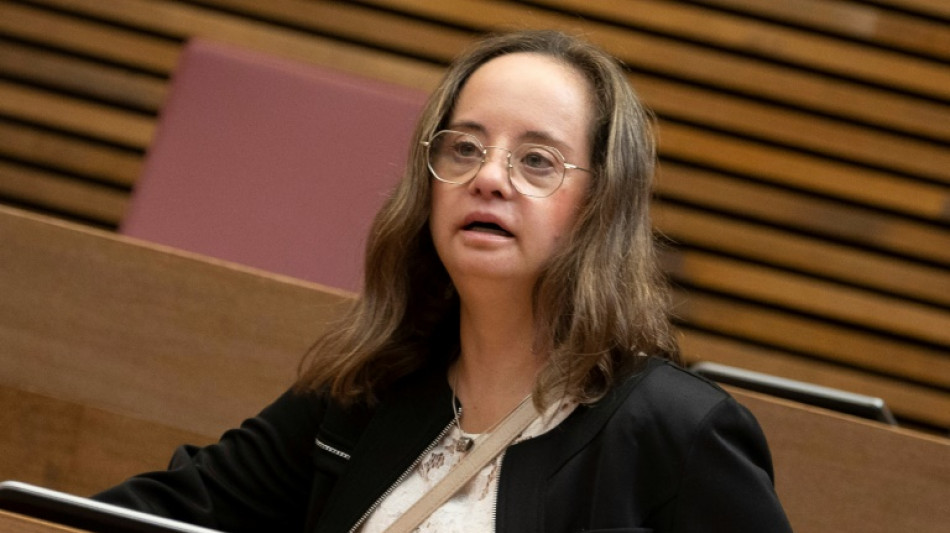
Pioneering MP hails disability reform in Spain / Photo: JOSE JORDAN - AFP

 Cable car offers small hope for Mongolia's gridlocked capital

 Man City scandal risks damage to Premier League's booming brand

 First-time Sepang F1 racers will master track 'from opening lap'
 Japan tightens rules for foreigners wanting permanent residency
 'Happiest moment': China's Mu first woman to win eSports Games gold

 EU talks deportations as five nations seek migrant centre in Africa

 Kenneth Branagh examines the scars of Iraq war in 'Atonement'

 Hundreds held, dozens wounded as French school protests escalate

 US government's new AI chatbot pulls back from debunking Trump

 US tennis star Navarro reveals health battle, ends season

 Panic, anger, tears: Evan Gershkovich's uneasy journey after Russian jail

 UK PM says 'strong indications' Iran involved in airbase incident

 Google restricts access to new AI model over safety concerns

 Watchdog clears former US Fed chief Powell in renovation probe

 Israel PM hails Indian pilot of rerouted flight for averting disaster

 Fury, Joshua kick off 'battle of Britain' in good spirits

 Ronaldo leaves Portugal training camp after coach says he is dropped

 Florence Pugh stars in 'East of Eden' adaption on Netflix

 Watchdog finds no criminal misconduct over US Fed renovations despite Trump probe

 In Manchester, City fans 'devastated' while rival fans call for relegation

 UK-France Channel migrant exchange deal scrapped: London

 Portugal boss denies 'incident' with Ronaldo

 Israel PM says one of the pilots of rerouted flight tried to crash plane

 Manchester City: Main points of damning judgement and possible sanctions

 Italy looking for 'identity' under Mancini says Scalvini
Addressing Valencia's regional parliament, Mar Galceran's confidence is striking: she is Spain's first lawmaker with Down syndrome and one of just a few elected across Europe.
She is fighting to change Spanish society's approach to people with disabilities, the formal description of which was amended in the Constitution on Thursday.
Galceran, 46, was voted into Valencia's regional parliament in September, the first person with Down syndrome to be elected in Spain at regional or national level.
Elected as an MP for the right-wing opposition Popular Party (PP), she wants "to change the way society views people with disabilities".
And she has welcomed the rare move to revise Spain's Constitution to replace the word "handicapped" ("disminuido") with "people with disabilities" which was approved by the Senate upper house on Thursday.
Using the term "disminuido" or its colloquial equivalent "minusvalido" ("less valid") has long been "offensive and insulting to the collective of people with disabilities", she told AFP.
"Because we are not 'diminished' nor are we 'less valid'. We are not worth less than other people."
The reform, which also expands their rights, is only the third-ever change to Spain's Constitution since it was approved in 1978, and the first of a social nature.
"Words matter," she said, explaining the importance of "seeing the people and not the disability they have".
- A 'necessary' reform if late -
A member of the PP since she was 18, she spent many years as a civil servant, and always took a stand against the discrimination she faced over her genetic condition.
She spent four years as head of Asindown, a foundation in the Valencia region which helps the families of children with Down syndrome.
An avid runner who loves dancing and once worked in childcare, Galceran says her teenage years were marked by "rejection".
Growing up, she had "acquaintances but never friends, because they saw me as different and didn't really count me as a friend".
Her network of real support always came from her family, who "have always supported me in my decisions".
Since being sworn in, Galceran has been active in the parliamentary committee on people with disabilities, which she believes needs a "cross-party" approach within the healthcare sector, within families, within work and education.
"And there's still a lot left to be done."
For her, the constitutional reform was one of the top priorities.
While it remains largely symbolic, Galceran sees it as a "fair" and "necessary" step -- even if it should have happened earlier.
- 'With different abilities' -
Until now, the wording of article 49 of the Constitution has said that Spain's public authorities are responsible for policies involving the "treatment, rehabilitation and integration of the physically, sensory and mentally handicapped".
The new version says "persons with disabilities are entitled to rights" that must be exercised in "freedom and genuine equality, without discrimination", and stresses the importance of attention to "the specific needs of women and girls with disabilities".
A large majority of Spanish Senators approved the reform in its final reading on Thursday. Only the three from far-right party Vox voted against, arguing they did not want to vote in unison with the ruling left.
Socialist Prime Minister Pedro Sanchez said the measure settled "a moral debt owed to more than four million Spaniards" with one degree or another of disability.
"There is still a long way to go to achieve full inclusion, to embrace the diversity that defines us and to make visible what for so long was painfully ignored," he added during a debate in the lower house of parliament last week, acknowledging the reform was "late".
"The first thing we must do is ask their forgiveness" for using "such an offensive term for so many years," he added.
For Galceran, the debate over language needs to go even further: one day she hopes that even the term "disabled" will be changed to refer to "people with different capacities".
ctpe/vab/hmw/ds/giv
M.Qasim--SF-PST