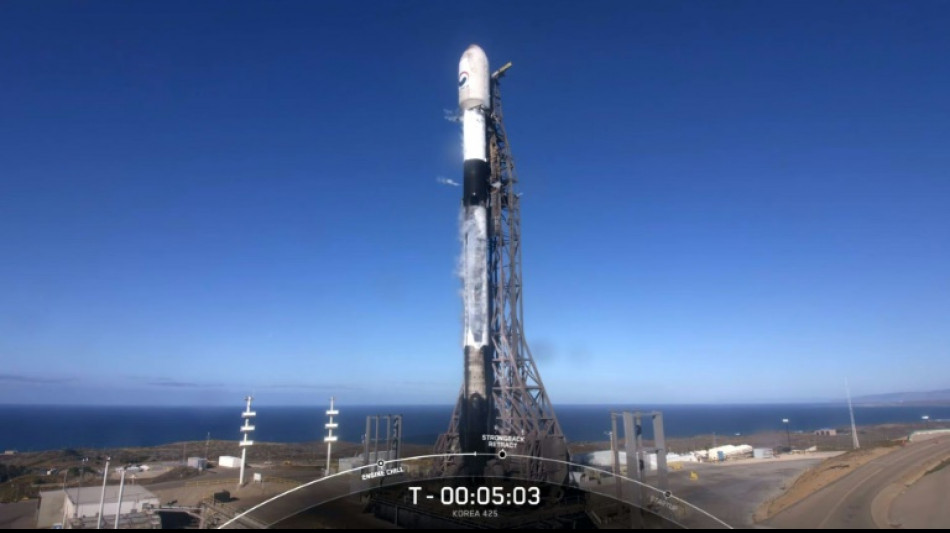
South Korea confirms first spy satellite in orbit / Photo: - - SPACEX/AFP

 Swedish Social Democrats leader to make new bid to form government

 North Korea calls Seoul 'despicable' after DMZ apology demand

 Taiwan boxer Lin wins gold as virtual taekwondo makes Games debut

 Man City face appeal deadline after explosive financial verdict

 Pole vault superstar Duplantis to skip indoor season

 Sri Lanka drop Asalanka from T20 against Pakistan

 Disney president says layoffs 'extremely painful' but necessary

 Indian flydubai pilot opened cockpit door to save passengers

 Alex Marquez clocks record lap at MotoGP Japan practice

 Tom Kim leads Asian Games golf in chase to avoid military service

 Asian stocks hit as oil spike fans rate hike bets, eyes on US jobs

 'We're losing our scientists': west Africa's STEM struggle
 World powers gather in Pacific to chart climate battle

 Return of swarming moth spectacle has Australia in a flutter

 Browns snuff out Rodgers fightback to beat Steelers 27-24

 Braves power past Phillies to set up Dodgers showdown

 Asian stocks drop as oil spike fans rate hike bets, eyes on US jobs

 Viral anti-vax posts weaponise Philippine inoculation fears

 Saudi coalition accuses Houthis of drone attack on Medina

 Effective Altruism: the philosophy behind Silicon Valley's AI fears

 Chinese judoka accused of biting as home hope wins Asian Games gold

 Four-member crew docks at International Space Station

 Portugal win without Ronaldo as Klopp's Germany get first victory

 Wemby: 'Very sad' to see players endorse betting firms

 Manchester City Women scrape draw with Real Madrid

South Korea confirmed Saturday its first military spy satellite had reached orbit after a successful SpaceX rocket launch and that communication was established with ground control.
Seoul's reconnaissance satellite, carried by one of Elon Musk's SpaceX Falcon 9 rockets, intensifies a space race on the Korean peninsula after the North launched its own first military eye in the sky last week.
South Korea's defence ministry said Saturday its satellite reached orbit soon after the "KOREA"-emblazoned SpaceX rocket lifted off from the Vandenberg US Space Force Base in California at 10:19 am local time (1819 GMT) Friday.
"The satellite was launched 0319 Seoul time and was successfully separated from projectile 11 minutes later and put into targeted orbital trajectory," the ministry said in a statement.
"We have confirmed its communications with the ground command."
Reaching orbit means that South Korea now has its first domestically built spy satellite to monitor nuclear-armed North Korea.
Seoul plans to launch four additional spy satellites by the end of 2025 to bolster its reconnaissance capacity over the North.
Set to orbit between 400 and 600 kilometres (250 to 370 miles) above Earth, the South's satellite is capable of detecting an object as small as 30 centimetres (11.8 inches), according to the Yonhap news agency.
"Considering resolution and its capacity for Earth observation... our satellite technology ranks in the top five globally," a defence ministry official said, as quoted by Yonhap.
The launch comes less than two weeks after Pyongyang successfully put its own spy satellite into orbit.
"Until now, South Korea has relied heavily on US-run spy satellites" when it comes to monitoring the North, Choi Gi-il, professor of military studies at Sangji University, told AFP.
While the South has "succeeded in the launch of a military communications satellite, it has taken much longer for a reconnaissance satellite due to higher technological hurdles", he said.
Following the North's successful launch of its spy satellite, Choi said, "the South Korean government needs to demonstrate it can also pull this off".
- 'Destroy' US spy satellites -
The nuclear-armed North's launch drew international condemnation which the North Korean leader's powerful sister, Kim Yo Jong, called "absurd", declaring that her country would never relinquish its space programme.
North Korea is barred by successive rounds of UN resolutions from tests using ballistic technology, and analysts say there is significant technological overlap between space launch capabilities and the development of ballistic missiles.
On Saturday, Pyongyang threatened to "destroy" US spy satellites if Washington "tries to violate the legitimate territory" of North Korea, referring to its satellite programme.
If the United States attempts to breach its space rights "by weaponizing the latest technologies illegally and unjustly", said a spokesperson of the North's defence ministry in a statement carried by state-run KCNA, "the DPRK will consider taking responsive action measures for self-defence to undermine or destroy the viability of the US spy satellites".
Experts have said putting a working reconnaissance satellite into orbit would improve North Korea's intelligence-gathering capabilities, particularly over South Korea, and provide crucial data in any military conflict.
Since last week's launch, the North has claimed its new satellite has already provided images of major US and South Korean military sites.
It has not yet disclosed any of the satellite imagery it claims to possess.
The North's launch of "Malligyong-1" was Pyongyang's third attempt at putting such a satellite in orbit, after two failures in May and August.
Seoul has said the North received technical help from Moscow, in return for supplying weapons for use in Russia's war with Ukraine.
kjk-burs/sco
L.Hussein--SF-PST