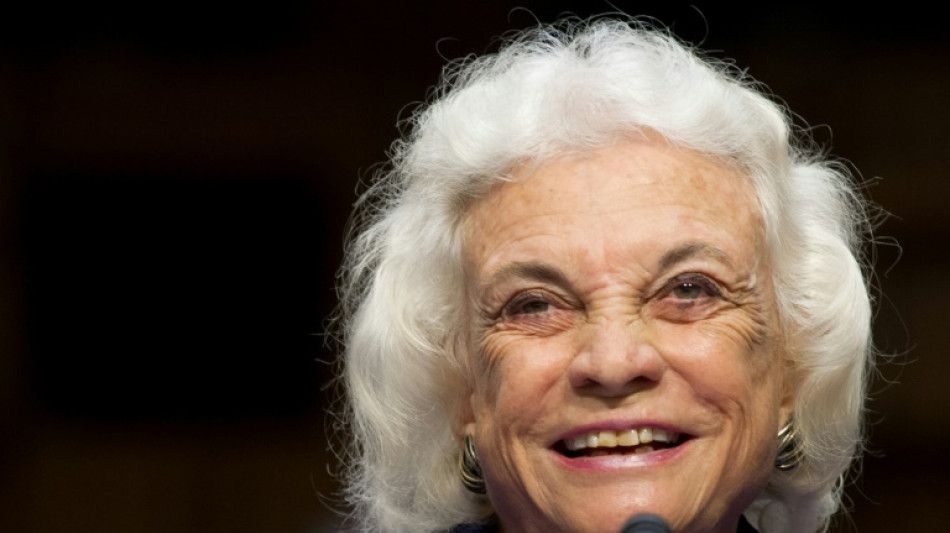
Longtime US justice Sandra Day O'Connor: the power of moderation / Photo: KAREN BLEIER - AFP/File

 Ethiopia's conflict: the regional dimension

 Life expectancy almost back to pre-Covid levels, says WHO

 Turkey's football referee chief faces judge in graft probe

 Verstappen goes own way to avoid the rain

 Oil slides, bonds steady as EU addresses diesel price surge

 Spain housing package at risk in parliament, as protests mount

 Swedish Social Democrats leader to make new bid to form government

 North Korea calls Seoul 'despicable' after DMZ apology demand

 Taiwan boxer Lin wins gold as virtual taekwondo makes Games debut

 Man City face appeal deadline after explosive financial verdict
 Pole vault superstar Duplantis to skip indoor season

 Sri Lanka drop Asalanka from T20 against Pakistan

 Disney president says layoffs 'extremely painful' but necessary

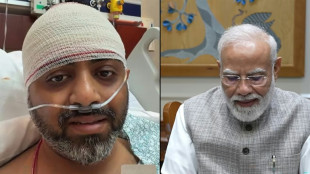 Indian flydubai pilot opened cockpit door to save passengers

 Alex Marquez clocks record lap at MotoGP Japan practice

 Tom Kim leads Asian Games golf in chase to avoid military service

 Asian stocks hit as oil spike fans rate hike bets, eyes on US jobs

 'We're losing our scientists': west Africa's STEM struggle

 World powers gather in Pacific to chart climate battle

 Return of swarming moth spectacle has Australia in a flutter

 Browns snuff out Rodgers fightback to beat Steelers 27-24

 Braves power past Phillies to set up Dodgers showdown

 Asian stocks drop as oil spike fans rate hike bets, eyes on US jobs

 Viral anti-vax posts weaponise Philippine inoculation fears

 Saudi coalition accuses Houthis of drone attack on Medina
Sandra Day O'Connor, the first woman to serve as a justice on the US Supreme Court, wielded enormous influence as the key centrist on a sharply divided bench, where she often displayed a preference for pragmatism over ideology.
Once spoken of as the most powerful woman in America, O'Connor often confounded both her critics and supporters during her nearly 25-year tenure on the nation's high court, refusing to be pigeonholed by the left or the right.
It was her refusal to be placed on either side of the political spectrum, or to be seen as merely the one woman on the bench, that made her a pivotal justice from the early 1980s until her retirement in early 2006.
"The power I exert on the court depends on the power of my arguments, not on my gender," she told a Washington University conference in 1990.
O'Connor, 93, died Friday following a years-long battle with dementia that saw her step back from public life in 2018.
Known as a moderate Republican, O'Connor was not an immediately popular choice when Ronald Reagan nominated her to the court in 1981, fulfilling his campaign pledge to name a woman to one of the first Supreme Court vacancies in his administration.
Conservatives criticized her lack of federal judicial experience and viewed her position on abortion with suspicion, while liberals -- though happy to see a woman on the bench -- voiced concern over her commitment to feminist issues.
After her first few years on the court, O'Connor emerged as a crucial "swing voter" -- breaking with her conservative colleagues and providing the fifth vote to make a liberal majority on several key occasions.
Many of those who regularly argued cases before the Supreme Court were known to pitch their arguments specifically with O'Connor in mind.
Richard Lazarus, who used to coach lawyers facing the justices when he taught at Georgetown University, considered her the touchstone.
"When Justice O'Connor asks a question at oral argument, every advocate would be well advised to answer in full, and pause and look at her, because nothing is more important to you than making sure you've addressed her concerns," Lazarus told The Washington Post in 2004.
O'Connor's reputation as a moderator and coalition-builder greatly enhanced her influence on a bench that was so divided on core legal philosophy.
As much as she infuriated liberals by siding with the majority that blocked the 2000 Florida vote recount and effectively handed the presidency to George W. Bush, she also outraged conservatives a few years later by helping to uphold the University of Michigan Law School's right to run an affirmative action admissions policy.
She proved the decisive vote on key cases that upheld the government's neutrality towards religion, including a 2005 ruling that it was unconstitutional for the Ten Commandments to be displayed in several courthouses.
"Allowing government to be a potential mouthpiece for competing religious ideas risks the sort of division that might easily spill over into suppression of rival beliefs," she wrote in a concurring opinion.
The position she occupied for years at the center of the bench was one that few subsequent justices embraced, as nominations to the court have grown increasingly partisan.
- 'Common good above party' -
Sandra Day was born on March 26, 1930, in El Paso, Texas and grew up on her parents' cattle ranch in southeastern Arizona.
It was an isolated childhood but one that helped prepare her for working and competing with men as she accompanied her father and the cowboys on their duties.
Sandra learned to drive at age seven and could fire rifles and ride horses proficiently by the time she turned eight.
After high school, she attended the prestigious Stanford University, where she majored in economics.
A legal dispute over her family's ranch stirred her interest in law and she enrolled at Stanford Law School, where she briefly dated William Rehnquist, a classmate with whom she would eventually serve on the Supreme Court for more than two decades.
Day ultimately married another fellow student, John Jay O'Connor, in 1952.
Following a five-year break from work when she started a family -- at a time such a pause was seen as career-ending -- she served as an Arizona assistant attorney general from 1965 to 1969, when she was appointed to a vacancy in the Arizona state senate.
In 1974, O'Connor ran successfully for trial judge, a position she held until her appointment to the Arizona Court of Appeals in 1979.
Eighteen months later, Reagan nominated her to the Supreme Court.
Upon leaving the court, in part due to her husband's battle with Alzheimer's, O'Connor committed her remaining years to civic engagement.
She founded iCivics in 2009 to teach middle and high school students about civics via online games and other remote learning tools. It reaches millions of students a year, according to its website.
When she herself retreated from public life in 2018, citing her own battle with Alzheimer's, she said that "putting country and the common good above party and self-interest" had best served the nation over the years.
It was a Democratic president who awarded O'Connor the nation's highest civilian honor, the Presidential Medal of Freedom, in 2009.
At that White House ceremony, Barack Obama recalled how the young O'Connor was offered just one private sector job upon graduation, as a legal secretary, but chose public service.
"Sandra Day O'Connor is like the pilgrim in the poem she sometimes quotes, who has forged a new trail and built a bridge behind her for all young women to follow," Obama said.
X.AbuJaber--SF-PST