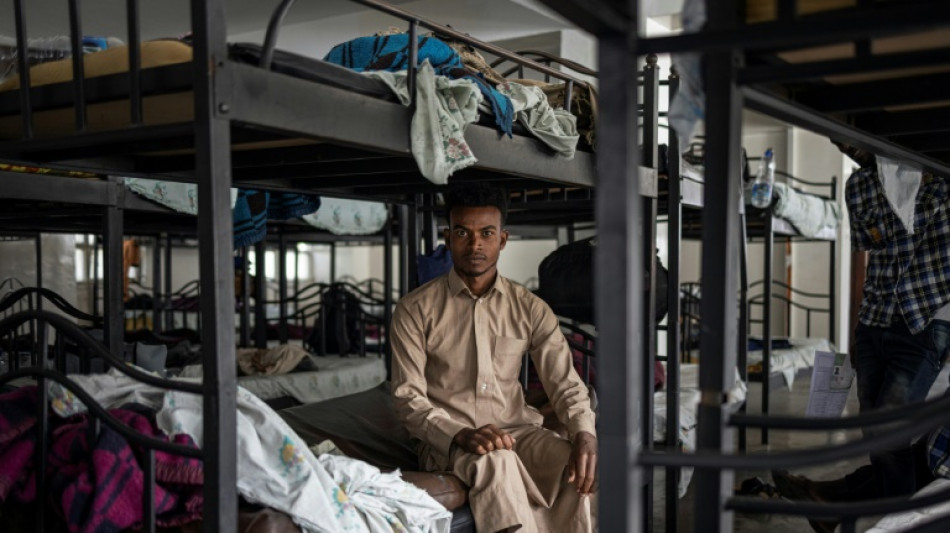
Traumatic journeys of Ethiopians seeking a better life / Photo: Michele Spatari - AFP

 Food, medicine shortages deepen in Russian-occupied Oleshky

 Man City whistleblower Rui Pinto facing 'dire consequences' - lawyers
 Russia 'tearing Kyiv apart', mayor says, as strikes paralyse traffic

 Taiwan boxer Lin wins Games gold as Japan edge North Korea on penalties

 Japan tame North Korea to win Games gold after shootout drama

 US posts weak job growth data in September

 Ethiopia's conflict: the regional dimension

 Life expectancy almost back to pre-Covid levels, says WHO

 Turkey's football referee chief faces judge in graft probe

 Verstappen goes own way to avoid the rain

 Oil slides, bonds steady as EU addresses diesel price surge

 Spain housing package at risk in parliament, as protests mount

 Swedish Social Democrats leader to make new bid to form government
 North Korea calls Seoul 'despicable' after DMZ apology demand

 Taiwan boxer Lin wins gold as virtual taekwondo makes Games debut

 Man City face appeal deadline after explosive financial verdict

 Pole vault superstar Duplantis to skip indoor season

 Sri Lanka drop Asalanka from T20 against Pakistan

 Disney president says layoffs 'extremely painful' but necessary

 Indian flydubai pilot opened cockpit door to save passengers

 Alex Marquez clocks record lap at MotoGP Japan practice

 Tom Kim leads Asian Games golf in chase to avoid military service

 Asian stocks hit as oil spike fans rate hike bets, eyes on US jobs

 'We're losing our scientists': west Africa's STEM struggle
 World powers gather in Pacific to chart climate battle

Starvation, torture, robbery -- young Ethiopian migrant "returnees" recount the horrors they endured on their fruitless journeys in search of a better life in the Gulf.
"I was imprisoned and beaten for money. I have a scar on my back which has lasted five months," said 23-year-old Abu Gizaw Assefaw, now back home nursing his shattered dreams of a job in oil-rich Saudi Arabia.
Abu Gizaw is among hundreds of thousands of people, mainly Ethiopians, who each year embark on a treacherous journey through the Horn of Africa, crossing scorching desert, rough seas and active war zones in search of economic opportunity.
Many do not make it.
The "Eastern Route" is described by the International Organization for Migration as "one of the most dangerous and complex human migratory routes in Africa and the world".
The migrants AFP spoke to said they left because they had no livelihood in Ethiopia, Africa's second most populous nation that is riven by armed conflict, climate disasters and economic crisis.
- 'Didn't eat for days' -
Abu Gizaw told how he took a bus with 10 friends from Addis Ababa to the Afar region of northern Ethiopia, then trekked through the desert for days to reach the sea.
"You can imagine how difficult it was. The sun was blistering. We didn't eat for days. I lost many of my friends to starvation," said Abu Gizaw.
He was one of dozens of Ethiopian migrant "returnees" being processed at an IOM transit centre in Addis Ababa who now face an uncertain future back home.
In Djibouti, he and his friends ran into human traffickers, and ended up paying 30,000 birr ($540) each for the crossing to Yemen, only to be caught again by smugglers demanding even more money.
"In Yemen, if you don't pay them, they take people from the group and kill them. Our families sold everything that they had including land and sent us the money. If not, they kill."
He finally reached Saudi Arabia, but said he was captured and dumped in the desert, eventually finding his way back by boat to Djibouti and then Ethiopia.
- 'Vultures preyed on the dead' -
Although the majority of those taking the Eastern Route are men, the number of women doubled to 106,700 in 2022, the IOM said.
Eighteen-year-old Neyima Mohammed said she was desperate to go to Saudi Arabia to make money after the failure of her small business selling groceries.
But she faced horror after horror on the journey and eventually gave up.
They were passed from one trafficker to another after they started out from her hometown of Silte in southern Ethiopia, and encountered many thieves who beat the men and stole their money.
"There was starvation, thirst," she said. "Many of our friends died on the road and also a boat sank and many drowned in the sea."
After they reached Yemen, she and her friends were involved in a road accident that killed and injured a number of people, she said, signalling the end of their journey.
"We laid them on the road because there was no cemetery. Vultures preyed on their dead bodies."
Back in Addis, she said: "I am happy that I came back alive to my country. I want to forget what happened to me and want to continue my life."
- 'Came back empty-handed' -
Shamsadin Awol, 20, said if he had known what trials and tribulations awaited him on the route to Saudi Arabia, he would never have left his home in eastern Ethiopia.
Smugglers took him to Hargeisa, the capital of the breakaway Somali region of Somaliland, then to Yemen and Saudi Arabia.
"You must pay to continue the journey, you can't even travel for five minutes if you don't pay," he said.
"I received 275,000 birr (almost $5,000) throughout my journey but spent it in vain. I used up everything and came back empty-handed."
His relief was palpable on his return to Ethiopia, saying he had suffered from mental health issues while away.
"When we entered and breathed the air of Oromia we gave praise to the Lord. Coming back home alive was so great," he said, vowing to never travel with traffickers again.
"I want to send this message to my brothers and sisters: It is better to live in your own country with poverty than to lead a luxurious life in another nation."
A.AlHaj--SF-PST