
Rare survey details how Gazans wary of Hamas before Israel attack / Photo: Bryan R. Smith - AFP

 England's Carse charged by cricket body over nightclub incident

 Amazon vows $1 bn for data center towns, decries 'myths'

 Oil prices drop on G7 fuel release, US jobs data boosts stocks

 G7 agrees deal to ease global energy supply concerns

 Spain's government dealt blow as lawmakers reject housing bills
 Food, medicine shortages deepen in Russian-occupied Oleshky

 Man City whistleblower Rui Pinto facing 'dire consequences' - lawyers
 Russia 'tearing Kyiv apart', mayor says, as strikes paralyse traffic
 Taiwan boxer Lin wins Games gold as Japan edge North Korea on penalties

 Japan tame North Korea to win Games gold after shootout drama

 US posts weak job growth data in September
 Ethiopia's conflict: the regional dimension

 Life expectancy almost back to pre-Covid levels, says WHO

 Turkey's football referee chief faces judge in graft probe

 Verstappen goes own way to avoid the rain

 Oil slides, bonds steady as EU addresses diesel price surge

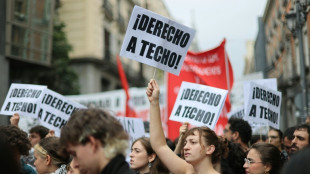 Spain housing package at risk in parliament, as protests mount

 Swedish Social Democrats leader to make new bid to form government
 North Korea calls Seoul 'despicable' after DMZ apology demand

 Taiwan boxer Lin wins gold as virtual taekwondo makes Games debut

 Man City face appeal deadline after explosive financial verdict

 Pole vault superstar Duplantis to skip indoor season

 Sri Lanka drop Asalanka from T20 against Pakistan

 Disney president says layoffs 'extremely painful' but necessary

 Indian flydubai pilot opened cockpit door to save passengers
Many Gazans were hostile to Hamas ahead of the group's brutal October 7 attack on Israel, with some describing its rule as a second occupation, according to rare polling data analyzed by a US-Palestinian researcher.
The findings are striking against a backdrop of protests and counter-protests triggered by the attack, with the relationship between Hamas and ordinary Gazans often the subject of heated debate.
"We find in our surveys that 67 percent of Palestinians in Gaza had little or no trust in Hamas in that period right before the attacks," said Amaney Jamal, dean of Princeton's School of Public and International Affairs.
"This is especially important because of the (erroneous) argument that all of Gaza supports Hamas, and therefore all of Gaza should be held accountable for the actions, atrocious actions of Hamas."
Jamal is one of the driving forces behind the Arab Barometer which conducts surveys and polling in the region, including in Gaza where fieldwork concluded on the eve of the attacks on Israel.
She said that Hamas, which won elections in the Palestinian territories in 2006 and is designated a "terrorist" organization by Washington and the EU, was seen as "corrupt" and "authoritarian" by many respondents.
"Seventy-five percent said in the previous 30 days, they could not afford to feed their households. So again, this is an impoverished society, a society that is basically saying the Hamas-led government has some levels of corruption," said Jamal.
- 'Peaceful reconciliation' -
"When we ask people, who do you blame?... we thought that the number-one culprit was going to be Israel because of the blockade. But most people cited Hamas corruption, more so than they cited the Israel blockade."
Jamal, 52 and born in California and brought up in her family's native Ramallah, said there was also a perception that "the Palestinian Authority or the Hamas-led government across time have become more dictatorial -- and more authoritarian."
"For the average Palestinian in the West Bank or in Gaza (they say) 'we have this (Israeli) occupation and then we have these Palestinian governments that are also authoritarian'. So a common phrase is we used to be occupied by one power, now we're occupied by two."
The latest Arab Barometer was undertaken in Gaza, where 399 people were surveyed, and the West Bank, where 790 were polled, from the end of September to October 6. Its findings were published in the journal Foreign Affairs.
"About 60 percent said that they believed they could not express their opinions freely and openly at the eve of the attacks (and) about 72 percent said that they could not protest peacefully against the Hamas-led government," Jamal said. "There was fear of retaliation or retribution from the government."
The Palestinian Authority of president Mahmud Abbas, which runs Palestinian areas in the West Bank, fared poorly in Jamal's survey, with only 9 percent of responses favorable.
Despite the majority negative view of Hamas uncovered by Jamal's research, the report cautions that following the Hamas attack on Israel, perceptions may have changed.
"Israel cut off water, food, fuel, and electricity supplies to Gaza following the October 7 attacks, plunging the territory into a deep humanitarian crisis... the suffering the Palestinians have experienced has likely hardened their attitude," it said.
Ahead of the attacks on Israel, more than half of respondents favored a two-state solution -- a Palestinian state alongside Israel.
The remainder opted either for a Palestinian-Israeli confederation or a one-state solution. But one-in-five supported armed resistance before the events of October 7, and the massive Israeli military response that followed.
"(Gazans were) open to a peaceful reconciliation with Israel based on 1967 borders," Jamal said.
T.Ibrahim--SF-PST