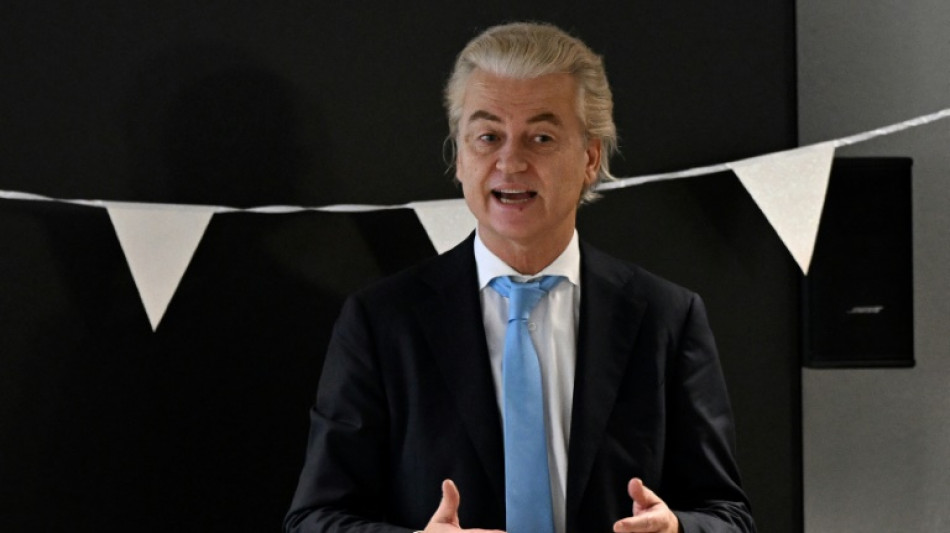
Blow for Wilders as Dutch ruling party snubs cabinet role / Photo: JOHN THYS - AFP

 Shinde Clarifies Torn Photo Controversy Amid Sonia Gandhi Book Protest

 AI Hacking Tool Artex Enables Global Cyberattacks by Low-Skill Actors

 BING X: اختفاء 22,624.66 وحدة من عملة SNC على منصة بينغ إكس — ما مدى أمان الرموز المودعة لدى المنصة؟ وهل يُعلَّق ترخيصها بموجب لائحة MiCAR

 BING X: 22,624.66 SNC have disappeared at BingX – how safe are tokens on BingX? Will BingX’s MiCAR licence be suspended?

 Dubai Police Expand Luxury Patrol Fleet with 525-hp Defender
Dutch firebrand Geert Wilders' already difficult task of forming a government became even harder on Friday, when the head of the ruling party immediately snubbed a role in his cabinet.
The Netherlands is under scrutiny in Europe and further afield after Wilders's PVV Freedom Party touched off a political earthquake by comfortably winning the general election on Wednesday.
But Wilders' dream of leading a far-right coalition as prime minister received a major blow when the liberal VVD of departing leader Mark Rutte declined to join him.
The complicated electoral maths of the Netherlands means Wilders needs the support of at least three other parties to build a stable coalition following his stunning win.
With 37 parliamentary seats already secured, Wilders has a long way to go to hit the magic 76 seats required for a stable coalition.
Virtually assured of seven seats from the BBB farmers party, Wilders still needs to convince the pro-reform New Social Contract Party of whistleblower Pieter Omtzigt to bring him 20 seats.
But even if Wilders gets Omtzigt on board, he still needs the VVD and its 24 seats.
VVD leader Dilan Yesilgoz, still reeling from an electoral battering after Rutte's 13 scandal-hit years at the helm, said the voters had delivered a clear message.
"The big winners are the PVV and the NSC. After 13 years, we are destined for a different role. The voters said: 'VVD, sit this round out'," Yesilgoz told reporters.
But cryptically, she said she would "support" a centre-right cabinet, raising the possibility of the VVD voting with a minority government on a case-by-case basis.
Wilders, 60, said he was disappointed with her decision.
"This does not make it any easier. Forming a government might now take months," he said.
Omtzigt described it as a "strange move", pointing to the fact that the election came about after the previous VVD government collapsed in a row over immigration.
"Now she gets the chance to talk about that with Wilders and then she says: 'Actually, we're not going to do that'."
- 'He deserves a chance' -
Yesilgoz's comments came ahead of the first formal talks between party leaders to negotiate a coalition -- a process likely to last well into next year.
The leaders appointed PVV senator Gom van Strien as "scout". As the top party, the PVV gets first crack at forming a government.
The scout's job is to shuttle between the parties, feeling out who is prepared to work with whom and crunching the numbers of the complex electoral maths.
The question is, can Wilders be Dutch prime minister, given past incendiary comments, including calling Moroccans "scum" and whipping up a crowd calling for "fewer, fewer" of them in the country?
"With Wilders as prime minister, the Netherlands has an impossible situation internationally," Sarah de Lange, Professor of Political Pluralism at the University of Amsterdam, told AFP.
She could even imagine a PVV-led coalition appointing a complete outsider as prime minister, leaving Wilders to focus on controlling his swelling ranks of MPs.
Wilders dialled down his more excessive anti-Islam, anti-immigrant rhetoric during the campaign but the PVV manifesto calls for a ban on mosques and the Koran, plus a referendum on leaving the European Union.
Opposition to Wilders is spilling out into the streets.
Rallies took place on Thursday in Utrecht and Amsterdam, with another expected in the capital on Friday.
Dutch Muslim community leaders have voiced fear and anxiety at the thought of a prime minister Wilders but some Muslims seemed prepared to give him the benefit of the doubt.
In an Amsterdam cafe, Burak Cen, a 40-year-old taxi driver said he didn't vote but he would have voted for Wilders.
"I think he deserves a chance," he told AFP.
"I honestly think he's just trying to drum up votes with his propaganda about mosques and Muslims. But otherwise what he says about the Dutch and poverty is right," added Cen.
O.Salim--SF-PST