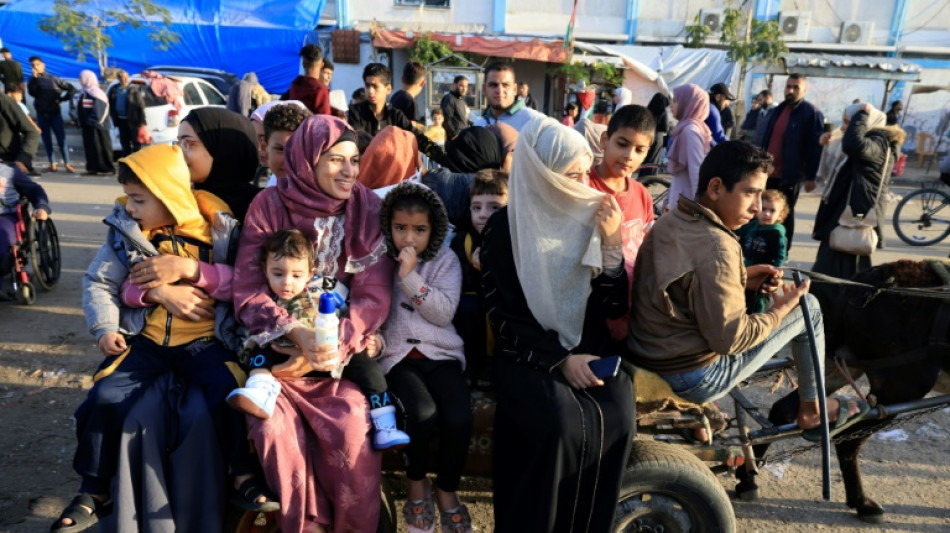
Gazans fill streets heading home as truce begins / Photo: Mahmud HAMS - AFP

 Trump expected to name intel chief Clayton as AI czar: reports
 Argentina unveils passports-for-investment scheme

 Brazil election debate chaos sparks censorship row

 England's Carse charged by cricket body over nightclub incident

 Amazon vows $1 bn for data center towns, decries 'myths'

 Oil prices drop on G7 fuel release, US jobs data boosts stocks

 G7 agrees deal to ease global energy supply concerns

 Spain's government dealt blow as lawmakers reject housing bills
 Food, medicine shortages deepen in Russian-occupied Oleshky

 Man City whistleblower Rui Pinto facing 'dire consequences' - lawyers
 Russia 'tearing Kyiv apart', mayor says, as strikes paralyse traffic

 Taiwan boxer Lin wins Games gold as Japan edge North Korea on penalties

 Japan tame North Korea to win Games gold after shootout drama

 US posts weak job growth data in September
 Ethiopia's conflict: the regional dimension

 Life expectancy almost back to pre-Covid levels, says WHO

 Turkey's football referee chief faces judge in graft probe

 Verstappen goes own way to avoid the rain

 Oil slides, bonds steady as EU addresses diesel price surge

 Spain housing package at risk in parliament, as protests mount

 Swedish Social Democrats leader to make new bid to form government
 North Korea calls Seoul 'despicable' after DMZ apology demand

 Taiwan boxer Lin wins gold as virtual taekwondo makes Games debut

 Man City face appeal deadline after explosive financial verdict

 Pole vault superstar Duplantis to skip indoor season

With children and pets in their arms and their belongings loaded onto donkey carts or car roofs thousands of displaced Gazans headed home Friday as a four-day Israel-Hamas truce began.
The din of war was replaced by the horns of traffic jams and sirens of ambulances making their way through crowds emerging from hospitals where they had taken refuge.
For nearly seven weeks, Israeli strikes on the Gaza Strip had been relentless.
But on Friday morning, no more shots were heard in Khan Yunis, in the south of the Palestinian territory.
Hayat al-Muammar was among those hurrying to take advantage of the truce deal, under which hostages seized from Israel will be freed in exchange for Palestinian prisoners.
"I'm going home," said the 50-year-old, who had been sheltering in a school.
"We fled the death, destruction and everything," she told AFP.
"I still don't understand what happened to us -- why did they do this to us?" she asked.
The lives of Gazans have been turned upside down since militant group Hamas, which rules the Palestinian territory, launched an unprecedented attack on Israel on October 7.
Israeli authorities say around 1,200 people, mostly civilians, were killed and around 240 taken hostage in the cross-border raids.
Weeks of sustained Israeli bombardment in response has killed nearly 15,000 people, around two thirds of them women and children, Gaza's Hamas government says.
Some 1.7 million of the territory's 2.4 million people are estimated to have been displaced, the United Nations says.
With more than half of homes damaged or destroyed according to the UN, Gazans were unsure if would still have a roof over their heads when they return.
- 'War not over' -
Whipping a donkey pulling his cart, Ahmed Fayad, 30, hit the road heading back to his village with 70 members of his family who he said had taken refuge in a school.
An elderly man walked by with a bag on his shoulder, saying he felt safe enough to return to his home near the border with Israel.
Around them, a multitude of men, women and children travelled on foot, carts or tuk-tuks with the few belongings they had taken with them when the war started.
One woman carried her cat in her arms through the streets.
Large parts of Gaza have been flattened by thousands of air strikes, and the territory faces shortages of food, water and fuel.
Israel has told Palestinians to move from northern Gaza for their safety.
Israeli warplanes over southern Gaza dropped leaflets warning people not to head back to the north.
"The war is not over yet," they read. "Returning to the north is forbidden and very dangerous!!!"
Khaled al-Halabi left his home in northern Gaza at the start of the war, heading for Rafah in the far south on the Egypt-Gaza border.
"I wish I could go and see my house," he said.
He did not plan to risk the journey home, but at least with the truce "we will finally breathe after 48 days", he said, welcoming the arrival of aid trucks from neighbouring Egypt.
Raed Saqer, who took refuge in Rafah, said he hoped the promises of increased aid would come true.
"We needed this truce to treat the wounded, so that people could recover a little, because people displaced from the north are experiencing an unspeakable tragedy,” he said.
"We hope it's the first step towards a definitive ceasefire," he said.
V.Said--SF-PST