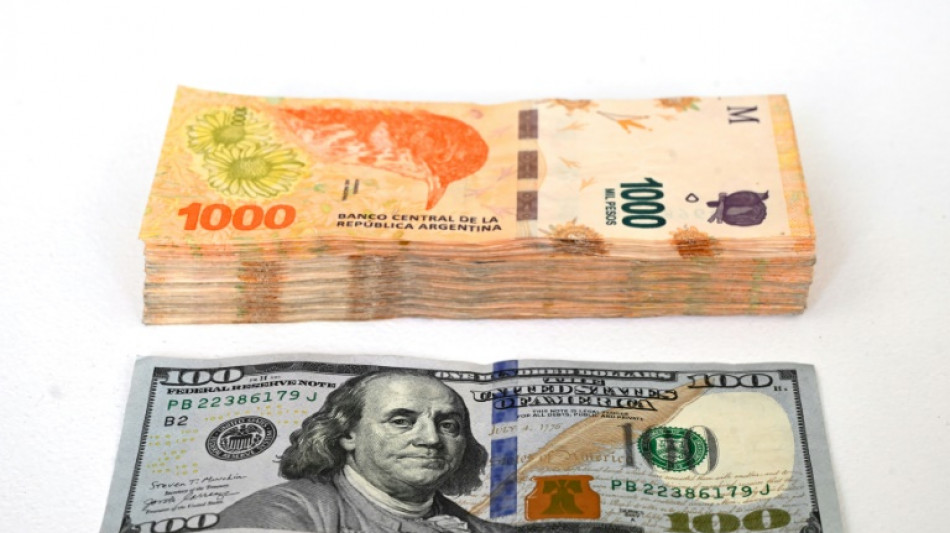
Debt, inflation and the peso: Argentina's election worries / Photo: Luis ROBAYO - AFP

 Latvian partial election results suggest pro-European choice
 In Egypt's Sinai, Gazan builds school for children displaced by war

 Trump tariffs a mixed bag for US auto industry

 Yemen government forces say struck Houthi targets

 Music links past, present for Pedro Pascal's cellist in 'Behemoth!'
 ALEX BODI ȘI AMBASADORUL REPUBLICII SUDANUL DE SUD, GUM DOMINIC MATIOK, DISCUTĂ LA BERLIN DESPRE POSIBILITATEA ÎNFIINȚĂRII UNUI CONSULAT ONORIFIC LA BUCUREȘTI

 Dodgers step up World Series three-peat bid with 5-3 win over Braves

 Spain break down Czechs as England outclass Croatia in Nations League

 Yamal on target as Spain hold off Czech Republic

 Latvian exit polls suggest pro-European choice
 Lula, Bolsonaro wrap up campaigns ahead of knife-edge election
 Tuchel hails 'complete' England after Croatia demolition

 Fury to invite Trump to lead ring walk before Joshua showdown

 Fashion industry in 'precarious moment', says Vivienne Westwood supremo

 Seventh heaven for England in Nations League rout of Croatia

 Storms, flooding cause chaos on Greek holiday island of Crete

 #IAmJaneDoe: online support campaign in US university rape case

 Brazil shine on Selecao's first visit to India
 Zverev sets up Djokovic quarter-final at China Open, Rybakina out
 Happier at home, Bordeaux hammer Lyon in Top 14

 Lula, Bolsonaro in final push for votes ahead of knife-edge election

 Boisterous fashion week barnstorms 'sleepy' Nigerian capital

 UAE investigators say flydubai co-pilot was planning 'terrorist act'

 Rahul smacks century in India v Windies ODI

 Daryz seeks to join exclusive club of dual Arc winners
Argentina is Latin America's third-largest economy, bursting with natural resources, but has been unable to claw its way out of decades of economic instability that has brought its population to its knees.
As Argentines head to the polls on Sunday for a first-round election, presidential candidates have campaigned hard on proposed elixirs for the country's economic ills.
Here are the main challenges facing the country as it heads to the polls:
- Record inflation -
Weary Argentines have become accustomed to seeing prices soar from one day to the next, with inflation fueled by rampant money printing used to finance government overspending.
In September, annual inflation hit 138 percent.
"Doing the shopping gives me chills. I went from using a shopping cart to a bag and now I hold what I can buy in one hand," said Lidia Pernilli, 73, who bought two bananas instead of a kilo, after the price more than doubled in a month.
"Argentina has this reputation of a voting public that is just willing to sustain levels of inflation and economic struggle because they are just resilient" and have "learned to live with it", said Benjamin Gedan, director of the Argentina Project at the Washington-based Wilson Center.
"To some degree, that has been true, but no one could live with the conditions they have now."
- The dollar peso tango -
Argentina's peso and a myriad of dollar exchanges have resulted in a currency quagmire that has turned citizens into savvy economists.
The government keeps strict control over the value of the peso, clamping down on the purchase of foreign exchange to protect its dwindling reserves.
This has led to a thriving informal market for the dollar -- with daily rates for the so-called "blue dollar" advertised on television and news sites.
This parallel dollar is now three times the value of the official rate -- meaning the threat of a painful currency devaluation is always looming.
The disparity has led to a plethora of official exchanges: the "Coldplay Dollar" for concert tickets, the "Qatar Dollar" for Argentines traveling abroad, or the "Soy Dollar" for the agriculture sector.
Deeply distrustful of their volatile peso and banks, Argentines convert their cash to dollars on the black market whenever possible, and the Central Bank estimates some $244 billion is stashed away in homes.
- Debt, drought, and dwindling reserves -
Argentina has been bailed out by the International Monetary Fund 22 times, despite several major defaults.
The most recent loan of $44 billion dollars was granted in 2018. The government has been in near constant renegotiations of a refinancing plan agreed in 2022.
A historic drought -- the country's worst in a century -- saw agricultural exports plummet in the past two years, leading to a shortfall in $20 billion in revenue.
The IMF predicts Argentina's economy will contract by 2.5 percent in 2023.
The country has loaned money from Qatar, and has used yuan from a currency swap with China to make payments to the IMF, to avoid touching its dwindling reserves.
The Central Bank says the country has $25 billion in its reserves, but analysts believe the real amount is far lower.
After the election "there will be significant expectation that Argentina gets its house in order as a basis for continued support," said Mark Sobel, US chairman of the Official Monetary and Financial Institutions Forum (OMFIF).
- The painful remedy -
Any candidate seeking to set Argentina on the path to fiscal discipline and economic stability faces an uphill battle in a country heavily dependent on the state, which subsidizes public transport, electricity and water.
"Forty percent of the country is now living in poverty and an unimaginable amount of Argentines depend on the state, either for social welfare programs or direct employment," said Gedan.
"The pain will be acute and spread widely.... That's why the politics of stabilization are so difficult."
- A glimmer of hope -
After the drought, Argentina's agricultural industry is expecting booming harvests of soy and maize between 2023 and 2024.
The next government will also benefit from a savings in energy imports as a new gas pipeline ramps up production from southern Vaca Muerta -- a massive oil and gas reserve.
The country's massive lithium reserves are also predicted to bring in precious dollars.
E.AbuRizq--SF-PST