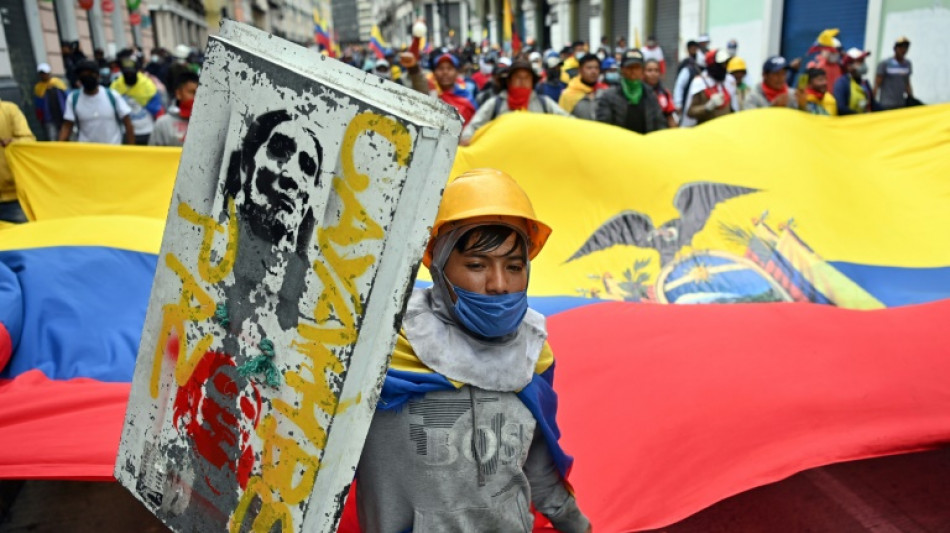
Ecuador: from Darwin to drug trafficking / Photo: MARTIN BERNETTI - AFP/File

 Teens on target again as USA down Mexico 3-0

 World records prove Asian Games were a hit, says top official

 US prison chief who oversaw botched execution resigns
 'Chaotic' Asian Games threaten Japan hopes of hosting Olympics again
 Finnish town braces for change from Google data centres

 What is fuelling French school protests?

 Without lawyers, migrant children face deportation from the US
 Three-peat seeking Dodgers open playoffs with a win, Rays hold off Yankees

 Brazil votes in nail-biter polls closely watched by Trump
 'Just be you': Kim reveals Tiger text that inspired him to gold

 Myanmar migrants returned to war-torn nation from Malaysia

 ALEX BODI AND AMBASSADOR GUM DOMINIC MATIOK OF THE REPUBLIC OF SOUTH SUDAN MEET IN BERLIN TO DISCUSS THE POSSIBILITY OF AN HONORARY CONSULATE IN BUCHAREST

 Lula, Bolsonaro wrap up campaigns ahead of Brazil's knife-edge vote

 Toulouse edge Castres in Top 14 derby

 Murakami homer propels White Sox to MLB playoff win over Guardians

 Israel targets top Hamas leader in deadly Gaza strike on anniversary

 Houthis say struck oil facility near Riyadh, as Saudis hit Sanaa

 AI needs safety layers like nuclear plants: ex-OpenAI engineer

 MVP Judge will miss Yankees' MLB playoff series against Rays

 New lizard species discovered in Peru

 Fernandes hails Portugal's 'greatest symbol' Ronaldo, calls for unity
 Grandidier-Nkanang double takes Pau to Top 14 summit despite Vannes fightback

 Trainer Scott gets perfect Arc boost with top notch double

 Ex-PM says Putin cannot admit 'mistake' over Ukraine

 Houthis say Saudi Arabia launches dozens of strikes on Yemen capital

Five things to know about Ecuador, which holds a runoff presidential election on Sunday.
- New narco-trafficking hub -
The election campaign has been dominated by pledges to tackle the lawlessness that has engulfed the once peaceful South American nation.
In the last few years, Ecuador has become a key player in the regional cocaine trade as drug trafficking from Colombia and Peru expands into the Andean country, taking advantage of lax security in ports on its Pacific coast.
The drug trade has spurred a wave of horrific violence, making security the top concern of voters.
Ecuador's murder rate since 2018 has quadrupled, kidnappings are rife, and a string of clashes between rival drug gangs has claimed more than 400 lives in Ecuadoran prisons since 2021, leaving behind a trail of dismembered and burned bodies.
- Indigenous power -
Ecuador's more than one million Indigenous people have cultivated powerful political representation, which has played a key role in the downfall of three presidents between 1997 and 2005.
In June 2022, the country was paralyzed by 18 days of Indigenous-led protests over the high cost of living and fuel prices, in which six people died.
Three decades earlier, an Indigenous uprising forced the government to surrender more than two million hectares (7,700 square miles) of land to Amazonian and Andean tribal groups.
But while the constitution recognizes their ownership of the land, the state maintains control of everything under the soil.
- Assange protector -
For seven years, the Ecuadoran embassy in London was at the center of the Julian Assange saga, offering asylum to the WikiLeaks founder pursued by the US for divulging military secrets about the wars in Iraq and Afghanistan.
But in 2019 Ecuador's government -- which shifted right after distancing itself from former socialist president Rafael Correa -- decided it had had enough of Assange and booted him out of the mission, accusing him of meddling in the politics of other states and being unhygienic, among other complaints.
The Australian has since been in a high-security prison east of London, where he is fighting Britain's plans to extradite him to the United States.
- Oil, bananas and shrimp -
One of the many ways drugs traffickers are getting their product out of the country is by smuggling it among one of Ecuador's top exports: bananas.
The fruit is the country's third leading export product after oil and shrimp, with Ecuador in 2020 overtaking India as the world's top exporter of the crustaceans.
The country's violence has also engulfed shrimp farmers, who are forced to shell out millions of dollars for private security industry-wide amid a wave of armed heists at sea and on land for their "pink gold."
- Galapagos Islands -
Ecuador is home to the famous Galapagos Islands, a marine-rich archipelago made up of 234 islands, inlets and rocks, with flora and fauna found nowhere else in the world.
Observing its wonders in the 19th century, British scientist Charles Darwin developed his theory of evolution after studying finches and mockingbirds there.
The impact of human activity through climate change and mass tourism threatens the unique ecosystems on the islands, listed as a world heritage site by UNESCO.
F.AbuShamala--SF-PST