Could Israel-Hamas conflict descend into wider regional war? / Photo: - - KHAMENEI.IR/AFP

 Teens on target again as USA down Mexico 3-0

 World records prove Asian Games were a hit, says top official

 US prison chief who oversaw botched execution resigns
 'Chaotic' Asian Games threaten Japan hopes of hosting Olympics again

 Finnish town braces for change from Google data centres

 What is fuelling French school protests?

 Without lawyers, migrant children face deportation from the US
 Three-peat seeking Dodgers open playoffs with a win, Rays hold off Yankees

 Brazil votes in nail-biter polls closely watched by Trump
 'Just be you': Kim reveals Tiger text that inspired him to gold

 Myanmar migrants returned to war-torn nation from Malaysia

 ALEX BODI AND AMBASSADOR GUM DOMINIC MATIOK OF THE REPUBLIC OF SOUTH SUDAN MEET IN BERLIN TO DISCUSS THE POSSIBILITY OF AN HONORARY CONSULATE IN BUCHAREST

 Lula, Bolsonaro wrap up campaigns ahead of Brazil's knife-edge vote

 Toulouse edge Castres in Top 14 derby

 Murakami homer propels White Sox to MLB playoff win over Guardians

 Israel targets top Hamas leader in deadly Gaza strike on anniversary

 Houthis say struck oil facility near Riyadh, as Saudis hit Sanaa

 AI needs safety layers like nuclear plants: ex-OpenAI engineer

 MVP Judge will miss Yankees' MLB playoff series against Rays

 New lizard species discovered in Peru

 Fernandes hails Portugal's 'greatest symbol' Ronaldo, calls for unity
 Grandidier-Nkanang double takes Pau to Top 14 summit despite Vannes fightback

 Trainer Scott gets perfect Arc boost with top notch double

 Ex-PM says Putin cannot admit 'mistake' over Ukraine

 Houthis say Saudi Arabia launches dozens of strikes on Yemen capital

A potential intervention by Tehran-backed Lebanese Shiite militia Hezbollah and uncertainty over the role played by Iran itself are risk factors that could push the unprecedented conflict between Israel and Hamas into a wider regional war, analysts say.
For now, there is no indication of an impending offensive by Hezbollah against Israel, despite growing border tensions.
Iran, officially at least, has insisted it has no involvement in the Palestinian militant group's assault on Israel.
While some neighbouring Arab countries -- which have been keen to improve relations with Israel -- see a chance to play a role as mediator.
But the situation is extremely volatile.
Thousands have already been killed on both sides since Hamas on Saturday launched its devastating attacks against Israeli civilian targets, prompting massive Israeli retaliatory strikes on the densely-packed Gaza Strip.
But even as Israel contemplates a ground offensive in Gaza, it could face a nightmarish second front on its northern border against Hezbollah, with which it went to war in 2006.
On Wednesday, the two sides traded fire for a fourth day.
Earlier this week, Hezbollah said three of its members had been killed in Israeli strikes on south Lebanon.
"We are deeply concerned about Hezbollah making the wrong decision and choosing to open a second front to this conflict," a senior US defence official, who asked not to be named, told journalists in Washington.
- 'Contained reaction' -
So far there is no sign of Hezbollah, which analysts say is a more formidable fighting force than its Palestinian ally Hamas, launching a similar offensive of its own.
"A conflagration is not in the interest of Lebanon which is going through a major political and economic crisis", said Hosni Abidi, director of the Geneva-based Center for Studies and Research on the Arab World and the Mediterranean (CERMAM).
"Yes, there is a risk of spillover but even Hezbollah has a contained and calibrated reaction," he said.
For Agnes Levallois, vice-president of the Institute for Mediterranean Middle East Research and Studies (IREMMO), Hezbollah's activity in southern Lebanon is a warning.
"But I don't think it's in their interest for this to escalate," she said.
Key regional powers such as Egypt and Saudi Arabia also appear more eager than in the past to seek to calm tensions and boost their international prestige by playing the role of mediator.
Saudi Crown Prince Mohammed bin Salman, the kingdom's de-facto ruler who had been seeking a normalisation of ties with Israel, told Palestinian president Mahmud Abbas in telephone talks he was working to prevent "an expansion of the conflict".
Steven Cook, senior fellow at the Council on Foreign Relations said it's "unlikely" there would be any kind of "interstate conflict" between an Arab army and Israel.
But he added there is "a real danger" of an escalation between Hezbollah and Israel, a "nightmare scenario".
"It's something that I think everybody should be on high alert for," he added.
- 'Taking the risk'? -
The greatest risk may be from Iran's clerical leadership, which has always refused to recognise Israel and regards it as the Islamic republic's arch regional enemy.
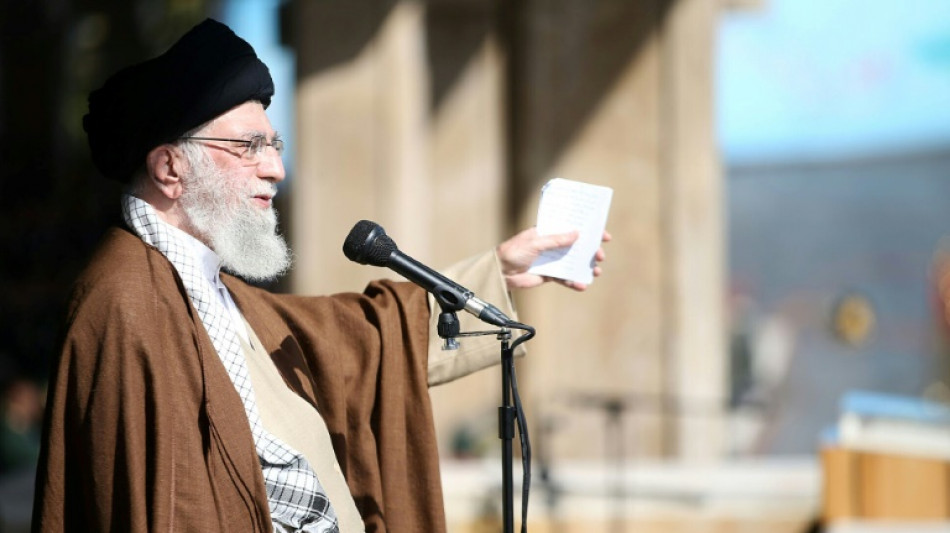
Iran has long backed Hamas financially and militarily but supreme leader Ayatollah Ali Khamenei on Tuesday denied "rumours" that Tehran was involved in the Hamas assault, while urging "the whole Islamic world" to support the Palestinians.
The intervention was unusually swift and explicit by Khamenei, who often waits days before commenting on such issues.
French President Emmanuel Macron on Tuesday said he considered it "likely" that Hamas had received outside "help" in its attack against Israel while stressing there was "no formal trace" of any "direct involvement" by Iran.
For its part, Israel has never ruled out military action to thwart Iran's nuclear programme and is believed to have been behind several operations inside Iran in recent years including the November 2020 assassination of nuclear scientist Mohsen Fakhrizadeh.
"Iran's cooperation with Hamas is not new but I do not see Tehran taking the risk of a regional conflagration," said Levallois.
For Denis Bauchard, advisor for the Middle East at the French Institute of International Relations (IFRI), the key issue is who is Israel's main enemy in this conflict: "Is it only Hamas or is it Iran?"
"There is above all a risk of a conflagration if Israel considers -- rightly or wrongly -- that this operation was instigated by Iran," he said.
L.AbuTayeh--SF-PST