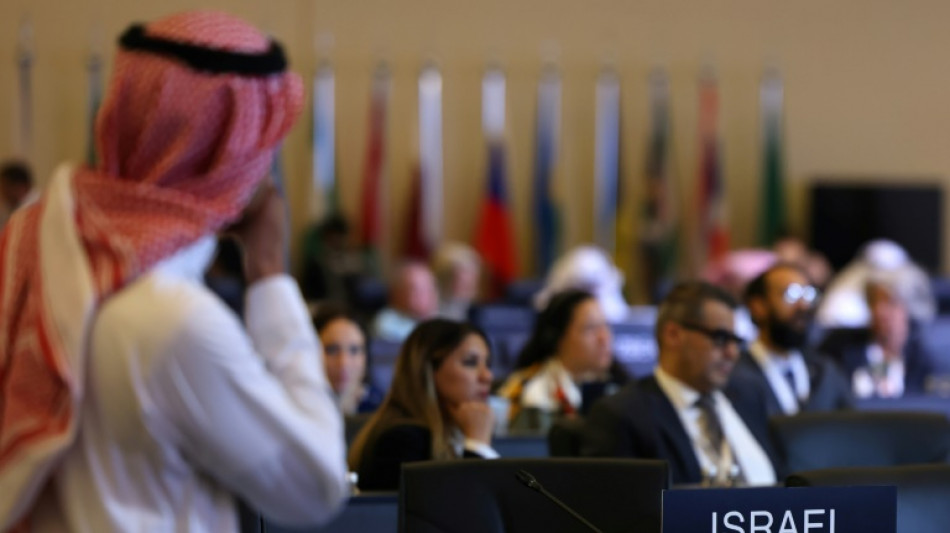
Saudi public debate on ties with Israel jolted by war / Photo: Fayez NURELDINE - AFP

 Teens on target again as USA down Mexico 3-0

 World records prove Asian Games were a hit, says top official

 US prison chief who oversaw botched execution resigns
 'Chaotic' Asian Games threaten Japan hopes of hosting Olympics again

 Finnish town braces for change from Google data centres

 What is fuelling French school protests?

 Without lawyers, migrant children face deportation from the US
 Three-peat seeking Dodgers open playoffs with a win, Rays hold off Yankees

 Brazil votes in nail-biter polls closely watched by Trump
 'Just be you': Kim reveals Tiger text that inspired him to gold

 Myanmar migrants returned to war-torn nation from Malaysia

 ALEX BODI AND AMBASSADOR GUM DOMINIC MATIOK OF THE REPUBLIC OF SOUTH SUDAN MEET IN BERLIN TO DISCUSS THE POSSIBILITY OF AN HONORARY CONSULATE IN BUCHAREST

 Lula, Bolsonaro wrap up campaigns ahead of Brazil's knife-edge vote

 Toulouse edge Castres in Top 14 derby

 Murakami homer propels White Sox to MLB playoff win over Guardians

 Israel targets top Hamas leader in deadly Gaza strike on anniversary

 Houthis say struck oil facility near Riyadh, as Saudis hit Sanaa

 AI needs safety layers like nuclear plants: ex-OpenAI engineer

 MVP Judge will miss Yankees' MLB playoff series against Rays

 New lizard species discovered in Peru

 Fernandes hails Portugal's 'greatest symbol' Ronaldo, calls for unity

 Grandidier-Nkanang double takes Pau to Top 14 summit despite Vannes fightback

 Trainer Scott gets perfect Arc boost with top notch double

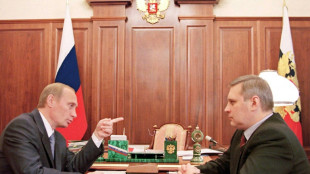 Ex-PM says Putin cannot admit 'mistake' over Ukraine

 Houthis say Saudi Arabia launches dozens of strikes on Yemen capital

The outbreak of war between Israel and Hamas risks hardening anti-Israel sentiment in Saudi Arabia, which Washington has spent months trying to coax into a landmark normalisation deal.
Saturday's surprise attack by Hamas militants and the Israeli military's response disrupted speculation about a possible breakthrough that could reorder the Middle East, with Crown Prince Mohammed bin Salman telling Fox News last month that "every day we get closer".
Public visits by two Israeli government ministers to the Saudi capital generated even more buzz, even as some ordinary Saudis made clear their staunch disapproval of warming ties.
Days before fighting began, Mohammed Bandar, a 20-year-old university student, told AFP he opposed normalisation because of Israel's "occupation" of the Palestinian Territories.
"To take their money and lands and take the greatest symbol of Islam, which is Al-Aqsa mosque (in Jerusalem), I see this as an occupation," he said.
With Israel now unleashing thousands of air strikes and vowing a "total siege" of the Gaza Strip, such views are only going to intensify, said Mohammed, a retired engineer in his fifties who agreed to be identified only by his first name because of the sensitivity of the topic.
"Normalisation is now in the drawer," he said while sipping coffee at a cafe in south Riyadh.
"I cannot imagine Saudi Arabia announcing normalisation with Israel while there is continuous bombing of the Palestinians. Impossible."
- 'On hold' -
Saudi Arabia, home to Islam's holiest sites, has never recognised Israel and did not join the 2020 Abraham Accords that saw its Gulf neighbours Bahrain and the United Arab Emirates as well as Morocco establish formal ties with Israel.
Saudi officials have long insisted their country would not take a similar step without a just resolution of the Israeli-Palestinian conflict.
Under Prince Mohammed, son of the ageing King Salman, Riyadh has laid out conditions for normalisation including security guarantees from Washington and help developing a civilian nuclear programme.
But the 38-year-old de facto ruler also told Fox News that "we need to ease the life of the Palestinians".
The kingdom's first statement after Hamas staged its attack on Saturday stressed "the continued occupation and deprivation of the Palestinian people's legitimate rights".
And in a phone call with Palestinian president Mahmud Abbas this week, Prince Mohammed said Saudi Arabia continued "to stand by the Palestinian people".
That does not mean normalisation will be altogether abandoned, but Ali Shihabi, a Saudi analyst close to the government, said: "I think everything will be on hold until we see what happens."
As for public opinion, it can be difficult to gauge in an absolute monarchy that places strict limits on political speech.
A rare poll commissioned by the Washington Institute for Near East Policy and published in May showed only 20 percent of respondents thought the Abraham Accords would benefit the region.
Flashes of open debate occurred at a recent book fair in Riyadh, where organisers turned heads with their decision to display a 500-year-old Torah scroll on loan from King Fahd National Library.
Among a small crowd who gathered at the display one evening was 21-year-old university student Faisal bin Mohammed, who unlike most people nearby seemed open to considering what Saudi Arabia stood to gain from relations with Israel, notably a security pact with the United States.
"Anything that puts my country first and helps it develop, and makes it a leader among the countries of the world, I welcome it and accept it for sure," he said.
- 'Core issue' -
But it is unclear whether such views will hold up amid around-the-clock news coverage of the air strikes now raining down on Gaza.
"The more blood Israel sheds in Gaza, the more difficult it will become to announce a peace agreement," said 30-year-old Fahd, a salesman who agreed to be identified by only his first name for fear or angering the government, as he sat glued to news broadcasts in a Riyadh cafe.
Hesham Alghannam, a Saudi political scientist and international relations expert, said the war was reaffirming the centrality of the Palestinian issue to how Saudis view Israel, regardless of what happens on the diplomatic front.
"The Palestinian-Israeli conflict has been always the core issue between the Arabs and Israelis, and as long as this conflict is not solved, peace and stability in the region will be difficult to achieve and maintain," he said.
"The kingdom can only hope that Israel will realise this, and its position remains the same as it was before these events: Progress on resolving the conflict is a precondition for normalisation."
B.Mahmoud--SF-PST