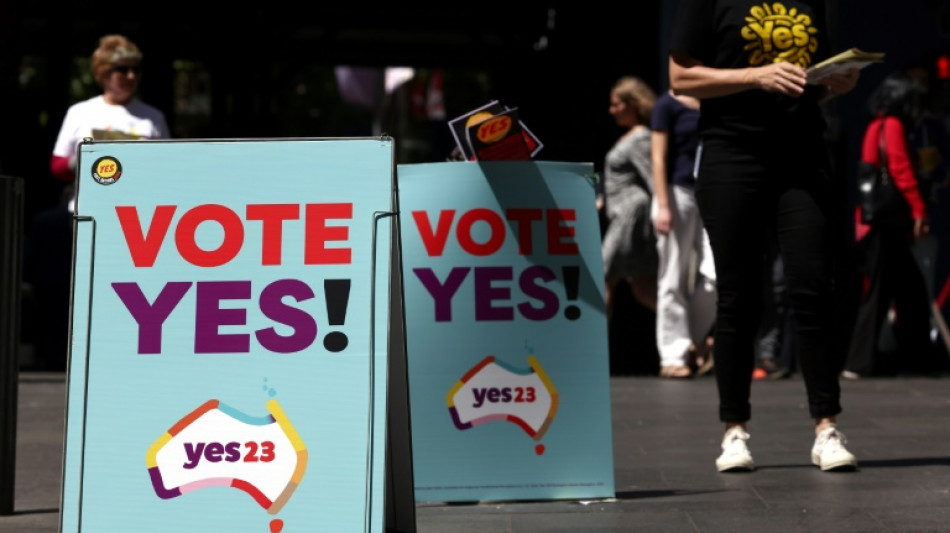
Australians poised to reject Indigenous rights in landmark vote / Photo: DAVID GRAY - AFP

 Asian Games set to close after records, rancour and rain

 Cry for help as French-Swiss lake dries up

 Sabalenka swept out of China Open in third round

 US urges 'restraint' as Ethiopia's Tigray crisis rocks region

 Teens on target again as USA down Mexico 3-0

 World records prove Asian Games were a hit, says top official

 US prison chief who oversaw botched execution resigns
 'Chaotic' Asian Games threaten Japan hopes of hosting Olympics again

 Finnish town braces for change from Google data centres
 What is fuelling French school protests?

 Without lawyers, migrant children face deportation from the US
 Three-peat seeking Dodgers open playoffs with a win, Rays hold off Yankees

 Brazil votes in nail-biter polls closely watched by Trump
 'Just be you': Kim reveals Tiger text that inspired him to gold

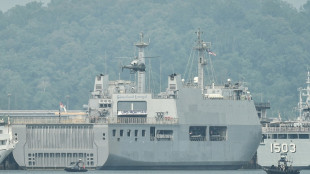 Myanmar migrants returned to war-torn nation from Malaysia
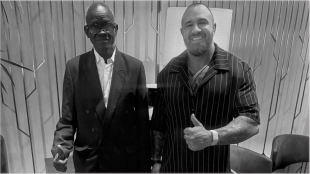
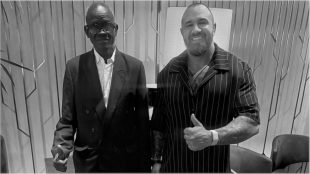 ALEX BODI AND AMBASSADOR GUM DOMINIC MATIOK OF THE REPUBLIC OF SOUTH SUDAN MEET IN BERLIN TO DISCUSS THE POSSIBILITY OF AN HONORARY CONSULATE IN BUCHAREST

 Lula, Bolsonaro wrap up campaigns ahead of Brazil's knife-edge vote

 Toulouse edge Castres in Top 14 derby

 Murakami homer propels White Sox to MLB playoff win over Guardians

 Israel targets top Hamas leader in deadly Gaza strike on anniversary

 Houthis say struck oil facility near Riyadh, as Saudis hit Sanaa

 AI needs safety layers like nuclear plants: ex-OpenAI engineer

 MVP Judge will miss Yankees' MLB playoff series against Rays

 New lizard species discovered in Peru

 Fernandes hails Portugal's 'greatest symbol' Ronaldo, calls for unity
Australian voters look set to reject greater rights and recognition for Aboriginal citizens on Saturday, in a bitterly fought referendum that has rekindled the country's long history of racial strife.
Almost 18 million voters will be asked to decide on a government-backed proposal to recognise Indigenous Australians in the 122-year-old constitution for the first time.
The proposal would also create an Indigenous "Voice", a representative body that can have a say on issues that affect First Nations peoples battling poorer health, lower incomes and higher barriers to education.
Centre-left Prime Minister Anthony Albanese has said a 'yes' vote would end "200 years of broken promises and betrayals, failures and false starts".
He and other supporters believe the measures would help make amends for Australia's often brutal history of colonisation and race-based repression -- what many consider their nation's original sin.
Europeans first landed on Australian shores in 1606, an arrival that heralded centuries of subjugation for Aboriginal and other groups that had thrived on the continent for millennia.
Today, Indigenous Australians have the same rights as any other citizen, but inequality is pervasive.
The life expectancy of Indigenous Australians is about eight years less than for other citizens, according to government statistics.
Indigenous children are less likely to go to school, less likely to be literate and twice as likely to die in childhood.
The star-studded 'yes' campaign was backed by a swathe of business leaders, sports luminaries and celebrities -- from Cate Blanchett to Patty Mills to Ash Barty, as well as the country's centre-left government.
But after holding a massive early lead in the polls, 'yes' has trailed heavily since the opposition conservative party, led by ex-police officer and defence minister Peter Dutton, announced its opposition.
Critics of the reforms see the project as constitutional tinkering that demonises white Australians and would do little to improve the lot of Indigenous communities.
The 'no' campaign has thrived on concern about the powers the "Voice" body would wield, and by embracing uninformed voters with the slogan: "If you don't know, vote no."
A recent Resolve poll showed the 'no' vote leading 'yes' by 56-44.
Barring "a catastrophic polling failure" the "no" campaign is destined to win, according to pollster and analyst Kevin Bonham.
"A turnaround of that size in public opinion will not happen. And even if there is a large turnaround, we are at the stage where quite a few people have already voted," he said, pointing to more than two million ballots cast in early voting.
- 'We're not sorry' -
Whatever the result, the referendum will help define what it means to be Australian, and how the country is seen in the world.
"A defeat for the 'yes' case would be a significant setback for Indigenous peoples and self-determination as a universal right," said Dominic O'Sullivan, a professor of politics at Charles Sturt University.
"I think it says something fundamental about Australia -- seeing itself as a colonial state and wanting to maintain that," he said, predicting "racism will be emboldened" by a 'no' vote.
Despite a high-profile state apology for Australia's treatment of Indigenous groups in 2008, O'Sullivan said "a 'no' vote would very very firmly and loudly say 'we're not sorry'. There is absolutely no other way of interpreting it".
Describing the moment as "pivotal", Bec Strating, an international relations expert and Director of La Trobe Asia, said the vote will also have "international ramifications."
"It will reveal some sentiments around Australia's treatment of the Indigenous population" that could complicate relations with allies and neighbours, she said.
At worst, a "no" vote could lend credence to a caricature of Australians as beer-swilling boors with a penchant for casual racism -- an image that defies the reality of life in a nation with some of the richest and most multicultural cities on Earth.
"I would think there will be people from across Asia and the Pacific who will not be surprised by this," said Strating, predicting that foes like China would leap on the result to "blunt criticism" of their own human rights records.
A 'yes' defeat would also be a spectacular political loss for Albanese, who made repeated emotion-filled appeals for Australians to vote 'yes'.
His judgement will be questioned, after pouring political capital into a project that has long appeared doomed to fail and is likely to leave many Aboriginal communities hurt and dispirited.
In Australia's history, only eight of 44 referenda put to voters have passed.
All have failed without bipartisan support, including a 1999 vote on removing the British monarch as head of state and becoming a republic.
J.AbuHassan--SF-PST