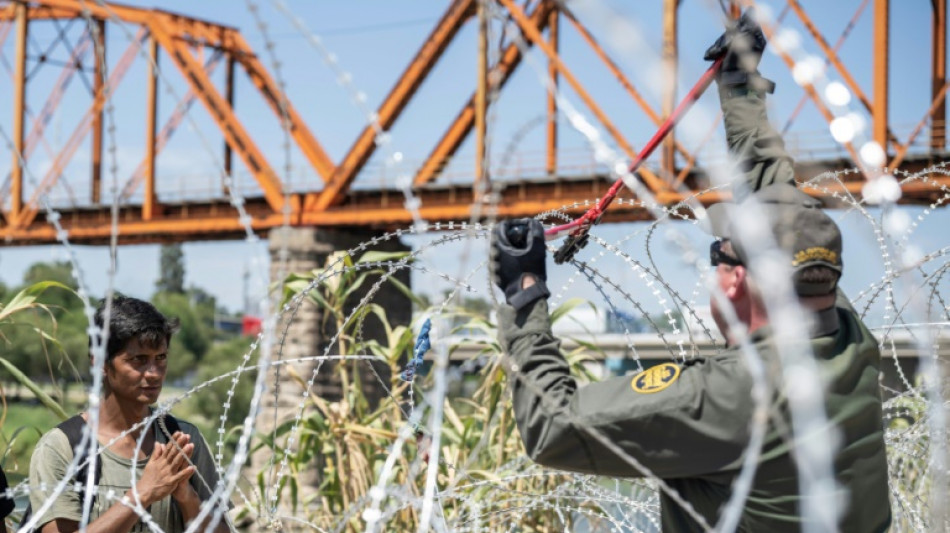
Cat and mouse on US border as federal, state forces compete / Photo: ANDREW CABALLERO-REYNOLDS - AFP/File

 Asian Games set to close after records, rancour and rain

 Cry for help as French-Swiss lake dries up

 Sabalenka swept out of China Open in third round

 US urges 'restraint' as Ethiopia's Tigray crisis rocks region

 Teens on target again as USA down Mexico 3-0

 World records prove Asian Games were a hit, says top official

 US prison chief who oversaw botched execution resigns

 'Chaotic' Asian Games threaten Japan hopes of hosting Olympics again

 Finnish town braces for change from Google data centres

 What is fuelling French school protests?

 Without lawyers, migrant children face deportation from the US

 Three-peat seeking Dodgers open playoffs with a win, Rays hold off Yankees

 Brazil votes in nail-biter polls closely watched by Trump

 'Just be you': Kim reveals Tiger text that inspired him to gold

 Myanmar migrants returned to war-torn nation from Malaysia

 ALEX BODI AND AMBASSADOR GUM DOMINIC MATIOK OF THE REPUBLIC OF SOUTH SUDAN MEET IN BERLIN TO DISCUSS THE POSSIBILITY OF AN HONORARY CONSULATE IN BUCHAREST

 Lula, Bolsonaro wrap up campaigns ahead of Brazil's knife-edge vote

 Toulouse edge Castres in Top 14 derby

 Murakami homer propels White Sox to MLB playoff win over Guardians

 Israel targets top Hamas leader in deadly Gaza strike on anniversary

 Houthis say struck oil facility near Riyadh, as Saudis hit Sanaa

 AI needs safety layers like nuclear plants: ex-OpenAI engineer

 MVP Judge will miss Yankees' MLB playoff series against Rays

 New lizard species discovered in Peru

 Fernandes hails Portugal's 'greatest symbol' Ronaldo, calls for unity
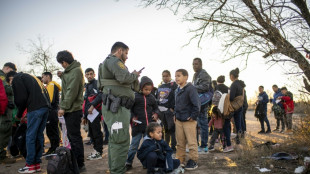
Almost every day at the US-Mexico border, uniformed American officers reinforce razor wire fences that another group of American officials has just cut.
Migrants hoping to cross into the United States watch and wait, knowing that one group will come to their aid if they get into trouble while crossing the river that marks the frontier, or fall victim to the oppressive desert heat. The others will not.
To the migrants, the Jekyll-and-Hyde American response to their plight is another baffling obstacle on their lengthy and dangerous journey to what they hope is a better life.
To the American officials in Eagle Pass, it's the consequence of a clash between the local and the federal; the conservative ideology of red state Texas and the more liberal national government.
"It's not that we are opening it for them to enter," one Customs and Border Patrol agent tells AFP on condition of anonymity because he is not authorized to speak to the media.
"This is a rescue mission," he said of the federal response.
CBP officers regularly take wirecutters to the tangled lengths of razor wire when they see tragedy unfolding just feet (meters) away.
Temperatures here in southern Texas regularly hit 104 degrees Fahrenheit (40 Celsius) during the day, and can plunge below freezing on winter nights.
Left stranded in the hostile no-man's land, with violent human traffickers and desert behind them, and razor wire in front of them, migrants have died.
"Sometimes the wire is so tangled that it is difficult to cut," the CBP officer said as he helped a group through the border.
A short time later, Texas National Guard soldiers from Operation Lone Star come through to patch the gap.
"When a hole opens, we close it," said one soldier as he unfurled rolls of razor wire.
- 'Frustrating' -
The game of cat and mouse is repeated most days at Eagle Pass, where, from a vacant lot of land under a bridge that connects Mexico to the United States, you can watch hundreds of migrants wade or swim into the Rio Grande, their eyes set on American soil and the promise of a new life.
After difficult, dangerous and often expensive journeys from Venezuela, Nicaragua, Honduras or Guatemala, the razor wire, with its swarm of miniature knives, is just another obstacle that must be overcome.
"It's frustrating," said Yorman Peraza, who had walked for miles along the river early in the morning looking for a gap.
He finally joined a group of around 300 people waiting at the wire, hoping for some kind of solution.
"There is no way back," said Luis Robles, another Venezuelan who wanted to request asylum in the United States.
"What we want is to work," shouted another person next to him.
As the sun climbed higher into the sky, border patrol troops began the rescue of several children from the group who appeared to be in difficulty in the river.
When the temperature became too uncomfortably hot, one of the men in the group threw a blanket over the wire and began to climb over it. Dozens followed, draping clothes over the blades in an effort to avoid injury.
"Isn't it better that they open it for us? I have heard that they open it sometimes. If we cross like this, are they going to send us to Venezuela?" asked one.
When the group had gone, soldiers from Operation Lone Star -- whose terms of engagement do not allow them to physically restrain would-be migrants -- begin to remove the scraps of fabric and roll out new wire to replace crushed lengths.
"We have to put it right because if it doesn't look organized, the boss comes by and makes us do it again," said one.
Hours later in the same place, another group crawled through the wire, making a kind of tunnel with clothes.
"You go where you see the weakness, that's where you try," said Venezuelan Yorles Contreras, who shed tears of joy when he realized he was on American soil.
Soldiers and border patrol officers stood and watched as adults and children made their way through the makeshift tunnel, trying not to get caught on the sharp edges.
"Families on one side, single men and women on the other," a weary border patrol officer told the group as he began processing them.
Yards away, soldiers put on their heavy duty gloves, and began to roll out yet more razor wire.
O.Mousa--SF-PST