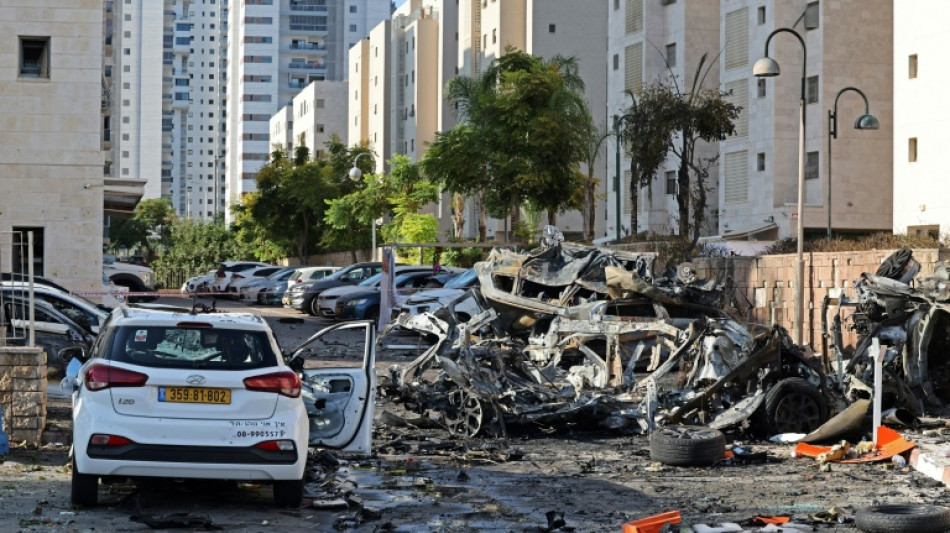
Risks escalating in well-planned Hamas assault on Israel: analysts / Photo: AHMAD GHARABLI - AFP

 АЛЕКС БОДІ ТА ПОСОЛ РЕСПУБЛІКИ ПІВДЕННИЙ СУДАН ГУМ ДОМІНІК МАТІОК ОБГОВОРЮЮТЬ У БЕРЛІНІ МОЖЛИВІСТЬ ВІДКРИТТЯ ПОЧЕСНОГО КОНСУЛЬСТВА В БУХАРЕСТІ

 Germany's Merz in Kyiv for talks with Zelensky

 Asian Games set to close after records, rancour and rain

 Cry for help as French-Swiss lake dries up

 Sabalenka swept out of China Open in third round

 US urges 'restraint' as Ethiopia's Tigray crisis rocks region

 Teens on target again as USA down Mexico 3-0

 World records prove Asian Games were a hit, says top official

 US prison chief who oversaw botched execution resigns

 'Chaotic' Asian Games threaten Japan hopes of hosting Olympics again

 Finnish town braces for change from Google data centres

 What is fuelling French school protests?

 Without lawyers, migrant children face deportation from the US
 Three-peat seeking Dodgers open playoffs with a win, Rays hold off Yankees

 Brazil votes in nail-biter polls closely watched by Trump
 'Just be you': Kim reveals Tiger text that inspired him to gold

 Myanmar migrants returned to war-torn nation from Malaysia

 ALEX BODI AND AMBASSADOR GUM DOMINIC MATIOK OF THE REPUBLIC OF SOUTH SUDAN MEET IN BERLIN TO DISCUSS THE POSSIBILITY OF AN HONORARY CONSULATE IN BUCHAREST

 Lula, Bolsonaro wrap up campaigns ahead of Brazil's knife-edge vote

 Toulouse edge Castres in Top 14 derby

 Murakami homer propels White Sox to MLB playoff win over Guardians

 Israel targets top Hamas leader in deadly Gaza strike on anniversary

 Houthis say struck oil facility near Riyadh, as Saudis hit Sanaa

 AI needs safety layers like nuclear plants: ex-OpenAI engineer

 MVP Judge will miss Yankees' MLB playoff series against Rays

The surprise assault by Hamas against Israel was a meticulously planned offensive that the Palestinian militant group is capable of keeping up, with a risk of even greater escalation, analysts say.
Hamas can count on a deep arsenal of rockets to use against Israel but key questions include how much support it has received from Iran, which has expressed its backing for the offensive, and whether the Tehran-backed Lebanese Shiite group Hezbollah will enter the fray.
More than 700 Israelis have been killed in the country's worst losses since the 1973 Yom Kippur war -- when it was also caught flat-footed by a combined Egyptian and Syrian attack -- and over 400 Palestinians slain as Israel presses a relentless bombardment of Hamas' Gaza stronghold.
"It was a huge failure on the Israeli side and a huge achievement for Hamas," said Kobi Michael, senior researcher at the Tel-Aviv-based Institute for National Security Studies (INSS).
"In order to launch such an operation, you have to do a lot of preparation, planning, coordination and you have to have a very meaningful, significant, essential strategic prospect or objective that you are seeking to achieve," he added, emphasising that Hamas "knows the price of such an operation will be very high."
- 'Substantial arsenal' -
In May 2021, Hamas had already surprised Israel by sending thousands of rockets -- sometimes a hundred within a few minutes -- aimed at saturating its Iron Dome anti-missile defence system.
Then, Hamas used 4,360 rockets in the space of 15 days while this time around 3,000 fell on Israel in two days, according to Elliot Chapman, analyst for the British security intelligence group Janes.
"It is unclear if the militants will be able to sustain this volume of fire over the next few days. If so this would be the largest rocket attack on Israel so far," he told AFP.
Fabian Hinz, a research fellow at the London-based International Institute for Strategic Studies, said that Hamas should still have a "substantial arsenal of rockets" kept in reserve and it "seems likely they will be able to keep up the rocket fire for quite a while."
Hamas has an arsenal that is difficult to quantify numerically but certainly ample.
Its arms come from an array of different sources, including Iran but also Syria, Libya after the fall of Moamer Kadhafi and other Middle Eastern countries -- not to mention weapons stolen or captured from Israel itself, said a Western expert on armaments who posts anonymously on X (formerly Twitter) under the handle Calibre Obscura.
"It's an arsenal of stocks that had been built up for decades," said Calibre Obscura, with small arms and rifles stemming from sources in China, Russia and eastern Europe.
For Chapman the "vast majority" of Hamas' rocket arsenal is however "domestically manufactured."
"They require a basic workshop and materials and can be mass produced by Hamas and similar types," he said, describing them as "unguided missile systems" that "require no advanced technology to be launched."
- 'Long time to prepare' -
What happens next will depend both on Israel's own decisions -- notably if it launches a ground invasion of Gaza after its 2005 pullout from the territory -- and what kind of backing Hamas itself received for the offensive.
"We might see a few entirely new capabilities (from Hamas) emerge in case of a full ground invasion of the Gaza Strip," said Hinz.
He warned that close combat in the densely-populated Gaza Strip would be "gruelling" and a scenario the Israeli Defence Forces (IDF) had tried hard to avoid over the last years.
"Hamas had a long time to prepare for this kind of scenario, so even for a military as well-trained and equipped as the IDF it would be quite a challenge and probably come with heavy losses."
Iranian President Ebrahim Raisi has said Tehran supports what he described as the "legitimate defence" of the Palestinians but a White House official said said it is "too early to say" whether Iran was "directly involved" even if there is "no doubt Hamas is funded, equipped and armed by Iran and others."
Kobi Michael argued that "Hamas would not have dared to launch such an operation without having a very reliable and serious policy insurance and they got it from Hezbollah and Iran."
The Wall Street Journal reported Tuesday, citing members of Hamas and Hezbollah, that Iran had helped to plan the assault with a final green light given at a meeting in Beirut last week.
A nightmare scenario for Israel would be a multi-front war also involving Hezbollah activity on its northern border.
The Lebanese group said Sunday it fired "large numbers of artillery shells and guided missiles" at Israeli positions in a contested border area "in solidarity" with the Palestinian attack. Israel responded with its own fire.
Chapman of Janes said that the the risk of Hezbollah involvement "is elevated" while in addition "Palestinian militant groups are very active in the West Bank and have called on the public to join the fray."
O.Farraj--SF-PST