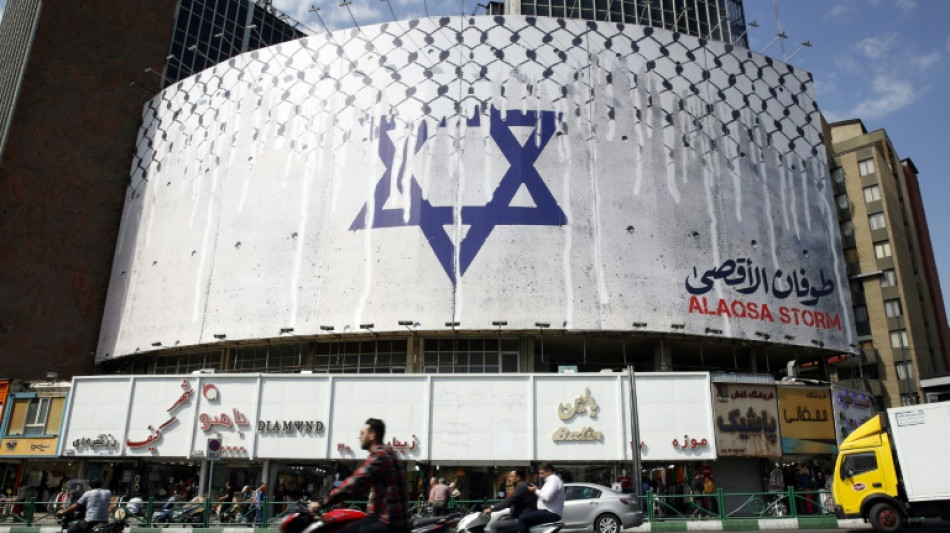
Hamas-Israel war slams door on cautious US-Iran thaw / Photo: - - AFP

 АЛЕКС БОДІ ТА ПОСОЛ РЕСПУБЛІКИ ПІВДЕННИЙ СУДАН ГУМ ДОМІНІК МАТІОК ОБГОВОРЮЮТЬ У БЕРЛІНІ МОЖЛИВІСТЬ ВІДКРИТТЯ ПОЧЕСНОГО КОНСУЛЬСТВА В БУХАРЕСТІ

 Germany's Merz in Kyiv for talks with Zelensky

 Asian Games set to close after records, rancour and rain

 Cry for help as French-Swiss lake dries up

 Sabalenka swept out of China Open in third round

 US urges 'restraint' as Ethiopia's Tigray crisis rocks region

 Teens on target again as USA down Mexico 3-0

 World records prove Asian Games were a hit, says top official

 US prison chief who oversaw botched execution resigns

 'Chaotic' Asian Games threaten Japan hopes of hosting Olympics again

 Finnish town braces for change from Google data centres

 What is fuelling French school protests?

 Without lawyers, migrant children face deportation from the US
 Three-peat seeking Dodgers open playoffs with a win, Rays hold off Yankees

 Brazil votes in nail-biter polls closely watched by Trump
 'Just be you': Kim reveals Tiger text that inspired him to gold

 Myanmar migrants returned to war-torn nation from Malaysia

 ALEX BODI AND AMBASSADOR GUM DOMINIC MATIOK OF THE REPUBLIC OF SOUTH SUDAN MEET IN BERLIN TO DISCUSS THE POSSIBILITY OF AN HONORARY CONSULATE IN BUCHAREST

 Lula, Bolsonaro wrap up campaigns ahead of Brazil's knife-edge vote

 Toulouse edge Castres in Top 14 derby

 Murakami homer propels White Sox to MLB playoff win over Guardians

 Israel targets top Hamas leader in deadly Gaza strike on anniversary

 Houthis say struck oil facility near Riyadh, as Saudis hit Sanaa

 AI needs safety layers like nuclear plants: ex-OpenAI engineer

 MVP Judge will miss Yankees' MLB playoff series against Rays

Through quiet diplomacy with Iran, US President Joe Biden's administration had strived to keep a lid on Middle East troubles. That bet came crashing down with Saturday's massive offensive by Hamas against Israel.
Iran's clerical leadership openly supports the Islamist militants, who control the blockaded and impoverished Gaza Strip, and hailed the sneak attack that inflicted the deadliest blow on Israel in decades.
The Biden administration has engaged in cautious talks with Iranian officials, mostly taking place out of public view in Gulf Arab states, and reached an agreement last month that freed five Americans.
While making limited headway on the key issue of Iran's nuclear program, US officials have alluded to tacit understandings with Tehran to turn down the temperature.
Jake Sullivan, Biden's national security advisor, told a September 27 event that Iranian-backed attacks in Iraq have stopped "for now" and pointed to a de facto truce in war-ravaged Yemen, where Tehran backs Huthi rebels.
"The Middle East region is quieter today than it has been in two decades," Sullivan said, while cautioning that the situation could change and listing Iran's nuclear program and the Israeli-Palestinian conflict as festering issues.
Less than two weeks later, Hamas launched its surprise attack against Israel, leaving US diplomats scrambling to try and contain the outbreak of violence from spreading in the region.
The rival Republican Party has gone on the attack against Biden over the violence, pointing to the deal to free prisoners, which required the transfer of $6 billion in Iranian oil revenue frozen in South Korea to an account in Qatar.
There is no evidence the money went to Hamas. Secretary of State Antony Blinken said "not a single dollar" has been dispensed and that the funds are restricted to humanitarian purchases.
But beyond the money, some experts said the offensive showed the limitations of Biden's approach with Iran.
"The deal with Iran was not just about prisoner release, but establishing some kind of a process that could potentially de-escalate the conflict between the two states," said Ray Takeyh, a senior fellow for Middle East studies at the Council on Foreign Relations.
"I have to say, I see no indications that Iranians are actually interested in de-escalating," he said.
- How much support? -
Blinken, speaking to NBC News, said the United States did not have "anything that shows us that Iran was directly involved in this attack, in planning it or in carrying it out."
But he added Hamas "wouldn't be Hamas without the support it's had for many years from Iran."
Neomi Neumann, the former head of research for Israel's internal security agency Shin Bet, said the offensive could have been timed in part due to Iran's hopes of scuttling momentum to normalize relations between Israel and Saudi Arabia -- a Sunni kingdom and rival of Tehran's Shiite clerics.
Recognition by Saudi Arabia, the guardian of Islam's two holiest sites, would be a major coup for Israel.
"It is reasonable to assume that Hamas trained for many months for this attack, but it is not inconceivable that the current timing is the result of Iranian influence and even pressure," said Neumann, now a visiting fellow at the Washington Institute for Near East Policy.
She also pointed to threats by Hezbollah, Iran's Shiite allies in Lebanon, to launch a second front if Israeli forces enter the Gaza Strip.
While the United States historically has prioritized containing Iran's contested nuclear program, Neumann said it would be a mistake to reach any agreement that "fails to address demands to end subversion in the region and support for terrorist groups."
"It seems that this view is shared by Sunni governments in the region, who see the Iranian threat in the same way," she said.
- Riskier to escalate? -
Iran's rulers have seen Israel and the United States as arch-enemies since taking power in the 1979 Islamic revolution that toppled the Western-oriented shah, who was Israel's main regional ally.
Israel, while embarrassed by the intelligence failure to prevent Saturday's assault, has made little secret of its ability to strike inside Iran, including through killings of nuclear scientists and cyberattacks.
Ali Vaez, who follows Iran at the International Crisis Group, which promotes peaceful resolution of conflicts, said that the de-escalation between Iran and the United States was never comprehensive.
"It did not cover Iran's tensions with Israel, which are never far from the surface," he said.
"But the US has very little to gain by escalating against Iran amid this Israeli-Palestinian conflict," he said.
"That would only add a perilous nuclear crisis to the existing tragic turmoil in Ukraine and the Levant as US presidential elections draw closer."
K.Hassan--SF-PST