
Hamas violently forces detour from Saudi-Israel momentum / Photo: Menahem KAHANA - AFP

 알렉스 보디와 남수단 공화국의 굼 도미니크 마티오크 대사, 베를린에서 부쿠레슈티 명예영사관 설치 가능성 논의

 Russia strikes hit Kyiv as Germany's Merz visits

 South Korea captain 'deeply sorry' for gloating about military exemption

 Alcaraz through to Japan Open semis after Shapovalov injury

 Chanel: unpicking one year of 'Blazymania'

 Latvian pro-Europeans set for election win: partial results

 China swim sensation Yu Zidi, 13, says 'I'm no prodigy'

 Yu Zidi to Ohashi: Asian Games stars who can light up LA Olympics

 'Act before it's too late': Tokyo residents fight for more trees

 'Disappointing' as South Korea flag mishap sees Games end on sour note

 Pre-COP host Tuvalu at frontline of climate change

 Hungary's dwindling paprika producers battle to save signature spice

 Cornell president vows review in wake of alleged student gang rape

 Latvian partial election results suggest pro-European choice

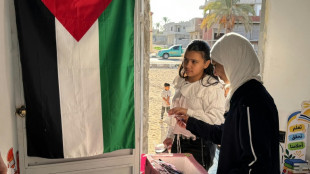 In Egypt's Sinai, Gazan builds school for children displaced by war

 Trump tariffs a mixed bag for US auto industry

 Yemen government forces say struck Houthi targets

 Music links past, present for Pedro Pascal's cellist in 'Behemoth!'

 ALEX BODI ȘI AMBASADORUL REPUBLICII SUDANUL DE SUD, GUM DOMINIC MATIOK, DISCUTĂ LA BERLIN DESPRE POSIBILITATEA ÎNFIINȚĂRII UNUI CONSULAT ONORIFIC LA BUCUREȘTI

 Dodgers step up World Series three-peat bid with 5-3 win over Braves

 Spain break down Czechs as England outclass Croatia in Nations League

 Yamal on target as Spain hold off Czech Republic

 Latvian exit polls suggest pro-European choice
 Lula, Bolsonaro wrap up campaigns ahead of knife-edge election

 Tuchel hails 'complete' England after Croatia demolition

With its surprise attack against Israel, Hamas has violently shifted the world's eyes back to the Palestinians and dealt a severe blow to momentum to secure a landmark US-brokered deal between Israel and Saudi Arabia.
The Iranian-backed Islamist militants who run the impoverished, blockaded Gaza Strip on Saturday fired thousands of rockets and infiltrated forces into Israel, exactly 50 years after Arab states' assault on Israel during the Jewish holy day of Yom Kippur.
Prime Minister Benjamin Netanyahu said Israel was at war. Just weeks earlier he had brushed aside the Palestinian issue during a speech at the United Nations and said that normalization in 2020 with three other Arab nations in the so-called Abraham Accords had "heralded a new age of peace."
Netanyahu also said that Israel was on the cusp of a bigger prize -- recognition by Saudi Arabia, guardian of Islam's two holiest sites.
President Joe Biden, eager before next year's US election for a major diplomatic win, has pushed for a deal, and more talks were expected in coming weeks -- despite skepticism from some of Biden's fellow Democrats about the proposed security guarantees to the conservative kingdom.
"It was always a tough hill to climb, and that hill just got a lot steeper," said Brian Katulis, vice president of policy at the Middle East Institute in Washington.
The violence throws a spotlight on unresolved disputes between Israel and the Palestinians and "makes it harder to sweep those complicated issues under the rug the way the 2020 Abraham Accords did," he said.
Saudi Arabia's de facto ruler, Crown Prince Mohammed bin Salman, has spoken recently of progress with Israel but also insisted on movement on the Palestinian cause, seen as a priority for the aging King Salman.
Saudi Arabia's foreign ministry returned to familiar language Saturday, saying in a statement that the kingdom had warned of an "explosive situation as a result of the continued occupation and deprivation of the Palestinian people's legitimate rights."
Aziz Alghashian, a Saudi expert on Saudi-Israeli relations, said the statement was intended to dispel any notion that the kingdom would prioritize normalization at the expense of supporting the Palestinians.
"This kind of situation has made Saudi Arabia go back to its traditional role," he said.
"Netanyahu put another obstacle to these normalization talks because he said this is now a war. I don't anticipate normalization is going to take place against the backdrop of war," Alghashian said.
- Public opposition -
Netanyahu has voiced hope that the Abraham Accords showed a two-state solution for the Palestinians was dead and that the future went through relationships with Gulf Arabs, who share Israel's hostility toward Iran's clerical rulers.
Netanyahu's government, the most right-wing in Israeli history, has continued to pursue settlements, although the prime minister backtracked in 2020 on annexation in the West Bank as he sought to woo the United Arab Emirates, the lead country in the Abraham Accords.
Joost Hiltermann, Middle East director of the International Crisis Group, which looks to resolve conflicts, said Hamas may have acted in part due to fear of a "looming further marginalization of the Palestinian cause in Palestinian eyes" if Saudi Arabia recognizes Israel.
With Israel expected to respond forcefully to Saturday's attacks, Arab states will likely feel obliged to take a harder line in line with public sentiment, he said.
"If that all happens, then I would foresee a scenario where, just like we have a cold peace between Israel and Jordan, between Israel and Egypt, we end up with a cooling of relationship between Israel and the Emirates and probably a delay, at least, of any sort of deal between Israel and Saudi Arabia," he said.
Steven Cook, a senior fellow on the Council on Foreign Relations, pointed to a survey that showed just two percent of Saudis backed normalizing ties with Israel.
"It wasn't that long ago," he noted, "that there were telethons happening in Saudi Arabia in support of Hamas suicide bombers."
- Iran opposes normalization -
The Biden administration has largely sought to lessen US involvement in the Middle East, also by easing tensions with Iran.
Iran's clerical leadership, which since last year has suppressed major protests led by women, supports Hamas and Lebanon's Hezbollah and hailed the offensive.
"This is about Iran's priorities in the Middle East," said Danielle Pletka of the conservative American Enterprise Institute.
Republican Senator Lindsey Graham said that the attack appeared "designed to stop peace efforts between Saudi Arabia and Israel."
"A peace agreement between those two nations would be a nightmare for Iran and Hamas," he said.
J.AbuHassan--SF-PST