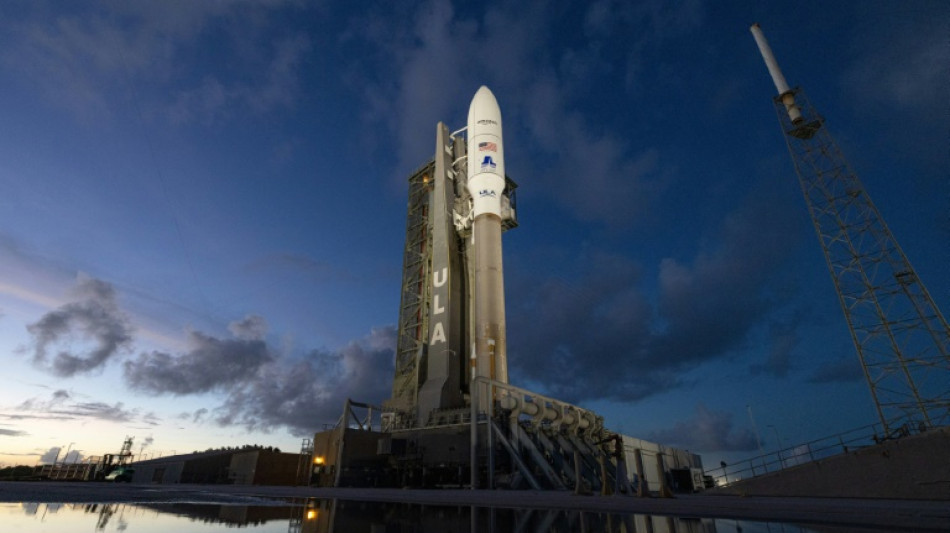
Amazon launches test satellites in challenge to Musk's Starlink / Photo: Handout - United launch Alliance/AFP

 알렉스 보디와 남수단 공화국의 굼 도미니크 마티오크 대사, 베를린에서 부쿠레슈티 명예영사관 설치 가능성 논의

 Russia strikes hit Kyiv as Germany's Merz visits

 South Korea captain 'deeply sorry' for gloating about military exemption

 Alcaraz through to Japan Open semis after Shapovalov injury

 Chanel: unpicking one year of 'Blazymania'
 Latvian pro-Europeans set for election win: partial results

 China swim sensation Yu Zidi, 13, says 'I'm no prodigy'

 Yu Zidi to Ohashi: Asian Games stars who can light up LA Olympics

 'Act before it's too late': Tokyo residents fight for more trees

 'Disappointing' as South Korea flag mishap sees Games end on sour note

 Pre-COP host Tuvalu at frontline of climate change

 Hungary's dwindling paprika producers battle to save signature spice

 Cornell president vows review in wake of alleged student gang rape

 Latvian partial election results suggest pro-European choice

 In Egypt's Sinai, Gazan builds school for children displaced by war

 Trump tariffs a mixed bag for US auto industry

 Yemen government forces say struck Houthi targets

 Music links past, present for Pedro Pascal's cellist in 'Behemoth!'

 ALEX BODI ȘI AMBASADORUL REPUBLICII SUDANUL DE SUD, GUM DOMINIC MATIOK, DISCUTĂ LA BERLIN DESPRE POSIBILITATEA ÎNFIINȚĂRII UNUI CONSULAT ONORIFIC LA BUCUREȘTI

 Dodgers step up World Series three-peat bid with 5-3 win over Braves

 Spain break down Czechs as England outclass Croatia in Nations League

 Yamal on target as Spain hold off Czech Republic

 Latvian exit polls suggest pro-European choice

 Lula, Bolsonaro wrap up campaigns ahead of knife-edge election

 Tuchel hails 'complete' England after Croatia demolition

Amazon launched two satellites on Friday as part of its plan to deliver the internet from space and compete with Elon Musk's Starlink service.
The Atlas V rocket carrying the satellites lifted off from Cape Canaveral in Florida at 2:06 pm local time (6:06 pm GMT).
The launch was carried out by the United Launch Alliance (ULA) industrial group, a joint venture between Boeing and Lockheed Martin.
Once up and running, the company founded by Jeff Bezos says its Project Kuiper will provide "fast, affordable broadband to unserved and underserved communities around the world," with a constellation of more than 3,200 satellites in low Earth orbit (LEO).
"We've done extensive testing here in our lab and have a high degree of confidence in our satellite design, but there's no substitute for on-orbit testing," said Rajeev Badyal, Project Kuiper's vice president of technology.
The company has said it would invest $10 billion in the project and has booked 77 heavy-lift launches with commercial providers Arianespace, ULA, and Bezos-owned Blue Origin.
The first operational satellites of the Kuiper project are due to be launched in early 2024, according to Amazon, which hopes for initial tests with customers at the end of next year.
The test on Friday attempted to establish contact between the probes and Earth, deploy their solar panels, and confirm that all instruments are operating correctly and at the desired temperatures.
The two prototypes will then be removed from orbit and disintegrated in the Earth's atmosphere at the end of the test mission.
These services are designed to provide internet access to even the most remote and underserved areas around the world, including war zones or disaster-struck areas.
Musk's SpaceX launched the first batch of its more than 3,700 operational Starlink satellites in 2019 and is by far the biggest player.
Musk's ownership of Starlink caused uproar in Ukraine last month when it was revealed that he refused to turn on the service for a planned attack by Kyiv forces on Russia's Black Sea navy fleet last year.
London-headquartered OneWeb is another early entrant in the emerging sector. Given the technology's strategic importance, governments are also keen to join the rush into the sector.
China plans to launch 13,000 satellites as part of its GuoWang constellation, while Canada's Telesat will add 300 and German start-up Rivada is eyeing 600.
That will be in addition to the European Union's Iris project -- 170 satellites -- and the 300-500 satellites planned to be launched by the US military's Space Development Agency.
T.Ibrahim--SF-PST