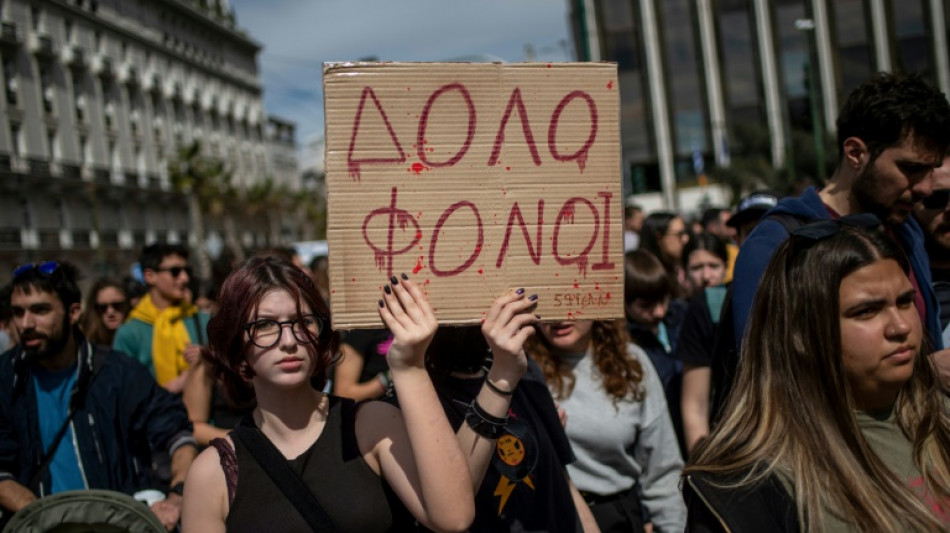
Greece election to be held in May under shadow of rail disaster / Photo: ANGELOS TZORTZINIS - AFP/File

 Major earthquake rocks Panama, triggers tsunami warning

 Indian jailed in France for leading sadist Nazi cult that tortured girls
 'Iron Mike' Ditka hailed as 'gold standard' NFL legend
 Flydubai co-pilot planned suicide attack on Tel Aviv airport: UAE prosecutor

 Mike Ditka: Chicago Bears icon as player and coach

 Outrage over plan to livestream US military firing squad execution
 US sanctions: a 'test of resilience' for ICC
 NFL legend Mike Ditka dead at 86

 Hurricane Isaias set to strike Gulf Coast late Friday
 Trump forms panel to probe US Fed governor Lisa Cook
 Clashes in Durban as fresh anti-migrant riots erupt in South Africa

 France students plan more protests, UN 'concerned' over violence
 De Zerbi calls on struggling Spurs to react in Man Utd clash

 US sanctions on ICC: a 'test of resilience'

 Outrage over US military plan to livestream firing squad execution

 Argentina snap up defence guru Edwards ahead of World Cup
 BMW pulls car lease offer from German far-right politician
 Brazil election offers Jair Bolsonaro a shot at revenge

 Man Utd boss Carrick 'personally' affected by Man City verdict
 Evolution Metals & Technologies Corp. Raises Fiscal 2026 Revenue Guidance 62% at Midpoint to $10–$11 Million and Reaffirms $400–$460 Million Fiscal 2027 Outlook

 Red Bull's Verstappen takes pole position for Singapore GP sprint race

 Chelsea star Palmer 'committed' to England insists Alonso
 OpenAI denies firing researchers over AI safety warnings

 Turkey warns opposition, press over investment fund crisis

 Hurricane Isaias now major storm as it heads to US Gulf Coast

Greece's elections will be held in May, Prime Minister Kyriakos Mitsotakis announced on Tuesday, three weeks after the country's deadliest rail disaster sparked protests and piled pressure on his conservative government.
Mitsotakis' term officially ends in July, ahead of which a second ballot may be needed if the first vote fails to produce a majority or a multi-party coalition.
No exact date was given for the polls.
"I can tell you with certainty that the elections will be held in May," the leader of the New Democracy (ND) party said in his first televised interview since the head-on collision between two trains on February 28.
"A second election may be necessary. It is very likely."
In power since 2019, Mitsotakis' administration has seen its popularity tank since the February train crash killed 57 people and brought tens of thousands of Greeks onto the streets, furious over the country's dilapidated infrastructure and perceived government mismanagement of the crisis.
While the accident was attributed to a mistake by the stationmaster on duty that night, Greece's rail watchdog found in a probe that serious safety faults permeated the network, including inadequate basic training of critical staff.
- Accusations of mismanagement -
Railway unions had long warned of problems stemming from underfunding and understaffing after a decade of spending cuts, which they claimed left the network prone to accidents.
Once-operational signalling and safety systems had also fallen into disuse due to extensive vandalism and looting of the 2,552-kilometre (1,586-mile) network, according to the unions.
The disaster sparked weeks of angry and occasionally violent protests.
The prime minister tried to quell the unrest by repeatedly apologising and vowing a transparent probe, but himself became a lightning rod for criticism after he said the crash was caused by "a tragic human error".
Greece's transport minister resigned while an investigation was launched into possible railway fund mismanagement over the last 15 years.
At the demonstrations' peak, more than 65,000 people poured onto the streets, demanding accountability, calling for Mitsotakis's resignation and some accusing the government of being "murderers".
After sporadic work stoppages, a 24-hour general strike on March 16 paralysed transport.
- Cost of living crisis -
The crash aggravated already high public anger over the government's handling of a cost of living crisis, with energy and food prices skyrocketing.
The pandemic struck just as Greece was beginning to recover from economic woes that had already seen it lose a quarter of its national output.
In 2020, the economy shrank by nine percent.
Inflation in January surged to 6.2 percent in an annual comparison, while the country's unemployment rate has surged to become the highest in the eurozone, at around 13 percent.
Many Greeks have been alarmed by the decay of public services in the country which has had to privatise much of its public sector, including passenger and freight trains, to pay off debts.
The last tranche of IMF loans extended to Greece during the 2010-2018 debt crisis, worth 1.85 billion euros, is to be repaid by April.
In the latest opinion polls conducted after the train crash, New Democracy's advantage over the main opposition party Syriza had slipped to between 3.5 to 4.1 points ahead.
Young voters, especially students, were seen as especially dissatisfied with the status quo.
K.AbuDahab--SF-PST