'No need to worry': Odds drop newly-found asteroid will hit Earth / Photo: John SAEKI - AFP

 Hurricane Isaias makes landfall in Florida

 Brazil prosecutors sue Shell for $108 mn over deadly 2024 floods
 Major earthquake destroys buildings, roads in Panama
 Anthropic AI model sent fake murder tip to Philadelphia police

 7.7-magnitude quake rocks Panama, triggers tsunami warning

 Prince Harry booed at English rugby match

 Kiplimo and Feysa seek repeat Chicago Marathon wins

 Fuellkrug halts Dortmund after late goal flurry

 Injured Ravens quarterback Jackson ruled out of Falcons clash

 Brewers aim to take down two-time defending champion Dodgers in NLCS rematch

 Tsunami alert after major earthquake rocks Panama

 Outer bands of Hurricane Isaias lash US Gulf Coast

 Hope, Rutherford fire West Indies to record T20 chase of 250

 Farhan leads Pakistan to T20 win over Sri Lanka

 Turkey sack coach Montella after Nations League woe

 US announces sanctions on ICC, hours after Nobel award to former judge

 Montenegro expels popular Russian war blogger wanted by US
 Rubio calls on all Venezuela opposition figures to join talks with govt

 Australia struggle against South Africa quicks in first Test

 Stocks advance as Trump rules out pre-vote Iran attack

 Australia struggle against South Africa's fast bowlers

 Massive debt puts France in a bind as investor doubts deepen

 Arteta urges 'respect' for process after Man City financial verdict

 'Human-authored' book labels gain ground amid AI scandals

 Man City whistleblower Pinto to stay under police protection

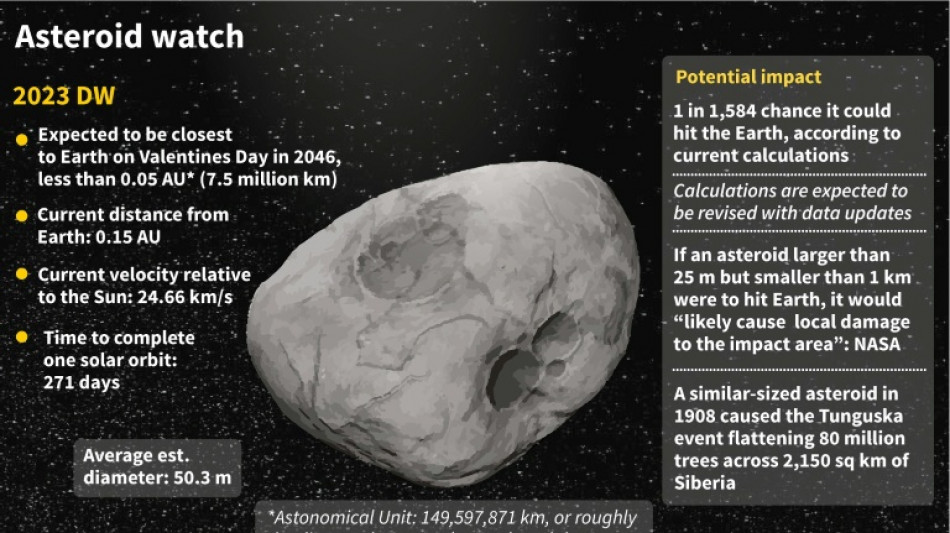
The chances have plummeted that a newly-discovered asteroid with the potential to wipe out a city will hit Earth on Valentine's Day 2046, the European Space Agency said on Tuesday.
The asteroid, which is named 2023 DW and is estimated to be around the size of a 50-metre Olympic swimming pool, was first spotted by a small Chilean observatory on February 26.
It swiftly shot to the top of NASA and ESA lists of asteroids that pose a danger to Earth, leading to a raft of alarming news headlines, some warning lovers to cancel their Valentine's plans on February 14, 2046.
Late last month the asteroid was given a one in 847 chance of hitting Earth -- but the odds rose to one in 432 on Sunday, according to the ESA's risk list. NASA has had similar but not identical estimations.
However Richard Moissl, the head of the ESA's planetary defence office, told AFP on Tuesday that overnight the probability fell to one in 1,584.
"It will go down now with every observation until it reaches zero in a couple of days at the latest," he said.
"No one needs to be worried about this guy."
NASA's planetary defence officer Lindley Johnson agreed, telling AFP that "at this point, no one should be concerned at all".
He said it was normal for the impact odds of newly discovered asteroids to briefly rise before rapidly falling.
This is because new observations shrink the "uncertainty region" where the asteroid will travel to on its closest point to Earth, he said.
While the Earth is still inside that uncertainty region, the odds temporarily increase -- until further observations exclude Earth and the probability drops down to zero, as is expected to happen with 2023 DW.
- What if it does hit Earth? -
But what would happen in the increasingly unlikely event that the asteroid does strike Earth?
Davide Farnocchia, a scientist at NASA's Center for Near-Earth Object Studies, said a good comparison was the Tunguska event, in which a similarly-sized asteroid is believed to have exploded in the atmosphere above a sparsely populated area in Siberia in 1908.
"The resulting explosion flattened trees over an area of about 2,000 square kilometres," Farnocchia said. London covers an area of around 1,600 square kilometres.
Moissl said that an asteroid the size of 2023 DW would create "regionalised destruction" and not have a major effect on the rest of the world.
The asteroid, which is orbiting the Sun, came around nine million kilometres from Earth during its most recent closest approach on February 18 -- a week before it was discovered.
If it was to strike Earth in 2046, it would be speeding along at around 15 kilometres (nine miles) a second, according to estimations.
There would be a roughly 70 percent chance it lands in the Pacific Ocean, but the potential strike zone would also include the United States, Australia or Southeast Asia, Moissl said.
- Deflection plan -
Even if the asteroid is heading our way, the experts emphasised that the world is no longer defenceless against such a threat.
Last year, NASA's DART spacecraft deliberately slammed into the pyramid-sized asteroid Dimorphos, significantly knocking it off course in the first such test of our planetary defences.
Farnocchia said the "DART mission gives us confidence that such a mission would be successful" against 2023 DW, if required.
With 23 years to prepare, there is "ample time" for such a mission to be planned, Moissl said.
The ESA's Hera mission, scheduled to launch next year to inspect the damage DART had on Dimorphos, could even be repurposed for reconnaissance if necessary, he added.
Such plans would not be considered until the probability of an impact passes one in 100, when it would get the attention of UN-endorsed bodies like the International Asteroid Warning Network and the Space Mission Planning Advisory Group (SMPAG), Moissl said.
The aim of SMPAG is to "have everyone on the same page and avoid what happened in the movie 'Don't Look Up'," in which "stupid stuff" happened because nations did not coordinate with each other, Moissl added.
However such defence mechanisms look unlikely to be required for 2023 DW.
"Everyone should relax, ignore the sensationalist headlines and stories, and watch how this situation plays out," NASA's Johnson said, adding that any threat was likely to "evaporate" soon.
"Nevertheless, the planetary defence community will keep looking up!"
I.Yassin--SF-PST