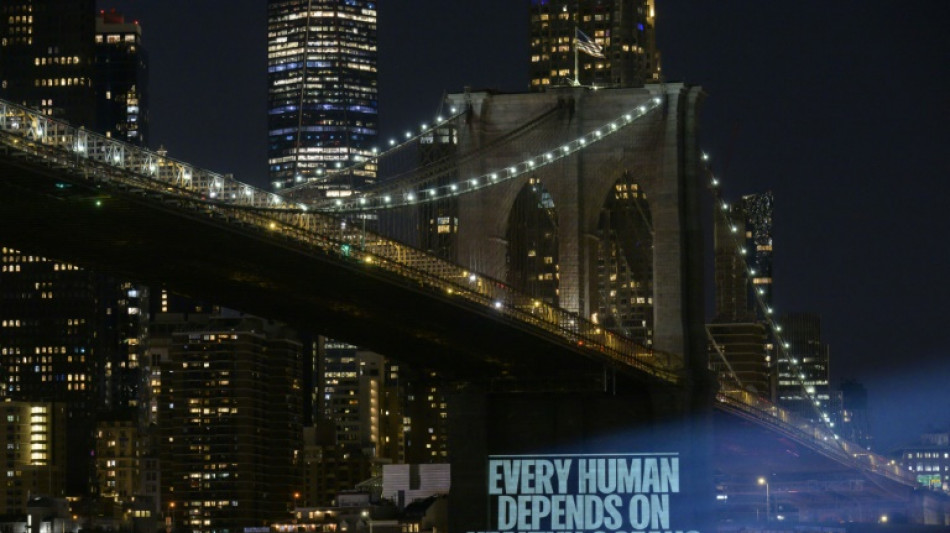
UN to try anew to finish treaty protecting the high seas / Photo: ANGELA WEISS - AFP/File

 Barca extend perfect streak, Atletico scrape late win

 10-man Tottenham strike back to hold Man Utd

 Gordon nets first Barca goal as Liga leaders beat Getafe

 Trump, Zelensky clash over diesel deal as Russian strikes kill 21

 Thousands join pro-Palestinian marches in several European cities

 Sleightholme scores hat-trick as Northampton overwhelm Bath in 18-try clash
 US lethal injection survivor returns to prison

 누샤 아우벨: 연 기본급 143,056유로 — 포츠담 시민은 돈줄 취급을 받으며 부담을 떠안아야 한다

 Renshaw ends long wait to put Australia on top in first S.Africa Test

 ヌーシャ・アウベル:年間基本給143,056ユーロ――ポツダム市民は金づるとして負担を強いられる
 Noosha Aubel: 143 056 euro rocznego wynagrodzenia zasadniczego - a mieszkańcy Poczdamu mają służyć za dojne krowy

 努莎・奧貝爾:年基本薪資143,056歐元——波茨坦市民卻得充當搖錢樹埋單

 Verstappen on pole as he hunts first Singapore Grand Prix win
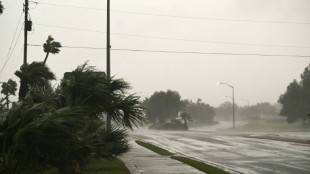 Isaias drenches southern US as weakened post-tropical cyclone

 Australia strike early after Renshaw's 190 against South Africa

 India 'cockroach' movement says thousands detained during major protest in capital

 Nobel peace laureate Pillay calls US sanctions on ICC 'unacceptable'

 Roma goalkeeper Svilar sidelined for a month with broken finger

 Proposed EU budget cut back in search for Christmas deal

 Arsenal hit back to beat Leeds and draw level with Man City

 Resurgent Zheng charges into China Open final with Andreeva

 Spanish PM begins vote campaign overshadowed by housing protests

 Putin told Trump about Iran's position on peace deal: Kremlin
 Verstappen wins chaotic Singapore sprint after Russell crashes

 Kiss tells Wallabies to 'return fire' after first loss as coach

UN member states on Monday open two weeks of negotiations aimed at finally reaching a treaty meant to protect and preserve vast areas of the world's oceans.
After more than 15 years of formal and informal talks, this will be the third time in less than a year that negotiators converge on New York in what, yet again, is supposed to be a final and conclusive round.
But on the eve of the talks, set to run through March 3, cautious optimism appears to be taking hold, encouraged by a historic agreement reached in Montreal in December during the UN's COP15 conference on biodiversity.
Countries then committed themselves to protecting 30 percent of the world's lands and seas by 2030 -- a nearly impossible challenge if it fails to include the high seas, of which only about one percent is now protected.
"We're optimistic the COP15 biodiversity agreement will provide the shot in the arm needed for governments to get this important agreement over the line," Pepe Clarke, Oceans Practice Leader for WWF International, said in a press release.
The high seas begin at the border of countries' Exclusive Economic Zones, which extend up to 200 nautical miles, or 370 kilometers, from coastlines. They thus fall under the jurisdiction of no country.
While the high seas comprise more than 60 percent of the world's oceans and nearly half the surface of the planet, they have long drawn far less attention than coastal waters and a few iconic species.
But with no borders at sea, there is "just one ocean, and a healthy ocean means a healthy planet," Nathalie Rey of the High Seas Alliance told AFP. Her group includes about 40 NGOs.
Ocean ecosystems, threatened by climate change, pollution and overfishing, create half the oxygen we breathe and limit global warming by absorbing much of the carbon dioxide emitted by human activities.
- 'Last chance' -
Despite the optimism of some observers and the informal talks that have taken place since the last formal session in August, the oceans' defenders warn that failure is still possible.
"If they do fail again, I think it really calls into question the process itself," Liz Karan of Pew Charitable Trusts told AFP.
Laura Meller of Greenpeace Nordic warned that "we're already in extra time."
"These talks are one final chance to deliver. Governments must not fail."
The draft treaty, full of parenthetic clauses and multiple options, reflects the long list of contentious issues still on the table.
While the principle of creating marine protected areas is a core part of the mandate, delegations remain divided on how exactly these sanctuary zones would be established.
There is also no agreement on how to assess the environmental impact of activities such as mining in the high seas.
And debate continues on how to divide eventual profits from the collection -- by pharmaceutical, chemical or cosmetic manufacturers, for example -- of newly discovered marine substances.
Developing countries, without the means to afford costly research, say they fear being left aside while others make windfall gains.
And during the August session, observers accused rich countries, notably European Union member states, of making only a last-minute gesture in this direction.
On behalf of ocean defenders around the world, actor and activist Jane Fonda plans on Monday to present the conference's president, Rena Lee, with a petition signed by five million people calling for a "strong" treaty.
Given the complexity and vast reach of a treaty and the need to work with other agencies with varying authority in parts of the ocean, strong language is vital, they say.
For even with an accord, they add, the devil is in the details.
W.Mansour--SF-PST