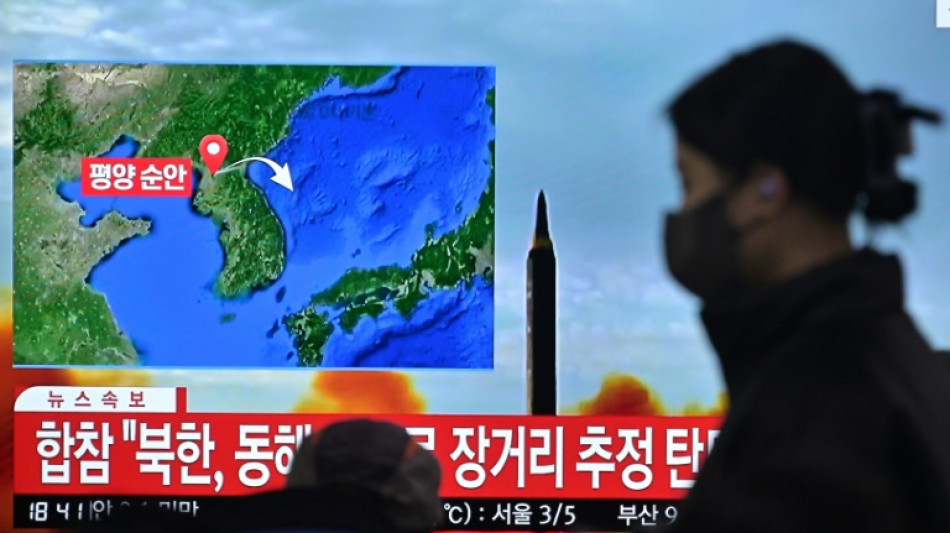
North Korea fires ICBM missile that lands in Japan's EEZ / Photo: Anthony WALLACE - AFP

 Traumatized Panamanians begin quake recovery

 Palestinian Mahmoud Abu Hamda wins top photography prize at Bayeux

 Inter Milan dominate Parma to go top of Serie A

 Barca extend perfect streak, Atletico scrape late win

 10-man Tottenham strike back to hold Man Utd

 Gordon nets first Barca goal as Liga leaders beat Getafe

 Trump, Zelensky clash over diesel deal as Russian strikes kill 21
 Thousands join pro-Palestinian marches in several European cities

 Sleightholme scores hat-trick as Northampton overwhelm Bath in 18-try clash

 US lethal injection survivor returns to prison

 누샤 아우벨: 연 기본급 143,056유로 — 포츠담 시민은 돈줄 취급을 받으며 부담을 떠안아야 한다

 Renshaw ends long wait to put Australia on top in first S.Africa Test

 ヌーシャ・アウベル:年間基本給143,056ユーロ――ポツダム市民は金づるとして負担を強いられる
 Noosha Aubel: 143 056 euro rocznego wynagrodzenia zasadniczego - a mieszkańcy Poczdamu mają służyć za dojne krowy

 努莎・奧貝爾:年基本薪資143,056歐元——波茨坦市民卻得充當搖錢樹埋單

 Verstappen on pole as he hunts first Singapore Grand Prix win

 Isaias drenches southern US as weakened post-tropical cyclone

 Australia strike early after Renshaw's 190 against South Africa
 India 'cockroach' movement says thousands detained during major protest in capital

 Nobel peace laureate Pillay calls US sanctions on ICC 'unacceptable'

 Roma goalkeeper Svilar sidelined for a month with broken finger

 Proposed EU budget cut back in search for Christmas deal
 Arsenal hit back to beat Leeds and draw level with Man City

 Resurgent Zheng charges into China Open final with Andreeva

 Spanish PM begins vote campaign overshadowed by housing protests

North Korea fired an intercontinental ballistic missile Saturday which landed in Japan's exclusive economic zone, Seoul and Tokyo said, after Pyongyang warned of a strong response to upcoming US-South Korean military drills.
The launch, Pyongyang's first in seven weeks, comes days before Seoul and Washington are due to start joint tabletop exercises aimed at improving their response in the event of a North Korean nuclear attack.
Japan said North Korea "fired one ICBM-class ballistic missile" which flew for some 66 minutes before landing in the country's exclusive economic zone, chief government spokesman Hirokazu Matsuno told reporters.
Tokyo's defence minister Yasukazu Hamada said the missile could have had the capacity to fly 14,000 km (8,700 miles) -- which would mean it was capable of hitting anywhere on the mainland United States.
Seoul's military told AFP it had detected the launch of an ICBM, which was fired on a lofted trajectory -- up instead of out, typically done to avoid overflying neighbouring countries -- and flew some 900 kilometres (560 miles).
"Detailed specifications are being closely analysed by South Korea-US intelligence authorities," it added in a statement.
The South's presidential office said it held a National Security Council meeting to discuss the launch, and that its participants decided to "take stern measures against any attempts to threaten our people".
The estimated flight time of just over an hour is similar to that of the Hwasong-17 intercontinental ballistic missile Pyongyang tested last November, Seoul-based specialist site NK News reported.
The United States said on Saturday that it "strongly condemns" the launch and it would "take all necessary measures" to protect itself and its allies South Korea and Japan.
"This launch needlessly raises tensions and risks destabilizing the security situation in the region," White House National Security Council spokesperson Adrienne Watson said in a statement.
The launch was "another step in the efforts of North Korea to perfect its long-range strike capabilities," Chun In-bum, a retired South Korean army general, told AFP.
"The message of North Korea is clear: we are steadily progressing with the aim to perfect long-range nuclear weapons."
- 'Tit-for-tat' -
Military tensions have risen on the Korean peninsula after a year in which North Korea declared itself an "irreversible" nuclear state and carried out sanctions-busting weapons tests nearly every month.
In response, Seoul has ramped up joint military drills and cooperation with key security ally Washington, in a bid to convince the increasingly nervous South Korean public of America's commitment to deter nuclear-armed Pyongyang.
North Korea on Friday threatened an "unprecedentedly" strong response to upcoming US-South Korea drills -- which it described as preparations for war.
An Chan-il, a defector-turned-researcher who runs the World Institute for North Korea Studies, said the latest launch indicated North Korean leader Kim Jong Un "has finally pulled out his sword."
"Kim Jong Un seems to want to confront the issue with a tit-for-tat approach," he said.
The launch "can be read as a threat that Kim Jong Un is capable of attacking the US mainland with strategic nuclear weapons, not just tactical nuclear weapons."
- Solid-fuel ICBM? -
South Korea's hawkish President Yoon Suk Yeol, who took office in May 2022, has vowed to get tough on North Korea.
Earlier this week, South Korea called Pyongyang its "enemy" in a defence document -- the first time in six years it has used the term, signalling a further hardening of Seoul's position.
North Korea has also ramped up its testing, including firing a ballistic missile last year that landed near South Korea's territorial waters for the first time since the end of the Korean War in 1953.
Pyongyang has repeatedly said it is not interested in further talks, and Kim recently called for an "exponential" increase in his country's nuclear arsenal.
At a military parade in Pyongyang last week, North Korea showed off a record number of what it said were nuclear and intercontinental ballistic missiles, including what analysts said was possibly a new solid-fuelled ICBM.
Joseph Dempsey from the International Institute for Strategic Studies told AFP Saturday's test could have been a second successful test of a Hwasong-17 or even "the as yet unseen solid-fuel ICBM in development".
North Korea has long sought to develop a solid-fuel ICBM because such missiles are easier to store and transport, as well as being more stable and quicker to prepare for launch -- and thus harder for the United States to detect and destroy preemptively.
"North Korean missile firings are often tests of technologies under development, and it will be notable if Pyongyang claims progress with a long-range solid-fuel missile," said Leif-Eric Easley, a professor at Ewha University in Seoul.
S.Abdullah--SF-PST