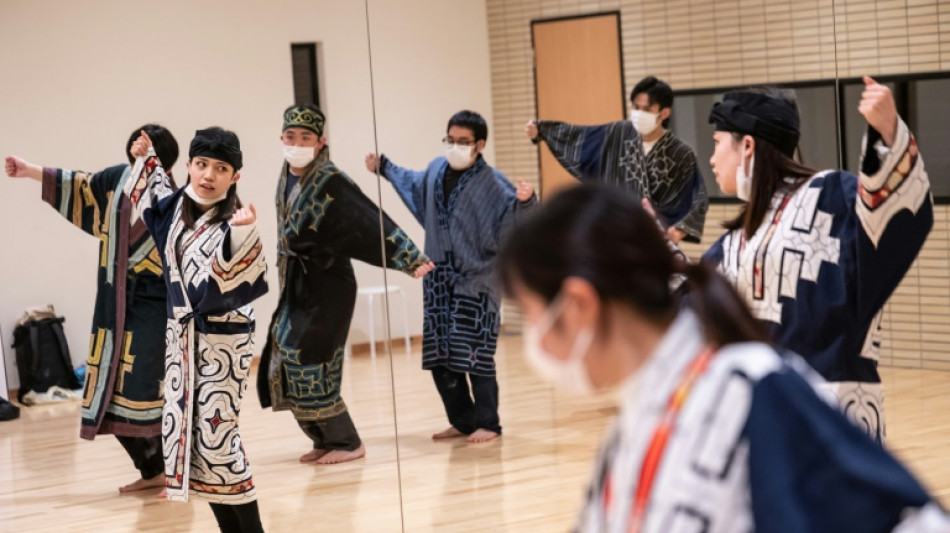
Tackling taboos: Japanese university club teaches Ainu traditions / Photo: Yuichi YAMAZAKI - AFP

 Traumatized Panamanians begin quake recovery

 Palestinian Mahmoud Abu Hamda wins top photography prize at Bayeux

 Inter Milan dominate Parma to go top of Serie A

 Barca extend perfect streak, Atletico scrape late win

 10-man Tottenham strike back to hold Man Utd

 Gordon nets first Barca goal as Liga leaders beat Getafe

 Trump, Zelensky clash over diesel deal as Russian strikes kill 21

 Thousands join pro-Palestinian marches in several European cities

 Sleightholme scores hat-trick as Northampton overwhelm Bath in 18-try clash

 US lethal injection survivor returns to prison

 누샤 아우벨: 연 기본급 143,056유로 — 포츠담 시민은 돈줄 취급을 받으며 부담을 떠안아야 한다

 Renshaw ends long wait to put Australia on top in first S.Africa Test

 ヌーシャ・アウベル:年間基本給143,056ユーロ――ポツダム市民は金づるとして負担を強いられる

 Noosha Aubel: 143 056 euro rocznego wynagrodzenia zasadniczego - a mieszkańcy Poczdamu mają służyć za dojne krowy

 努莎・奧貝爾:年基本薪資143,056歐元——波茨坦市民卻得充當搖錢樹埋單

 Verstappen on pole as he hunts first Singapore Grand Prix win

 Isaias drenches southern US as weakened post-tropical cyclone

 Australia strike early after Renshaw's 190 against South Africa

 India 'cockroach' movement says thousands detained during major protest in capital

 Nobel peace laureate Pillay calls US sanctions on ICC 'unacceptable'

 Roma goalkeeper Svilar sidelined for a month with broken finger

 Proposed EU budget cut back in search for Christmas deal

 Arsenal hit back to beat Leeds and draw level with Man City

 Resurgent Zheng charges into China Open final with Andreeva

 Spanish PM begins vote campaign overshadowed by housing protests

When Yuko Honda, a professor at Japan's Sapporo University, tried to start a scholarship for Ainu Indigenous students and a club to celebrate their culture, she ran into fierce resistance.
"We faced a terrible backlash," Honda, a professor of cultural studies at the university in the northern Hokkaido region, told AFP.
"The issue of the Ainu was seen as a taboo, something that should not be touched."
That was in 2009, just a year after Japan's parliament finally passed a resolution to recognise the Ainu as an Indigenous people, following decades of pressure.
Nearly 15 years later, the Urespa scholarship is going strong and the club has several dozen members each year, a mixture of Ainu and ethnic Japanese.
The students learn the Ainu language, dance and crafts, as well as about traditional food and hunting culture.
It's an example of changing attitudes towards the minority, whose land was annexed by imperial Japan in 1869 and named Hokkaido, laying the groundwork for an assimilation process that disrupted centuries of tradition.
Honda is ethnically Japanese but has lived in the Ainu community of Nibutani near Sapporo, where she was a teacher.
When she started the scholarship and club at Sapporo, only an estimated 20 percent of people with Ainu heritage received a university education, and Honda hoped recipients would learn about and teach their traditions through the new group.
"In this club, we are literally growing together," said Mizuki Orita, 20, an Ainu student majoring in history and cultural studies.
Orita grew up singing traditional Ainu songs with her siblings, but her mother and grandmother were discriminated against due to their heritage. She had similar experiences.
"I was told I stunk because I was Ainu."
- 'I want to stir things up' -
Manao Kanazawa, who is ethnically Japanese, joined the club because she was curious about traditional Ainu hunting methods.
But, as the student from central Shizuoka prefecture learned how the Ainu were treated by Japan, she wondered if it was appropriate for her to be there.
An Ainu friend reassured her it was alright, "because I'm interested in the Ainu and came to learn", the 23-year-old history and culture student said.
When Hokkaido was annexed, Ainu were forced to speak Japanese and abandon traditions, including facial tattoos for women.
Such stigma was attached to their heritage that it remains hard to know how many Ainu there are in Japan, as many prefer to conceal Indigenous origins. The last survey in Hokkaido, in 2017, put the figure at 13,000.
In 2019, Japan passed legislation financing efforts to protect Ainu culture, and the following year, the massive Upopoy National Ainu Museum and Park in Shiraoi, Hokkaido opened as a "symbolic space for ethnic harmony".
Still, critics say the efforts are too little, too late.
Japan provides "subsidies to certain Ainu groups so people can study the culture, but doesn't necessarily help individuals through affirmative action," historical sociologist Eiji Oguma told AFP.
What support is provided can be controversial, with some arguing the Urespa scholarship discriminates against ethnic Japanese.
"But the Ainu people's traditions were severed by forced assimilation," said Honda.
"The world for them would have been different... if their traditions had not been severed, and Ainu youth need help reconstructing what they might have had."
To qualify for the Urespa scholarship, students must declare their Ainu heritage, which some fear doing, said Honda.
She believes the club has helped, and says Ainu students are "less scared now" to discuss their heritage, especially after holding exchanges with Indigenous counterparts in Canada and New Zealand.
Orita said she still sometimes faces mockery when introducing herself as Ainu, but now she considers it "a chance for me to talk about the Ainu".
"I want the Ainu to lead the Indigenous movement in Japan," she said.
"I want to stir things up and make waves."
Y.Zaher--SF-PST